
About this story
On 13 August 1961 East German authorities began sealing the border between East and West Berlin overnight, rolling out barbed wire and blocking crossings in Operation Rose. The improvised barrier soon hardened into the Berlin Wall, turning a still-connected Cold War city into a lasting fortified frontier.
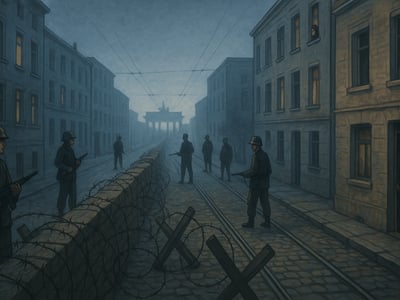
Border barriers in Berlin as East German authorities sealed crossings on 13 August 1961.
On 13 August 1961, East German authorities began closing the border between East and West Berlin in a sudden overnight operation that reshaped the city and became one of the defining images of the Cold War. Before dawn, security forces rolled out barbed wire, blocked streets, interrupted rail links, and cut crossing points between the eastern and western sectors. What began that morning as a quickly assembled barrier would soon develop into the fortified border system later known around the world as the Berlin Wall.
Why Berlin remained an open wound
The closure did not happen in an ordinary city. After the Second World War, Berlin had been divided among four occupying powers, even though it lay deep inside the Soviet zone of Germany. Over time, the political split between the Soviet-backed German Democratic Republic in the east and the Federal Republic of Germany in the west turned Berlin into a place where rival systems met directly. Yet the city remained interconnected in practical ways. Streets crossed sector lines. Rail lines linked different parts of Berlin. People commuted, visited relatives, and moved through spaces that political tension had not yet fully sealed.
That unusual geography made Berlin a particular problem for East German leaders. While the inner-German border elsewhere had become increasingly difficult to cross, Berlin still offered a route from East Germany to West Berlin. By 1961, the East German state was dealing with continuing population losses as many people used that opening to leave. This movement affected workers, professionals, and young people, and it exposed the limits of administrative control in a divided city that was still physically connected.
East German leader Walter Ulbricht headed the government that ordered the closure, and Soviet leader Nikita Khrushchev had approved the plan beforehand. The operation, known as Operation Rose, was launched in the early hours of 13 August. Its timing mattered. By acting at night and moving quickly, the authorities sought to prevent confusion in their own ranks, reduce the chance of organized resistance, and avoid a direct confrontation at the moment of closure.
Operation Rose seals the sector border
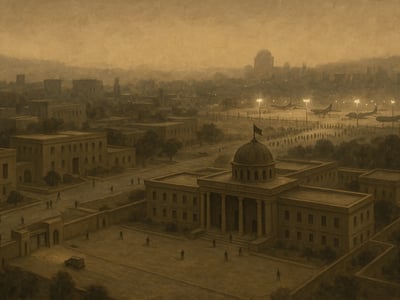
The first barriers were not the concrete wall segments later associated with Berlin. They were improvised and functional: coils of barbed wire, temporary fencing, roadblocks, and armed personnel positioned along the sector border. But even in that initial form, the closure had immediate consequences. Streets ended abruptly. Public transport routes were disrupted. Familiar crossings disappeared within hours. A line that had existed politically and administratively became visible in the urban landscape.
One of the clearest examples was Bernauer Straße. There, the border ran in an especially striking way: the buildings were in East Berlin, while the street itself belonged to West Berlin. Residents suddenly found themselves at the edge of a sealed frontier without having moved. Windows facing the western side became points of escape and control. The street quickly became one of the best-known places showing how the border cut not only through a city map but through daily life, housing, and personal relationships.
Streets, doorways, and daily life cut apart
Other symbolic sites also underscored the gravity of the moment. The Brandenburg Gate, already loaded with political meaning in divided Berlin, stood near a newly hardened boundary. For West Berlin's leadership, including Mayor Willy Brandt, the closure was an immediate crisis with human and diplomatic implications. Western governments, including that of U.S. President John F. Kennedy, had to assess how to respond in a city where any misstep risked a larger confrontation involving the Soviet Union.
That possibility of confrontation was real. Berlin had long been one of the most dangerous pressure points of the Cold War. A sudden border closure by East German forces, backed by Moscow, raised the question of how far the Western powers would challenge changes on the ground. In the end, the initial sealing of the border held. The operation did not collapse from civilian resistance, administrative confusion, or an immediate military clash. But the tension remained high, and later in 1961 Berlin would again become the site of direct East-West confrontation, most notably at Checkpoint Charlie.
From barbed wire to a lasting frontier
What happened on 13 August was not a finished structure but the start of a process. The temporary wire barrier was gradually replaced by more durable and elaborate fortifications. Over time, the border system came to include concrete wall segments, patrol roads, watchtowers, and additional security installations. The change from a hurried overnight closure to a long-term engineered frontier showed how quickly an emergency political decision could become built into the physical form of a city.
For Berliners, the consequences were immediate and enduring. Travel that had once been routine became restricted or impossible. Families, workplaces, and neighborhoods were separated. The sealed border altered not only movement but also habits, expectations, and the meaning of ordinary urban space. A corner, station, or doorway could become part of an international standoff.
Why it still matters
The beginning of the Berlin Wall remains important because it offers a clear example of how states use border infrastructure to control movement. On 13 August 1961, the first barrier was simple and quickly assembled, but its effects were profound. It demonstrated that border policy is not only a matter of laws and announcements; it can be imposed physically, street by street, until a city itself is reorganized around restriction.
The event also helps explain the Cold War in concrete terms. Rather than an abstract rivalry between governments, it shows how global tension could shape rail lines, apartment buildings, workplaces, and family life. Berlin became a place where international politics entered daily routines with unusual force and visibility.
Finally, the border closure in Berlin remains a useful case for understanding how temporary security measures can become permanent systems. What began with barbed wire in August 1961 was later turned into a fortified structure that lasted until 1989. That long development gives historians and the public a way to study how political decisions are translated into durable physical landscapes, and how those landscapes continue to define memory long after the original crisis has passed.
When East German forces sealed the Berlin border on that August morning, they were not only blocking crossings. They were transforming the map of a city into a visible frontier of the Cold War, one that would stand for nearly three decades.
Timeline
- Ulbricht denies wall plans
- Border closure begins in Berlin (Operation Rose)
- Checkpoint Charlie standoff
- Berlin Wall opens
What you uncovered
A Border Made Overnight
You didn't just…complete a scene from Cold War Berlin; you traced the moment when a political boundary was turned into a controlled urban system almost overnight.
What stands out is not only that the border closed, but how quickly ordinary city connections were redefined as security problems. Streets, rail lines, and doorways that had linked daily life were recast within hours as points to block, guard, and fortify. That shift helps explain why the Berlin Wall endures as more than a symbol: it shows how state policy can become embedded in the built environment and remain there for decades.
On 13 August 1961, Bernauer Straße became an immediate focal point because the buildings stood in East Berlin while the street in front lay in West Berlin.
FAQ
What happened on 13 August 1961 in Berlin?
On 13 August 1961, East German security forces began Operation Rose by sealing the border between East and West Berlin with barbed wire and roadblocks. This was the start of the fortified border system later known as the Berlin Wall.
Who ordered the Berlin border closure?
Walter Ulbricht, chairman of the East German State Council, led the government that ordered the closure overnight on 12-13 August 1961. Soviet leader Nikita Khrushchev had approved East German plans before the operation.
What did the first barrier in Berlin look like?
The first barrier consisted of barbed wire, roadblocks, and other temporary obstacles across streets, rail links, and crossing points. It was later replaced by more permanent concrete wall segments and fortified border installations.
Why was Bernauer Straße important on that day?
Bernauer Straße became an immediate focal point because building entrances lay in East Berlin while the street itself was in West Berlin. That made the border closure especially visible there on 13 August 1961.