
About this story
On 30 August 1999 voters across East Timor took part in a United Nations-organized popular consultation on a proposed special autonomy within Indonesia. UNAMET, created in June after the 5 May New York Agreements, ran registration and polling under tense conditions; turnout reached about 98.6 percent. On 4 September the UN announced that 78.5 percent had rejected autonomy, setting the path toward independence restored in 2002 — after a violent aftermath that required a multinational force.
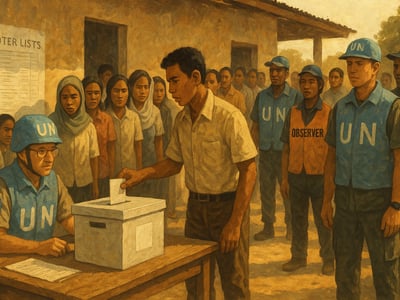
UN-organized voting in East Timor during the 30 August 1999 popular consultation.
On 30 August 1999, voters across East Timor took part in a United Nations-organized popular consultation that asked them to make a stark political choice: accept a proposal for special autonomy within Indonesia, or reject it. The vote was not yet a formal declaration of statehood, but it was a decisive test of whether a disputed territory could express its political future through a supervised ballot. In a place marked by decades of conflict and pressure, even the act of voting carried unusual weight.
Agreements in New York, a mission on the ground
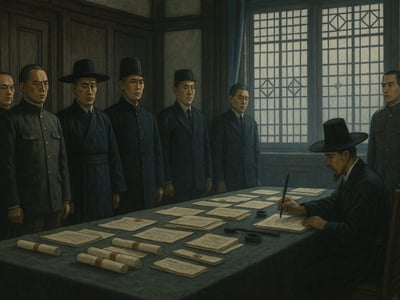
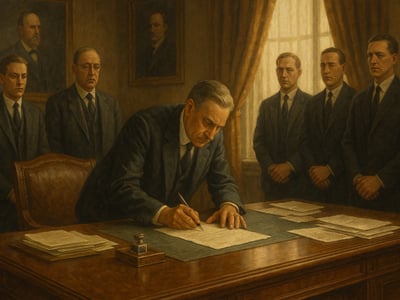
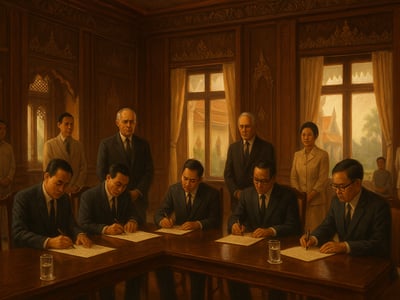
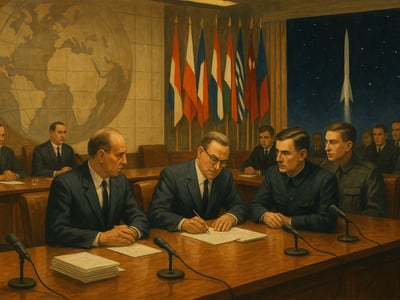
The consultation emerged from diplomatic agreements reached earlier that year. On 5 May 1999, Indonesia, Portugal, and the United Nations signed agreements in New York that created the framework for the ballot. Those agreements did not settle every political question surrounding East Timor, but they established a process. The United Nations would help organize and administer the consultation, and the result would indicate whether the autonomy proposal had public support.
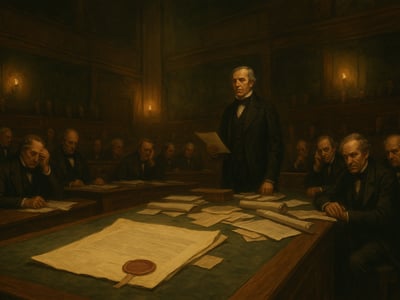
That administrative role soon took institutional form. On 11 June 1999, the UN Security Council adopted Resolution 1246, creating the United Nations Mission in East Timor, known as UNAMET. Its task was practical as much as political: register voters, prepare polling arrangements, inform the public about the choices on the ballot, and manage counting procedures. These functions can sound technical, but in East Timor they were central. A vote could only carry legitimacy if people believed that registration was real, ballots were secured, and counting would be conducted under a process that outside observers and local participants could recognize as credible.
The consultation was held under difficult conditions. East Timor’s political status had long been contested. Portugal had ruled the territory for centuries, and after the upheavals of decolonization in the mid-1970s, Indonesia invaded in 1975 and later annexed it. Over the following years, the territory became the focus of armed resistance, international debate, and repeated scrutiny of human rights conditions. By the 1990s, East Timor had become one of the most closely watched unresolved questions of decolonization and sovereignty in the international system.
Voting day under UNAMET
Several figures were closely associated with the process, though the consultation itself depended on many layers of local and international work. UN Secretary-General Kofi Annan represented the organization overseeing the process. Indonesian President B. J. Habibie was central to the political opening that made the consultation possible. Indonesian Foreign Minister Ali Alatas was involved in the diplomatic negotiations. Xanana Gusmao, a leading East Timorese figure, remained an important symbolic presence in the broader struggle over the territory’s future. On the ground, UNAMET chief Ian Martin oversaw the mission’s work.
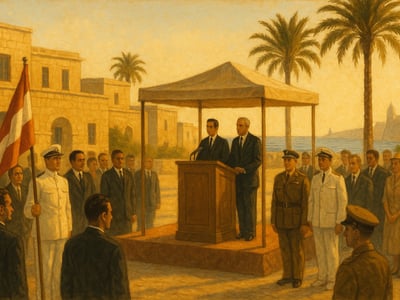
When voting day arrived on 30 August, polling took place across the territory under UNAMET administration. The practical challenge was considerable: people had to reach polling stations, officials had to verify eligibility, ballots had to be handled securely, and the process had to continue despite tension and fear. Yet participation was extraordinarily high. According to the official figures later announced by the United Nations, turnout reached about 98.6 percent of registered voters. That number alone suggested that, whatever the risks and pressures surrounding the consultation, East Timorese voters treated the occasion as consequential.
A counted rejection of autonomy
The ballot itself was framed around the autonomy proposal rather than a direct yes-or-no question labeled “independence.” Voters were asked whether they accepted special autonomy for East Timor within the Republic of Indonesia or rejected that proposal. In political terms, rejecting the proposal meant setting in motion a separation from Indonesia under the framework then agreed. That structure mattered. It reflected the diplomatic language of the time and the effort to create a mechanism that all parties would at least formally recognize.
After the ballots were cast, UN officials carried out the counting under the consultation procedures. That stage was as important as election day itself. In a deeply sensitive political process, the legitimacy of the result depended not only on turnout but on verification and announcement through an accepted channel. On 4 September 1999, the United Nations announced the outcome: 78.5 percent had voted against the proposed special autonomy, while 21.5 percent had voted in favor.
From certified result to a fragile transition
The result made clear that the autonomy arrangement lacked support among the voting population. It also transformed the consultation from a one-day administrative event into a turning point in state formation. A ballot designed to measure public acceptance of a political formula had instead demonstrated overwhelming rejection of continued integration on those terms.
What followed was not orderly transition alone. The period after the announcement saw serious violence and destruction, a fact that must be distinguished from the voting day itself but cannot be separated from the larger story of 1999. The aftermath showed that even a well-administered consultation could not by itself guarantee security. On 15 September 1999, the UN Security Council adopted Resolution 1264, authorizing a multinational force to restore peace and security in East Timor.
Why it still matters
The East Timor consultation remains a key example of internationally supervised self-determination. It is often remembered not just because people voted, but because the mechanics of the process were so visible: agreements among states, a UN mandate, registration, polling, counting, and public certification of the result. It demonstrated that sovereignty disputes are not resolved by principle alone; they also depend on institutions capable of converting political claims into a documented outcome.
It also continues to matter as a case study in the relationship between electoral administration and security. UNAMET could organize a ballot and certify a result, but the events that followed showed the limits of electoral procedure when protection on the ground is fragile. For historians, diplomats, and election specialists, East Timor remains an example of how legitimacy, logistics, and security are linked rather than separate.
The consultation also marked a hinge between disputed status and eventual statehood. East Timor’s formal restoration of independence would come later, in 2002, but the vote of 30 August 1999 established the public record on which that transition rested. For that reason, the consultation is remembered not simply as an election-like event, but as a documented moment when a population’s political choice was registered before the world.
Timeline
- New York Agreements signed
- UNAMET established
- East Timor popular consultation
- United Nations announces the result
- East Timor restores independence
What you uncovered
When Procedure Shapes Statehood
You didn't just…complete a puzzle; you traced how a carefully administered vote became a turning point between contested rule and a new political future in East Timor.
This consultation mattered not only because people voted, but because each procedural step gave the outcome legibility beyond the territory itself. Agreements, registration, UN administration, counting, and security were not background details: they were the mechanism that turned a political claim into a result other institutions could recognize and act on. That is why the event still matters as a case of how electoral process can shape a transition to statehood under international oversight.
UN Security Council Resolution 1246 established UNAMET on 11 June 1999 to organize and conduct the popular consultation in East Timor.
FAQ
What was the East Timor popular consultation of 1999?
It was a United Nations-organized vote held on 30 August 1999 in East Timor. Voters were asked whether to accept special autonomy within Indonesia or reject it.
What choices were on the ballot in East Timor?
The ballot offered two options: accept special autonomy within Indonesia, or reject the autonomy proposal. The consultation was conducted across the territory under UNAMET administration.
How high was turnout in the East Timor vote?
Turnout was reported at about 98.6% of registered voters. The participation rate was very high despite the difficult political and security conditions.
What was the result announced by the United Nations?
On 4 September 1999, the United Nations announced that 78.5% of voters had rejected the proposed special autonomy, while 21.5% supported it.
What happened after the East Timor results were announced?
On 15 September 1999, the UN Security Council passed Resolution 1264, authorizing a multinational force to restore peace and security in East Timor.