
About this story
On 29 August 1910 the Japan–Korea Treaty was proclaimed in Seoul and took effect, formally placing Korea under Japanese annexation after years of protectorate and administrative control. The treaty had been signed on 22 August by Resident-General Terauchi Masatake and Prime Minister Ye Wanyong. On 1 October the Government-General of Korea began operating as the colonial authority, replacing the sovereign institutions of the Korean Empire.
The 1910 proclamation in Seoul brought Korea under formal Japanese annexation.
On August 29, 1910, the Japan–Korea Treaty of 1910 was proclaimed and entered into force in Seoul, formally placing Korea under Japanese annexation. The step did not emerge suddenly from a single day’s decision. It marked the culmination of several years in which Japan had already expanded its power over Korean affairs, first through protectorate arrangements and then through deeper administrative control, before replacing the Korean Empire’s sovereign government with direct colonial rule.
From protectorate to administrative control
By the time the treaty took effect, the political balance on the peninsula had already shifted heavily. The Korean Empire had been under increasing pressure since the early twentieth century, especially after Japan’s victory in the Russo-Japanese War strengthened its position in Northeast Asia. On November 17, 1905, the Japan–Korea Protectorate Treaty placed Korea’s external affairs under Japanese control. That agreement reduced Korea’s ability to act independently in diplomacy and tied its future more closely to decisions made in Tokyo.
The next major step came on July 24, 1907, when another Japan–Korea agreement broadened Japanese authority over Korea’s internal administration. This moved control beyond foreign relations and into the workings of government itself. In the same period, Emperor Gojong’s attempt to appeal internationally through the Hague mission failed to reverse the situation, and he was forced to abdicate. His successor, Emperor Sunjong, occupied a throne whose room for independent action had become increasingly narrow.
Signing in Seoul, proclamation a week later
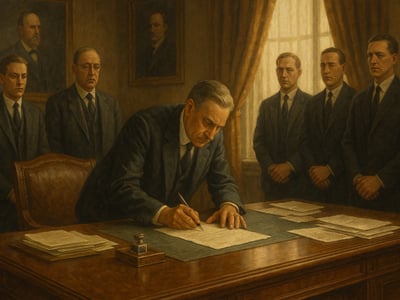
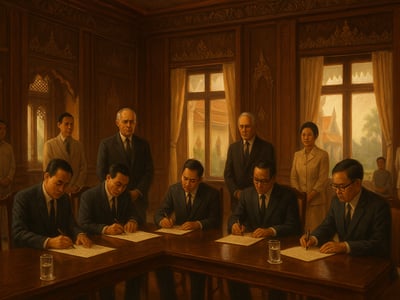
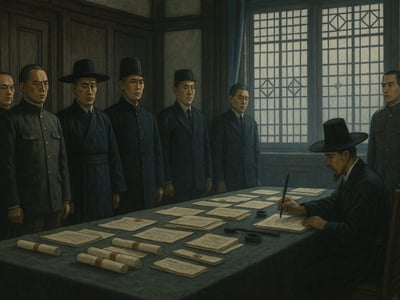
Against this background, the treaty of annexation was signed in Seoul on August 22, 1910. The Japanese side was represented by Resident-General Terauchi Masatake, the senior Japanese official in Korea. The Korean side was represented by Prime Minister Ye Wanyong. One week later, on August 29, the treaty was proclaimed and took legal effect within the framework asserted by the Japanese and Korean imperial governments of the time. From that moment, Korea was incorporated into the Japanese Empire.
In administrative terms, the change meant more than a new diplomatic status. The sovereign institutions of the Korean Empire were displaced by a colonial structure directed by Japan. On October 1, 1910, the Government-General of Korea began operating in Seoul as the new governing authority. That office became the central organ of colonial administration on the peninsula, overseeing political control, law enforcement, and major state functions under Japanese rule.
The Government-General replaces Korean sovereignty
What made the moment especially consequential was the way imperial expansion was expressed through formal documents and bureaucratic procedure. Rather than presenting annexation simply as conquest on a battlefield, the process was framed through treaties, proclamations, and administrative reorganization. This legal form gave the transfer of power an official appearance, even as questions persisted about authority, consent, and the conditions under which Korean officials had acted. Those questions would remain important long after 1910.
The issue of consent is central to understanding why the treaty remains historically sensitive. In official terms, the annexation was carried out through agreements between recognized governments and their representatives. Yet many historians and later Korean interpretations have treated those agreements as inseparable from coercive imperial pressure and unequal power. The narrow space available to Korean decision-makers, the earlier erosion of sovereignty, and the political circumstances surrounding the treaty have all shaped later arguments over whether the annexation could be regarded as legitimate.
Consent, coercion, and a lasting legal dispute
At the time, however, legal proclamation was only one part of a broader transformation. For Korean society, the end of the Korean Empire meant the replacement of one political order by another imposed from outside. Administrative systems were recast under colonial priorities, and resistance to Japanese rule did not disappear with the treaty’s enforcement. Instead, annexation became the starting point for a new phase of anti-colonial activity, political adaptation, and struggle under an empire that intended to govern Korea directly.
Seen from Tokyo, the treaty also represented the completion of a strategic project. Japan had moved from influence to protectorate, from protectorate to administrative control, and finally from control to annexation. Each step narrowed Korea’s remaining autonomy. The proclamation on August 29 made that progression official and public, turning what had been a gradual erosion of sovereignty into a formally declared colonial relationship.
Why it still matters
The treaty’s importance did not end with the establishment of colonial rule in 1910. It remains a key reference point in later disputes over sovereignty, legality, and historical responsibility. After 1945, as Japanese rule in Korea ended and new states emerged on the peninsula, the status of the annexation agreements became part of diplomatic and legal debate. Discussions of whether the treaty was valid at the time, or void because of coercion and defective consent, have continued to shape interpretations of the period.
The event also matters because it shows how empire could be built not only by force in the obvious military sense, but through documents, institutions, and official procedure. The language of treaty law and administrative order helped transform unequal power into a durable governing system. For historians, that makes the annexation of Korea an important case in the study of modern imperialism.
Its memory remains central in Korea–Japan relations as well. The annexation is not only a subject in archives and textbooks; it is part of a larger historical record that informs public memory, diplomatic language, and scholarship on colonial rule in East Asia. August 29, 1910, therefore stands as both a specific legal-administrative turning point and a date whose consequences continued far beyond the moment of proclamation.
Timeline
- Japan–Korea Protectorate Treaty
- Japan–Korea agreement expands internal control
- Annexation treaty signed in Seoul
- Japan–Korea Treaty proclaimed and takes effect
- Government-General of Korea begins
What you uncovered
Law and Legitimacy
You didn't just… complete a date puzzle; you traced the moment when legal proclamation was used to turn prior control into formal colonial rule over Korea.
Annexation was not only a military or diplomatic outcome but also an administrative act presented through official procedure. That matters because later debates did not focus only on what changed, but on whether the change could be considered legitimate at all. The gap between legal form and accepted consent is one reason this event still shapes historical argument and diplomatic memory.
The Government-General of Korea began operating in Seoul on 1910-10-01 as the colonial governing authority.
FAQ
What happened on 29 August 1910 in Korea?
On 29 August 1910, the Japan–Korea Treaty of 1910 was proclaimed and entered into force. Korea was incorporated into the Japanese Empire under formal annexation.
Who signed the 1910 annexation treaty?
The treaty was signed on 22 August 1910 in Seoul by Resident-General Terauchi Masatake and Korean Prime Minister Ye Wanyong. It was then proclaimed and made effective on 29 August 1910.
What had happened before the treaty took effect?
Before 1910, Japan had already increased its control over Korea. The 1905 Japan–Korea Protectorate Treaty put Korean external affairs under Japanese control, and a 1907 agreement expanded Japanese authority over internal administration.
Why is the treaty still disputed?
Its legitimacy remains disputed because questions have long been raised about the authority and consent behind its conclusion. The treaty is also central to later debates over sovereignty and colonial rule.