About this story
On 11 September 1973 Chile’s armed forces overthrew President Salvador Allende. La Moneda was surrounded and bombed; Allende delivered a last radio address and died in the palace. By nightfall a junta led by Gen. Augusto Pinochet held the state. The day ended an elected government and opened a military dictatorship later documented in archives, courts, and truth commissions.
La Moneda in Santiago during the Chilean coup of 11 September 1973.
On September 11, 1973, Chile’s constitutional government collapsed in a matter of hours as the armed forces moved against President Salvador Allende in Santiago. The day centered on La Moneda, the presidential palace, where Allende remained while military units surrounded key points in the capital. Before the assault ended, he delivered a final radio address from inside the building. By the end of the day, Allende was dead, La Moneda had been bombed, and military commanders led by Gen. Augusto Pinochet had taken control of the state.
A presidency closed in hours
The coup did not come out of nowhere. Chile had experienced deep political polarization during Allende’s presidency, along with economic strain, strikes, and escalating confrontation between supporters and opponents of his government. But the events of September 11 were distinguished by their speed and coordination. The armed forces and the national police leadership moved against a sitting president, seeking not simply to pressure him but to remove him from office and replace the existing constitutional order.
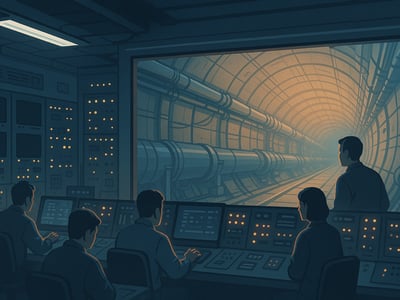
As the morning unfolded in Santiago, control over communications and government space became critical. Allende stayed in La Moneda rather than leave the seat of government. That decision gave the day much of its symbolic force. The palace was not only an office; it was the visible center of presidential authority. Remaining there allowed Allende to speak to the country one last time, even as the military closed in.
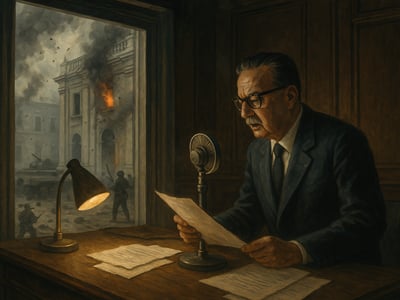
His final radio address became one of the defining documents of the day. Broadcast from La Moneda, it presented his position at the moment his government was under direct attack. The speech has since been studied not just as a political statement but as a record of the last hours of Chile’s elected presidency before military rule. It was delivered under immediate pressure, with the outcome no longer in much doubt.
The last broadcast from La Moneda
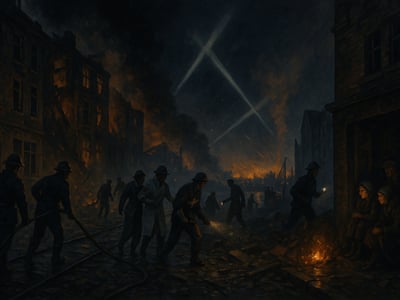
The coup soon turned into open military assault. Chilean Air Force aircraft bombed La Moneda, an extraordinary image that has remained central to public memory of the event. The attack demonstrated that the armed forces were acting jointly and that the confrontation had moved beyond negotiation. Troops and aircraft were now being used against the presidential palace itself, in the center of the capital.
Inside La Moneda, those with Allende faced immediate danger. The building was under attack, and the possibility of escape or prolonged resistance narrowed quickly. Accounts and investigations over the years have examined the final moments in detail, but the established fact is that Allende died inside La Moneda on September 11 during the coup. His death marked the end of his presidency and removed the central figure around whom constitutional resistance might have been organized.
Aircraft, troops, and a junta
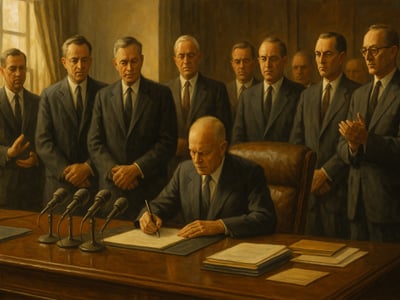
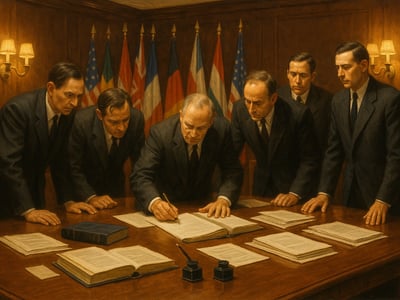
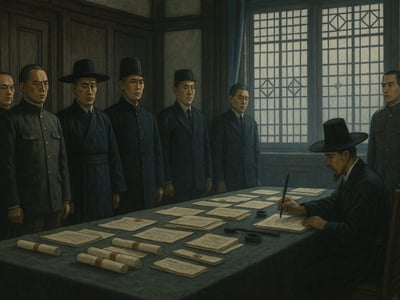
Once control had been seized, military leadership became formalized with unusual speed. Augusto Pinochet, José Toribio Merino, Gustavo Leigh, and César Mendoza emerged as the leaders of the new junta. They represented the main branches that had participated in the overthrow: the army, navy, air force, and carabineros. This mattered because a coup could have fractured if the services had not stayed aligned. Instead, the coordinated command structure helped turn a violent takeover into an operating government within hours.
The immediate aftermath was not limited to military occupation. The junta began issuing decree laws asserting authority over the Chilean state. This shift from force to formal rule was one of the most important features of the day. The coup was not only an armed action against a president in a palace; it was also the rapid construction of a new governing structure. In the days that followed, Congress was closed and constitutional processes were suspended, confirming that this was not a temporary intervention but the start of a new political order.
From force to decree law
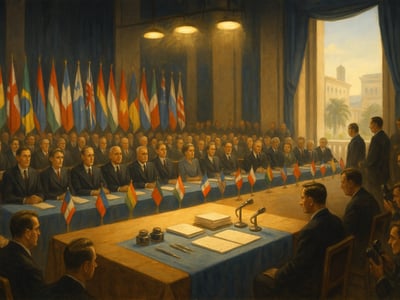
Internationally, the overthrow of Allende was quickly understood as a major Cold War event. Reactions spread across Latin America, the United States, and Europe. For many observers, Chile had seemed an especially significant test case because Allende had come to office through elections. The collapse of that government under military pressure therefore carried importance well beyond Chile itself. At the same time, later debates about foreign involvement, intelligence activity, and external influence have required careful distinction between documented evidence and broader political interpretation.
Within Chile, the coup opened the way to military rule under Pinochet. The dictatorship that followed became associated with repression, detention, exile, and human rights abuses, subjects later examined by truth commissions, courts, archives, and historical research. That longer history is essential to understanding why September 11, 1973, remains more than a single day of constitutional breakdown. It marks the beginning of a period whose effects reached into nearly every part of Chilean public life.
Why it still matters
The Chilean coup remains a central case study in how constitutional institutions can be dismantled very quickly once the armed forces decide to act in concert. In a single day, a sitting president was isolated, the presidential palace was attacked, state broadcasting became a battlefield of authority, and decree laws began translating military control into government power.
It also continues to matter for historians of the Cold War and of Latin America. The event sits at the intersection of domestic polarization, military intervention, and international rivalry. Because Chile’s overthrow was so heavily documented in speeches, military actions, decrees, diplomatic records, and later investigations, it has become one of the most closely studied examples of modern regime change.
Finally, the record of the coup and its aftermath continues to shape legal and archival work on political violence. Questions of responsibility, memory, and evidence did not end when the fighting stopped on September 11. They carried forward into truth commissions, judicial inquiries, and public debates over how democratic institutions fail and how societies document the damage afterward.
The images from La Moneda, the final radio address, and the rapid formation of the junta have therefore remained historically important not only because they describe the fall of one government, but because they show how force, communication, and legal authority can be combined to replace a constitutional system in the space of a single day.
Timeline
- Salvador Allende takes office as president of Chile
- Armed forces assault La Moneda; Allende dies during the coup
- Pinochet-led junta seizes control of the state
- Patricio Aylwin takes office, ending military rule
What you uncovered
How Power Changed Hands
You didn't just… complete a puzzle; you traced how Chile's constitutional government was displaced in a single day through force, communication, and command.
Coups do not become durable rule through violence alone. In Chile, control over the presidential palace, access to broadcasting, and the rapid issuance of decree laws helped turn a military assault into a functioning governing structure within hours. That sequence still matters because it shows how institutions can be dismantled not only by attack, but by quickly replacing the channels through which authority is announced and enforced.
On 1973-09-11, Salvador Allende delivered his final radio address from La Moneda in Santiago.
FAQ
What happened in Chile on 11 September 1973?
On 11 September 1973, Chile’s armed forces moved against President Salvador Allende’s government in Santiago. La Moneda presidential palace was attacked, and the coup ended Chile’s existing constitutional government.
How did Salvador Allende die during the coup?
Salvador Allende died on 11 September 1973 inside La Moneda during the coup. He had delivered his final radio address from the palace earlier that day.
Who led the new military junta in Chile?
The new junta was led by military commanders including Augusto Pinochet, José Toribio Merino, Gustavo Leigh, and César Mendoza. They took control after the coup.
What was Salvador Allende's final radio speech?
On 11 September 1973, Salvador Allende delivered his final radio address from La Moneda in Santiago. It was broadcast while the coup was underway and the palace was under attack.
What happened in Chile immediately after the coup?
In the immediate aftermath, the military junta issued early decree laws asserting control of the Chilean state. Those actions helped consolidate power after the takeover.