
About this story
On 6 August 1965, President Lyndon B. Johnson signed the Voting Rights Act, aimed at ending discriminatory barriers that blocked Black Americans from the ballot, especially in the South. The law became a cornerstone of the civil rights era and federal election enforcement.
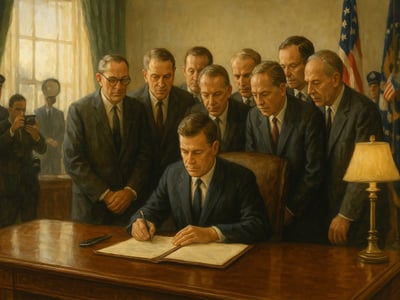
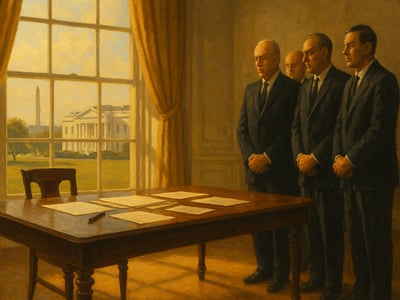
Lyndon B. Johnson signs the Voting Rights Act at the White House on August 6, 1965.
On August 6, 1965, President Lyndon B. Johnson signed the Voting Rights Act at the White House in Washington, D.C., turning a months-long legislative push into one of the most consequential federal civil-rights laws in U.S. history. The act targeted mechanisms that had long been used to restrict Black citizens from registering and voting, especially in parts of the South. It barred literacy tests and similar devices, and it created federal enforcement tools designed to act more quickly than ordinary lawsuits.
Selma and the fight for the ballot
The signing did not come out of a sudden change in policy. It followed years of organizing, litigation, and protest over voting access, along with repeated evidence that constitutional guarantees were not being enforced equally at the local level. In many places, registration systems were formally administered by county or state officials, but in practice they could be used to delay, discourage, or deny Black applicants. Literacy tests, procedural hurdles, and selective administration of rules gave local authorities broad power over who could enter the electorate.
By early 1965, Selma, Alabama, had become a focal point of that struggle. Local activists and national civil-rights groups had made voting rights central to their campaign there, arguing that barriers to registration were not isolated abuses but part of an entrenched system. The issue gained national attention on March 7, 1965, when Alabama state troopers attacked voting-rights marchers at the Edmund Pettus Bridge. Among those injured was John Lewis, then a leading figure in the movement. The images and reports from Selma made the dispute over registration procedures impossible to treat as a distant local matter.
Johnson’s appeal to Congress
Eight days later, on March 15, Johnson addressed a joint session of Congress and called for voting-rights legislation. His speech framed the issue as one of federal responsibility as well as constitutional principle. The key question was not simply whether discrimination existed, but whether the national government would create a practical method to stop it. Existing legal avenues often moved slowly. Case-by-case lawsuits could take months or years, while local officials retained the ability to continue applying restrictive rules in the meantime.
That problem shaped the design of the bill that moved through Congress. Lawmakers did not limit themselves to a broad declaration of rights. They built enforcement directly into the statute. The law suspended literacy tests and related devices in covered situations and authorized federal oversight where discriminatory patterns had been documented. It also allowed for the appointment of federal examiners in certain jurisdictions, so voter registration would not depend entirely on local officials accused of blocking access.
Designing federal enforcement
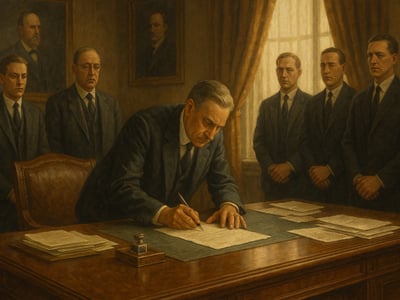
Congress approved the Voting Rights Act in 1965 and sent the enrolled bill to the White House. Johnson's signature on August 6 completed the legislative process, but the event was important not only as a formal act. It marked a decision by the federal government to intervene directly in an area that states had long claimed substantial control over: the administration of voting rules. That choice carried legal and political weight because it accepted a confrontation with state and local systems that insisted they were managing elections within their own authority.
One of the law's most significant provisions was Section 5, which required specified jurisdictions to obtain federal preclearance before changing voting laws or practices. Instead of waiting for a discriminatory change to take effect and then challenging it afterward, the federal government could review certain changes in advance. This was a major shift in enforcement logic. It recognized that by the time a discriminatory rule was fully litigated, an election or several elections might already have taken place under that rule.
Signature, Section 5, and lasting framework
The act also mattered because it linked national attention, presidential action, and legislative drafting into a single chain of events. Violence against marchers in Selma did not automatically produce legal reform; public outrage had to be translated into a bill, and that bill had to contain mechanisms strong enough to alter conditions on the ground. Johnson's administration and congressional supporters pursued a law that aimed to reduce delay, not just condemn discrimination in principle.
In the months and years after the signing, federal officials used the new law's authority to oversee registration and voting changes in covered jurisdictions. The statute was later amended and reauthorized, but its basic framework dated back to the choices made in 1965. That framework helped define how the federal government approached voting-rights enforcement for decades.
Why it still matters
The Voting Rights Act remains central because it established a model of enforcement that went beyond general constitutional promises. Before 1965, those denied access to the ballot often had to rely on lengthy court action against local systems that could continue operating while litigation unfolded. The act changed that by giving the federal government tools to step in more directly.
Its structure also influenced how later disputes over election law were handled. Section 5 preclearance, in particular, made federal review a routine part of voting-law changes in certain jurisdictions for many years. That meant the law was not only about punishing past discrimination; it was also about screening future changes before they took effect.
Because of that design, later reauthorizations and court decisions repeatedly returned to the 1965 act as the foundation of federal voting-rights policy. Debates over the balance between national authority and state control, and over how best to protect access to the ballot, have often centered on the framework first established when Johnson signed the act at the White House.
The event of August 6, 1965, therefore stands as more than a ceremonial signing. It was the moment when a broad civil-rights demand was turned into an enforceable federal statute, with specific provisions meant to change how voting rules were administered in practice. That is why the law remains a reference point in U.S. history: not only for what it declared, but for how it was built to work.
Timeline
- Selma voting-rights march
- Johnson addresses Congress on voting rights
- Voting Rights Act signed into law
What you uncovered
Law, Pressure, and Enforcement
You didn't just… complete a puzzle; you traced the moment when voting rights became a matter of direct federal enforcement, not only public principle.
The significance of the 1965 law was not only that it declared discrimination unacceptable. It connected public pressure after Selma, presidential action, and enforceable mechanisms such as oversight of covered jurisdictions. That structure mattered because it reduced the ability of hostile local systems to delay change through procedure alone.
Section 5 of the 1965 Voting Rights Act required certain jurisdictions to obtain federal preclearance before changing voting laws.
FAQ
What happened on August 6, 1965?
On August 6, 1965, President Lyndon B. Johnson signed the Voting Rights Act into law at the White House in Washington, D.C. The law was approved by Congress earlier that year before reaching the president for signature.
Which events helped lead to the Voting Rights Act?
The Selma voting-rights campaign, including the March 7, 1965 attack on marchers at the Edmund Pettus Bridge, helped build support for the law. On March 15, 1965, Johnson addressed Congress and called for voting-rights legislation.
What voting barriers did the law target?
The Voting Rights Act barred literacy tests and related devices used to restrict voter registration and participation. It was aimed at practices that had been used to block Black citizens from voting.
What did Section 5 of the Voting Rights Act require?
Section 5 required specified jurisdictions to obtain federal preclearance before changing voting laws. That gave the federal government a direct role in reviewing certain election-rule changes.