
About this story
On 13 October 2010 the rescue of 33 miners trapped in the San José mine near Copiapó, Chile, ended when shift foreman Luis Urzúa reached the surface last. A collapse on 5 August had cut them off. A drill note on 22 August proved they were alive, and the Fénix 2 capsule began lifting them out on 12 October.
Completion of the 2010 rescue of 33 miners at the San José mine in Chile.
On October 13, 2010, the rescue of 33 trapped miners at the San José mine near Copiapó in Chile was completed when shift foreman Luis Urzúa reached the surface. His arrival ended a 69-day ordeal that had begun with a collapse on August 5 at the copper-gold mine in the Atacama Region, leaving the men about 700 meters underground. By the time the final extraction was over, the operation had become one of the most closely watched rescue efforts in the world.
Contact from underground
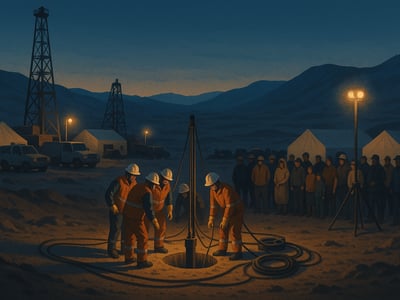
The central facts of the event were stark. A cave-in had cut off the miners far below ground, creating immediate uncertainty about whether they had survived and whether they could be reached. For more than two weeks, families waited above the mine as drilling teams tried to locate the trapped group. The surface camp that formed there became known as Camp Hope, a place of waiting, logistics, media attention, and constant updates. The name reflected both the uncertainty of the early days and the effort to maintain order around a crisis that was still unfolding.
A decisive moment came on August 22, when a drill probe returned with a note confirming that the miners were alive. The message, written in Spanish, read: "Estamos bien en el refugio los 33" — all 33 were well in the shelter. That short sentence changed the operation. Rescue planners no longer faced only a recovery mission. They had to sustain a group of men underground while engineers, miners, and officials worked out a way to bring them back safely.
From that point, the challenge became one of coordination and time. Food, water, medicine, and communication had to be sent down through narrow boreholes. The miners had to be monitored physically and psychologically while living in confinement far below the desert surface. Above ground, Chilean authorities and technical teams considered how to create a shaft wide enough for extraction without causing further collapse or delay. Mining specialists, engineers, and government officials were drawn into a problem that combined geology, mechanical reliability, medicine, and risk management.
Keeping thirty-three people alive
Among the public figures associated with the operation were Mining Minister Laurence Golborne and President Sebastián Piñera, both of whom became visible symbols of the state’s role in the response. But the rescue also depended on people whose work was less visible: drill operators, engineers, medics, communications staff, and mining crews who had to keep each stage working under pressure. Underground, leadership among the trapped miners also mattered. Luis Urzúa, as shift foreman, helped maintain order within the group during the long wait.
As plans developed, rescuers prepared a narrow capsule called Fénix 2 for the final ascent. The idea was technically simple to describe and difficult to execute: one miner at a time would enter the capsule and be raised through a drilled shaft to the surface. Yet the apparent simplicity concealed a long list of possible failures. The shaft had to be drilled accurately. Its walls had to remain stable enough for repeated passages. The capsule had to move reliably, and each ascent had to be monitored closely. Communication links could not be casually treated as secondary. Neither could medical checks, which were necessary because every miner was emerging from an extreme environment after weeks underground.
The Fénix capsule
The extraction phase began on October 12, 2010. Florencio Ávalos was the first miner brought to the surface in the Fénix 2 capsule. His ascent demonstrated that the system could work in practice, not just in planning. After that, the process continued in sequence, each trip repeating the same basic procedure but carrying the same stakes every time. The world watched a rescue that was not resolved by one dramatic instant, but by careful repetition. Each successful ascent reduced the number still below, yet also required sustained attention until the last man was out.
That final stage was part of what made the operation so notable. It was not enough to reach the miners or establish contact with them. The rescue had to function reliably again and again, through dozens of descents and ascents, with little room for error. The operation unfolded live before a large international audience, but at its core it remained a technical and human process shaped by routine, sequence, and control.
The last ascent
On October 13, Luis Urzúa emerged last, completing the rescue of all 33 miners. President Sebastián Piñera was present at the site near Copiapó as the operation concluded. For Chile, the moment carried official, emotional, and practical significance at once: relief for the families, recognition for the teams involved, and confirmation that a high-risk rescue plan had succeeded.
The end of the extraction did not erase the broader questions raised by the collapse. The San José mine disaster also led to renewed attention on mine safety oversight in Chile, including how such a dangerous failure had occurred in the first place. Public celebration of the rescue existed alongside scrutiny of the conditions that had made the rescue necessary.
Why it still matters
The 2010 Chilean mine rescue remains important partly because it offers a clear example of large-scale emergency coordination under intense pressure. Government officials, mining specialists, engineers, and medical teams had to work toward a single goal while adapting to uncertain conditions. The event is still studied as a case in rescue drilling, confined-space extraction, and the management of long-duration underground survival.
It also remains a reference point in discussions of mine safety. The successful outcome did not lessen the seriousness of the original collapse. Instead, it underscored how much depended on prevention, regulation, and oversight before any rescue ever becomes necessary. In that sense, the event is remembered not only for the extraction itself, but also for the questions it raised about responsibility in hazardous industries.
Finally, the rescue showed how modern media can shape public engagement with disaster response. Millions followed the operation in real time, seeing both the technical process and the emotional reunions at the surface. That visibility helped turn a remote mining accident in northern Chile into a global event. More than a decade later, the rescue is still recalled as a moment when engineering, endurance, and careful coordination were visible to the world in unusually direct form.
Timeline
- San José mine collapse
- Miners confirmed alive
- Rescue extraction began
- Rescue completed at San José mine
What you uncovered
A Rescue Built on Sequence
You didn't just… complete a puzzle; you traced a rescue in which each safe ascent depended on a larger system holding together underground and at the surface.
What made the operation work was not a single breakthrough, but the reliability of many linked decisions. Drilling, capsule movement, medical monitoring, and the order of extraction all had to be coordinated so that one success did not create a new risk. That is why the rescue still matters as a model of emergency planning: it shows how complex responses depend on sequence, redundancy, and discipline under pressure.
The first miner brought to the surface in the Fénix 2 capsule was Florencio Ávalos, and the last was shift foreman Luis Urzúa.
FAQ
Why is 13 October 2010 the end of the Chile mine rescue?
It was the day the rescue of all 33 trapped miners was completed at the San José mine near Copiapó. On that date, Luis Urzúa was the last miner brought to the surface, ending the extraction phase.
Who was rescued first and who was rescued last?
Florencio Ávalos was the first miner lifted out, on 12 October 2010. Luis Urzúa, the shift foreman, was the last of the 33 miners brought to the surface on 13 October 2010.
How deep were the miners trapped in the San José mine?
The miners were trapped about 700 meters underground after the collapse at the San José copper-gold mine near Copiapó. That depth made the rescue technically difficult and required a narrow extraction capsule.
How long were the miners underground before the rescue was finished?
They were underground for 69 days. The collapse happened on 5 August 2010, and the final miner was brought out on 13 October 2010.
What was the Fénix 2 capsule used for?
The Fénix 2 rescue capsule was used to lift the miners out one by one during the extraction phase. It was first used on 12 October 2010 when Florencio Ávalos was brought to the surface.