

About this story
On 22 September 1914 the German submarine SM U-9, commanded by Otto Weddigen, sank three British armoured cruisers in the North Sea near the Broad Fourteens. HMS Aboukir, Hogue, and Cressy were lost within about an hour; some 1,400 sailors died. The attack showed how a single submarine could break a surface patrol.
U-9 attacked Aboukir, Hogue, and Cressy in the southern North Sea on 22 September 1914.
On 22 September 1914, in the southern North Sea near the Broad Fourteens, the German submarine SM U-9 attacked a British cruiser patrol and sank three Royal Navy armoured cruisers within about an hour. HMS *Aboukir*, HMS *Hogue*, and HMS *Cressy* were all lost, and about 1,400 British sailors died. The action quickly became one of the best-known early naval shocks of the First World War, not because it involved a large fleet battle, but because a single submarine had shown how vulnerable large warships could be to attack from below the surface.
A patrol in the Broad Fourteens
At the time, the war was still in its opening phase. European navies had entered the conflict with expectations shaped by prewar planning, by the prestige of big surface fleets, and by long traditions of patrol and rescue at sea. Submarines were not new in 1914, but their full tactical and psychological effect had not yet been absorbed. The Royal Navy, the world’s largest navy, was patrolling the North Sea with cruisers intended to watch key waters and protect against enemy movement. In that setting, the British 7th Cruiser Squadron was carrying out its routine work when it encountered a danger that was still not fully understood.
The submarine commander was Kapitänleutnant Otto Weddigen. Bringing U-9 into attack range against several warships in open water was itself a difficult task. A submarine of that era had limited speed, limited visibility, and limited room for error. If detected, it could be fired upon, rammed, or forced away before completing an attack. Yet concealment was also its advantage. A submarine could observe, approach, and strike before the target clearly recognized what it was facing.
The first ship hit was *Aboukir*. When the torpedo struck, the immediate British interpretation was not necessarily that a submarine had attacked. In the opening moments, confusion shaped the response. Damage at sea could be read in different ways, and the habits of surface warfare still influenced decision-making. As *Aboukir* began to sink, nearby ships moved to assist. That was a deeply established naval instinct: ships helped survivors when they could, especially when the precise source of danger was uncertain.
Rescue that became a target
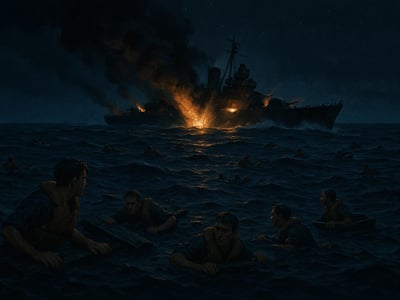
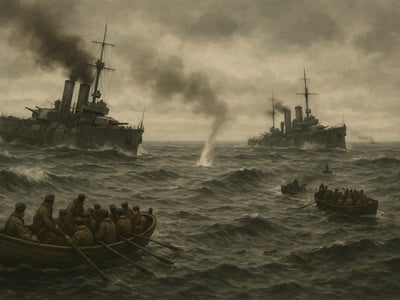
But that humanitarian and professional response created a new opening for U-9. Instead of scattering at speed, the British cruisers slowed and stopped in order to rescue men from the water. This made them far easier targets. The event’s central tension lies here. The officers and crews were responding to an emergency in a way that made sense within older assumptions about naval combat, yet those same actions increased their exposure to a new kind of weapon.
HMS *Hogue* stopped to recover survivors from *Aboukir*. U-9 attacked again, and *Hogue* was torpedoed. The second successful strike made the scale of the danger unmistakable. What had begun as the loss of one cruiser was becoming a much larger disaster. A squadron on patrol, designed as a visible instrument of sea power, was being broken apart by an enemy that was hard to see and harder to answer.
Three cruisers gone in an hour
The third cruiser, HMS *Cressy*, remained on the scene and was also hit by torpedoes from U-9. By the end of the morning action, all three British ships had sunk. The sequence was astonishing to contemporary observers. A single submarine had not merely damaged a patrol line or disrupted an operation; it had destroyed three major surface vessels in succession. The human loss was severe, and the tactical implications were immediate.
The destruction of *Aboukir*, *Hogue*, and *Cressy* drew scrutiny not only because of the number of lives lost but because of what it suggested about existing naval practice. Cruisers on patrol were exposed if they operated without adequate screening against submarines. Rescue efforts, essential as they were, could not be assumed to take place in safety once underwater attack became a real possibility. Ships that lingered in the area of a torpedo strike might be presenting a stationary target rather than offering effective support.
A new kind of sea war
For Britain, the episode was sobering. The Royal Navy remained a vast and powerful force, but power at sea no longer depended only on armor, guns, and numbers visible above the waterline. A relatively small underwater craft could force major changes in behavior. Commanders had to consider movement, spacing, screening, and the possibility that the first hit was only the beginning of a broader attack. In practical terms, the loss of the three cruisers pressed home that wartime patrol procedures could not rely on habits formed in earlier eras.
Weddigen’s role also attracted attention. His success made him one of the most noted submarine commanders of the early war. Yet the significance of the action goes beyond individual command. The sinking of the three cruisers became a case study in how quickly military technology can alter established doctrine. It showed that even before the war at sea had fully settled into its longer patterns, old assumptions were already under pressure.
Why it still matters
The attack by U-9 is still studied because it marked an early and unusually clear demonstration of submarine warfare’s effect on naval operations. It illustrated that large surface ships, however imposing they appeared, could be vulnerable to a hidden attacker using torpedoes with precision and timing.
It also influenced thinking about patrol and rescue procedures. Naval forces had to adapt by changing formations, improving screening, and treating the site of an initial strike as a continuing danger zone. The episode did not end rescue at sea, but it changed the circumstances under which rescue could be attempted.
More broadly, the sinking of *Aboukir*, *Hogue*, and *Cressy* remains a reference point in the history of technological change in warfare. It helps explain why the First World War at sea was not simply a contest of battleships and blockades. Underwater weapons, detection limits, and rapid tactical adaptation were becoming central features of modern naval conflict.
The event is therefore remembered not only as a wartime loss in the North Sea, but as a moment when the balance between visible naval strength and concealed striking power shifted in a way that contemporaries could not ignore.
Timeline
- Britain enters World War I
- U-9 sinks Aboukir, Hogue, and Cressy
- Otto Weddigen killed when U-29 is rammed
What you uncovered
When Rescue Became Risk
You didn't just… complete a naval history puzzle; you traced the moment when familiar rescue instincts met a form of warfare that had already changed the rules.
What made this attack so consequential was not only the loss of three cruisers, but the mismatch between older habits and newer technology. Stopping to pick up survivors was a deeply ingrained response in surface warfare, yet submarines turned that pause into exposure. The episode became a lesson in how quickly doctrine can lag behind the weapons already reshaping the battlefield.
The three British cruisers were lost within about an hour during the morning action in the southern North Sea.
FAQ
What happened on 22 September 1914 in the North Sea?
On 22 September 1914, the German submarine SM U-9 attacked the British 7th Cruiser Squadron in the Broad Fourteens area of the North Sea. HMS Aboukir, HMS Hogue, and HMS Cressy were all torpedoed and lost in the same action.
Who commanded U-9 during the attack?
U-9 was commanded by Kapitänleutnant Otto Weddigen. He led the submarine during the attack on the British cruisers.
Why were the British cruisers so vulnerable?
After HMS Aboukir was hit, HMS Hogue stopped to recover survivors, which left it exposed to another torpedo attack. HMS Cressy also remained on scene and was then hit by U-9 as well.
How many British sailors died in the sinking?
The Admiralty recorded about 1,400 British dead from the loss of Aboukir, Hogue, and Cressy. The exact total can vary slightly by source.
Why was this action important in World War I naval warfare?
The sinking showed how dangerous submarines could be to large surface ships in 1914. It also led to closer scrutiny of Royal Navy patrol and rescue practices in the North Sea.