
About this story
On 11 October 1987 volunteers unfolded the AIDS Memorial Quilt on the National Mall in Washington, D.C., during the March on Washington for Lesbian and Gay Rights. The first display included 1,920 handmade panels, each naming someone who had died of AIDS-related causes. The NAMES Project Foundation had been established in San Francisco that year, with Cleve Jones among its founders and Mike Smith central to its early work. The Quilt made private grief visible in a national civic space.
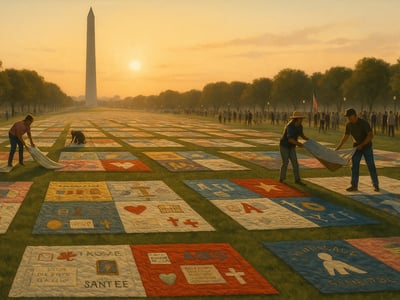
AIDS Memorial Quilt display on the National Mall, Washington, D.C., 11 October 1987
On October 11, 1987, at sunrise in Washington, D.C., volunteers unfolded the AIDS Memorial Quilt on the National Mall. What appeared across the grass was not a single textile but a vast assembly of handmade panels, each created in memory of someone who had died of AIDS-related causes. The first National Mall display included 1,920 panels, and by the end of the event the Quilt covered an area reported to be larger than a football field.
Grief that had stayed private
The display took place during the 1987 March on Washington for Lesbian and Gay Rights, giving the memorial an audience that was already gathered for public demonstration and collective presence. But the Quilt did something different from a march sign, a speech, or a policy demand. It turned names into a landscape. From a distance, the panels formed a large visual field. Up close, each section returned the viewer to a single person, remembered by friends, family, partners, or communities through fabric, stitching, color, and text.
The Quilt emerged in a period when AIDS had already reshaped many lives but was still surrounded by stigma, fear, and unequal public attention. Obituaries were often limited, euphemistic, or absent. Grief was frequently private, and in many places it was not publicly recognized on equal terms. The decision to bring personal memorials into one of the most visible civic spaces in the United States carried both practical and emotional risk. Organizers had to collect panels from many contributors, transport them, assemble them coherently, and present them in a way that preserved the dignity of each individual remembrance.
Panels from the NAMES Project
The NAMES Project Foundation had been established in San Francisco in 1987, with Cleve Jones among its founders. Mike Smith was also central to the project’s early formation. The idea was simple in form but demanding in execution: invite people to make cloth panels memorializing those lost to AIDS, then join those panels together so that individual grief could be seen as part of a larger historical reality. The result was both intimate and public. It required no official monument commission and no formal archive to begin recording names.
That combination mattered in 1987. The epidemic was not experienced the same way by all communities, and public recognition was uneven. The Quilt did not resolve those inequalities, but it made absence visible in a direct way. The names on the panels represented people whose deaths might otherwise have remained known only within small circles. Assembled together on the Mall, those separate acts of remembrance became difficult to overlook.
A quilt on the National Mall
There was also a material force in the choice of fabric. Textiles are associated with domestic labor, care, and touch. A quilt is made by joining pieces. In this case, that familiar form was adapted to public mourning on a national scale. Viewers encountered something legible without needing specialized language: stitched names, chosen symbols, favorite colors, messages of affection, and references to lives that had ended. The memorial did not ask the public to imagine statistics. It presented evidence of loss in handmade form.
Its setting amplified that effect. The National Mall is a space associated with ceremony, protest, and national memory. To place the Quilt there was to insist that these deaths belonged within the country’s visible public history. The timing, during the March on Washington for Lesbian and Gay Rights, linked remembrance to a broader demand for recognition. Yet the power of the display did not depend on rhetoric alone. It came from scale, repetition, and the cumulative weight of names.
Names kept in view
The logistics of the first display were themselves part of the story. Each panel had to be handled, positioned, and connected as part of a larger whole without losing its individuality. That process reflected the structure of the Quilt itself: decentralized contributions organized into a shared memorial. It was not built from a single artist’s design. It grew through participation. The people who made it were not only commemorating the dead; they were also creating a public record at a moment when many felt that existing institutions had failed to register the full human cost of the epidemic.
As the Quilt expanded in later years through additional displays and new panels, the Washington unveiling of 1987 remained a defining moment. It established the project’s visual language and demonstrated that remembrance could also function as a form of civic testimony. The Quilt was not merely about size, though its size drew attention. Its force came from the way scale and individuality worked together: one panel for one person, thousands of panels for a crisis.
Why it still matters
The first National Mall display remains an important reference point in the history of public memorials. It showed how a community-based project could document a health crisis through participation rather than through official collection alone. People contributed names and memories directly, and those contributions created an archive in plain sight.
It also broadened the idea of what an archive can be. The Quilt preserved information not just through written records but through fabric, design, and placement in public space. In that sense, it stands at the intersection of memorial art, historical documentation, and activism. It recorded who was lost while also making visible the conditions in which some losses had been ignored, minimized, or unevenly acknowledged.
Today, the 1987 display is remembered not only as a large gathering on the Mall but as a turning point in how mourning entered public view during the AIDS epidemic. It demonstrated that remembrance could be collective without becoming anonymous. Names remained central. So did the hands that stitched them into cloth.
That is why the image of the Quilt spread across the grass in Washington continues to endure. It marks a moment when private grief was assembled into a form that the broader public could see, walk among, and reckon with as part of national history.
Timeline
- Volunteers unfold the AIDS Memorial Quilt on the National Mall
- First display includes 1,920 panels
- Display coincides with the March on Washington for Lesbian and Gay Rights
What you uncovered
Names Made Visible
You didn't just complete a puzzle; you traced a moment when remembrance was deliberately placed in public view during the AIDS crisis.
The Quilt changed the scale at which loss could be seen. Names that might otherwise have remained within families, obituaries, or local communities were assembled into a collective record in one of the country's most visible civic spaces. That made remembrance function not only as mourning, but also as a form of public documentation outside traditional institutions. Its legacy still shapes how communities use memorials to make health crises legible to a wider public.
The first National Mall display of the NAMES Project AIDS Memorial Quilt included 1,920 panels.
FAQ
When was the AIDS Memorial Quilt first displayed in Washington, D.C.?
It was first displayed on 11 October 1987. The quilt was unfolded at sunrise on the National Mall in Washington, D.C.
How many panels were in the first National Mall display?
The first National Mall display included 1,920 individual quilt panels. They commemorated people who had died of AIDS-related causes.
Who helped found the NAMES Project in 1987?
Cleve Jones was among the founders of the NAMES Project Foundation. It was established in San Francisco in 1987.
What event was taking place during the Quilt's first display?
The display took place during the 1987 March on Washington for Lesbian and Gay Rights in Washington, D.C.
Why did the first Quilt display matter?
It made many private losses visible in a public setting and presented the names of people who had died of AIDS-related causes. The display became a powerful form of remembrance and public visibility.