
About this story
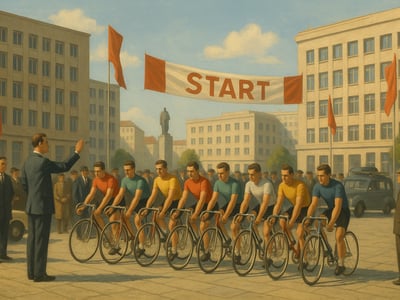
Start of the inaugural Okolo Slovenska at Stalin Square, Bratislava, 19 June 1954.
On 19 June 1954, the first Okolo Slovenska began in Bratislava with a ceremonial start at Stalin Square, the period name for a prominent public space in the city. The new event was organized as a seven-stage cycling race in Slovakia, then part of Czechoslovakia. What opened that day was more than a single sporting ceremony: it was an attempt to establish a durable road-racing competition that could continue beyond its first edition.
That first start carried a practical challenge that is easy to miss in retrospect. A race can be announced, named, and publicly launched, but it only becomes credible if it actually works over the days that follow. Organizers were not simply gathering riders for one visible moment in Bratislava. They were committing themselves to route planning, stage order, timing, officials, logistics, and local coordination across a multi-day event. For an inaugural edition, every one of those tasks had to be performed without the reassurance of a successful previous year.
The seven-stage format mattered for that reason. It signaled that Okolo Slovenska was intended as a serious stage race rather than a one-day local contest. Stage racing tests not only individual riders but also the ability of organizers to manage continuity from one day to the next. Roads had to be prepared, starts and finishes arranged, results recorded, and the race kept coherent as it moved through different places. In a first edition, any weakness in that chain could have damaged confidence in the event before it had time to develop a reputation.
Bratislava was an appropriate place for such a beginning. As Slovakia's principal urban center within Czechoslovakia, it offered visibility, administrative capacity, and the kind of public setting suited to a ceremonial launch. Starting at Stalin Square placed the race firmly in the civic landscape of the time. The name itself should be understood historically, as part of the political naming conventions of the 1950s rather than present-day usage. In that context, the square gave the opening of the race a formal and public character, linking sport, city life, and official organization.
Cycling in postwar Central Europe depended heavily on institutions. Races did not endure only because athletes were willing to ride them. They survived when clubs, federations, local authorities, newspapers, and sports administrators could support the recurring work required to stage them. The inaugural Okolo Slovenska belonged to that wider world of organized sport in 1950s Czechoslovakia. Its launch in 1954 shows how sporting life was built not just through competition itself, but through planning structures that turned an idea into a repeatable event.
This is one reason the first edition was a genuine test. If participation had been weak, if the stages had proved too difficult to manage, or if the race had failed to justify the effort required, the event might have remained a one-time experiment. New competitions are often fragile at the beginning. They need enough order, enough public attention, and enough institutional confidence to persuade organizers that another edition is worth attempting. The first Okolo Slovenska therefore carried the burden of proving that the concept could hold together in practice.
The public start in Bratislava also helped define the race's identity. Ceremonial openings are not just decorative. They tell spectators, riders, and officials that a competition deserves notice. A clearly marked starting place gives a race a recognizable beginning in public memory. For Okolo Slovenska, the opening at Stalin Square provided exactly that kind of anchor. Later history would give the race many more chapters, but the first one needed a visible scene that could establish the event as something more than an internal sporting schedule.
The fact that the race took place in Slovakia within Czechoslovakia is also important. In 1954, Slovak sport operated within broader Czechoslovak structures, and events often reflected both local identity and larger state-level organization. Okolo Slovenska was therefore regional in name and setting, yet connected to a wider sporting system. That balance helped give the race both grounding and support: it could represent Slovak road racing while still belonging to the institutional world that made multi-stage events possible.
Over time, races change. Routes are revised, categories shift, sponsorships come and go, and the practical scale of an event may expand or contract. Yet the first edition remains distinct because it establishes the basic claim that the race exists and can be run. In the case of Okolo Slovenska, 19 June 1954 marks that foundational moment. The inaugural start in Bratislava turned a proposal into an actual competition with riders on the road and stages still to complete.
Why it still matters
The 1954 opening matters because it marks the origin of one of Slovakia's recurring road-cycling traditions. Later editions may be better documented or more familiar to modern audiences, but they all depend on the fact that the first race was successfully launched and carried through as a seven-stage event. Origins matter in sport because continuity is never automatic.
It also matters because it shows how sporting traditions are built from both symbolism and administration. The ceremonial start at a major Bratislava square gave the event visibility, but visibility alone would not have been enough. The race had to function as a real multi-stage competition. In that sense, the first Okolo Slovenska illustrates a broader truth about organized sport: lasting events begin with public imagination, but they survive through disciplined execution.
Finally, the race offers a useful view into how 1950s Czechoslovak sporting institutions worked. Durable competitions were created not only by champions and results, but by officials, organizers, municipal support, and recurring structures. The inaugural Okolo Slovenska is therefore more than an item on a calendar. It is a small but clear example of how a sporting tradition begins—publicly, practically, and with no guarantee that it will last.
Timeline
- Postwar cycling competitions in Czechoslovakia
- Public sporting events in Bratislava in the 1950s
- Stage racing in Central Europe
- Sports institutions in Slovak and Czechoslovak cycling
- Inaugural Okolo Slovenska begins in Bratislava
What you uncovered
When a Race Becomes Real
You didn't just… complete a picture; you traced the moment when a public start in Bratislava had to prove that a new seven-stage race could actually work.
An inaugural sporting event is not remembered only because it begins, but because it convinces people it can be repeated. In 1954, the public start and the seven-stage structure had to support each other: one gave the race visibility, while the other gave it credibility. That combination helps explain how a single launch could become the starting point of a durable competition rather than a one-off experiment.
The first Okolo Slovenska began on 19 June 1954 with a ceremonial start at Stalin Square in Bratislava and was run as a seven-stage race.
FAQ
What was the first Okolo Slovenska and when did it begin?
The first Okolo Slovenska was an inaugural cycling race held on 19 June 1954. It was organized as a seven-stage event.
Where did the inaugural Okolo Slovenska start?
The ceremonial start took place at Stalin Square in Bratislava. The race began there before continuing as a multi-stage competition.
How many stages were in the 1954 Okolo Slovenska?
The 1954 edition was organized as a seven-stage race. That format turned the opening event into a sustained competition rather than a single-day start.
Why is the first Okolo Slovenska historically important?
It marked the beginning of a recurring road-cycling competition in Slovakia. The first edition established the event that later became part of the region’s sports tradition.