
About this story
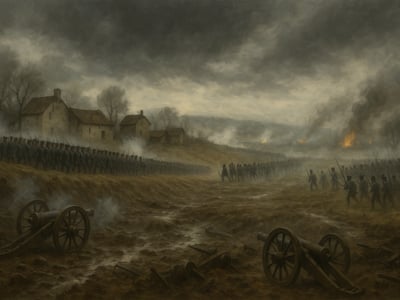
Battle of Waterloo near present-day Belgium, 18 June 1815.
On 18 June 1815, near Waterloo in the United Kingdom of the Netherlands, Napoleon Bonaparte fought the decisive battle of his Hundred Days return to power. Facing him was an Anglo-allied army under Arthur Wellesley, Duke of Wellington, drawn up near the Mont-Saint-Jean ridge south of Brussels. Somewhere beyond the immediate field, and crucial to the day’s outcome, Prussian forces under Gebhard Leberecht von Blücher were moving toward the sound of the guns. The battle would become one of the best-known military confrontations in European history, but at its center was a practical problem of timing: Napoleon needed to defeat Wellington before Blücher could fully arrive.
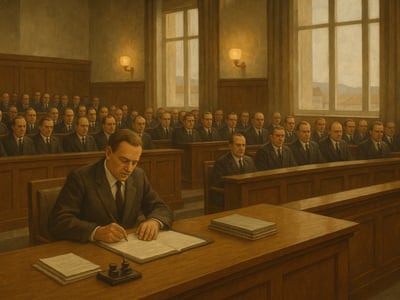
The campaign had moved quickly. After escaping from Elba, Napoleon returned to France and regained power, forcing the European powers gathered in the wider diplomatic setting of the Congress of Vienna to respond. The coalition against him was not improvising from nothing; the Final Act of the Congress of Vienna was signed on 9 June 1815, shortly before Waterloo, and the allied powers were already shaping the post-Napoleonic settlement. Napoleon’s hope was to strike before those larger forces could concentrate against him.
That logic shaped the opening of the campaign in Belgium. On 16 June, French forces defeated the Prussians at Ligny, while on the same day Wellington’s forces fought at Quatre Bras. These actions did not produce the clean separation Napoleon needed. Instead, they left the coalition armies damaged but still capable of cooperating. Over the next two days, as the Prussians withdrew and reorganized, the campaign turned into a race: could Napoleon beat Wellington first, or would the coalition timetable hold long enough to bring two armies together on one battlefield?
Wellington chose a defensive position near Mont-Saint-Jean, using the reverse slope and a line anchored by key strongpoints. Among the most important were Hougoumont on the allied right and La Haye Sainte near the center. These places were not the whole battle, but they helped shape its rhythm. To attack Wellington effectively, the French needed more than repeated pressure. They needed to break the line decisively before outside help changed the balance.
The battlefield itself added uncertainty. Ground conditions after heavy rain affected movement and artillery, and the day unfolded under the pressure of incomplete information. Napoleon had also detached Emmanuel de Grouchy to pursue the Prussians after Ligny, a decision tied to the assumption that the French could keep the coalition armies apart. But as the battle at Waterloo developed, uncertainty about exactly when and where Prussian troops would appear weighed heavily on French decisions.
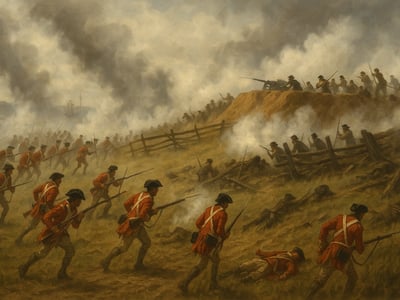
The fighting included major engagements at Hougoumont, La Haye Sainte, and later Plancenoit. At Hougoumont, what began as an attack on an allied strongpoint consumed large numbers of French troops and attention across much of the day. It fixed forces in place but did not yield the decisive breakthrough the French needed. Meanwhile, pressure mounted on Wellington’s center, where French assaults and artillery fire sought to weaken the Anglo-allied position.
La Haye Sainte became another focal point. Its position near the center made it important to both sides, and fighting around it reflected the broader problem facing Napoleon: local success had to be turned into strategic success quickly. French commanders, including Marshal Michel Ney, committed major attacks under difficult conditions, trying to force a rupture before the coalition advantage in coordination became overwhelming. But every hour mattered. Men, ammunition, cavalry, and command attention were being spent in a battle that had to be won fast.
As the afternoon wore on, the wider campaign closed in on the field. Elements of Blücher’s Prussian army began reaching the battlefield and engaged the French right flank in and around Plancenoit. That development changed the character of the battle. What had begun as a contest between Napoleon and Wellington now became a struggle against converging armies. French troops had to be diverted to contain the Prussian advance, reducing the force available for a decisive attack elsewhere.
This was the central tension of Waterloo in its clearest form. Napoleon’s plan depended on defeating one opponent before the other could intervene. Instead, the available window narrowed and then disappeared. Wellington’s army held long enough, though under intense pressure, for the coalition system to work as intended. Once the Prussian presence became substantial, the French army was no longer simply trying to break a defensive line. It was trying to do so while its own flank and rear were increasingly threatened.
By evening, the failed gamble of winning quickly had become a campaign-ending defeat. French attacks had not destroyed Wellington’s position before Prussian reinforcement altered the balance on the ground. The defeat at Waterloo was followed by Napoleon’s second abdication on 22 June 1815, four days after the battle. His final attempt to return as ruler of France had ended not in a prolonged new phase of war, but in the collapse of the campaign that was meant to secure it.
Why it still matters
Waterloo remains important not only because it marked the end of Napoleon’s final campaign, but because it offers a clear example of coalition warfare in practice. Separate armies under different commanders were able, despite earlier setbacks and the confusion of campaigning, to coordinate effectively enough to decide a battle. Historians and military scholars continue to study Waterloo as a case in command timing, communication, and the challenge of acting under uncertainty.
The battle also sits at the junction between war and diplomacy. It did not create the Congress of Vienna settlement from scratch; that settlement was already being formalized. But Waterloo helped determine whether the European political order being shaped in Vienna would face a renewed Napoleonic challenge or proceed without it. In that sense, the battle belongs both to military history and to the history of how nineteenth-century Europe was reordered.
It also endures because it was documented so extensively. Memoirs, dispatches, official reports, maps, and later national traditions all preserved different views of what happened on the field. That rich record makes Waterloo a lasting case study not only in battle, but in how battles are remembered, argued over, and given meaning long after the gunfire has stopped.
Timeline
- Congress of Vienna Final Act signed
- Battle of Ligny
- Battle of Quatre Bras
- Prussian movement toward Waterloo
- Battle of Waterloo
- Napoleon's second abdication and surrender
What you uncovered
When Timing Decides
You didn't just… complete a puzzle; you traced a moment when a battle turned on whether one army could prevail before another fully arrived.
Waterloo is often remembered as a single decisive clash, but its outcome depended heavily on coordination between separate forces moving on different clocks. Once Prussian troops began reaching the field, the question was no longer only whether Napoleon could break Wellington's position, but whether the French command could do so before the wider coalition effort closed in. That makes Waterloo a useful example of how campaigns are shaped not just by direct combat, but by timing, communication, and the ability of allied armies to act in concert.
The Congress of Vienna's Final Act was signed on 9 June 1815, just nine days before the battle.
FAQ
What happened at the Battle of Waterloo on 18 June 1815?
On 18 June 1815, Napoleon Bonaparte commanded French forces against Arthur Wellesley, Duke of Wellington’s Anglo-allied army near Waterloo. It was the निर्णive military battle of the Hundred Days campaign.
Who fought at Waterloo and where was it?
The battle was fought near Waterloo, south of Brussels, in the United Kingdom of the Netherlands, in what is now present-day Belgium. French forces faced the Anglo-allied army, and Prussian forces under Gebhard Leberecht von Blücher also arrived during the day.
Why did Napoleon lose the battle?
Napoleon needed to defeat Wellington before Blücher’s Prussians could fully join the field, but Prussian elements began reaching the battlefield and pressed the French right flank as the day went on. French attacks at places such as Hougoumont, La Haye Sainte, and Plancenoit did not produce a decisive breakthrough.
What happened after Waterloo?
Napoleon Bonaparte abdicated for the second time on 22 June 1815, four days after the battle. Waterloo was followed by the collapse of his return to power during the Hundred Days.