
About this story
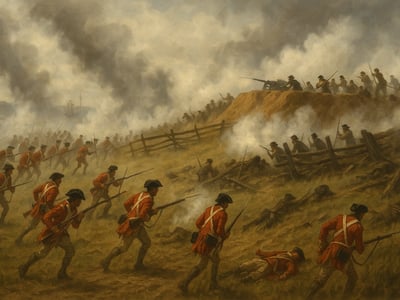
Fighting on Breed's Hill during the battle near Boston on 17 June 1775
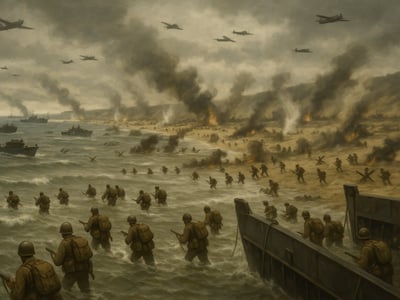
On June 17, 1775, British Army forces and colonial militia fought on the Charlestown Peninsula near Boston, Massachusetts, in an engagement that soon became widely known as the Battle of Bunker Hill. The familiar name can be misleading: most of the main fighting took place on Breed's Hill, a forward height closer to Boston. By the end of the day, British troops had taken the colonial earthworks there. Yet the cost of that success made the battle one of the early defining clashes of the American Revolutionary War.
The battle grew directly out of the tense military situation around Boston in the spring of 1775. After the fighting at Lexington and Concord in April, colonial forces had surrounded the town, beginning the Siege of Boston. British commanders under General Thomas Gage held the city, supported by the Royal Navy, while provincial forces watched the roads and heights around it. Control of high ground mattered greatly. Artillery placed on commanding positions could threaten troop movements, shipping, and lines of communication.
Against that background, colonial commanders decided to fortify the Charlestown heights. On the evening of June 16 and through the night into June 17, men under William Prescott constructed earthworks on Breed's Hill. Other colonial officers associated with the position and the wider defense included Israel Putnam and John Stark. The work was done within sight of Boston, and by daylight the new fortifications were impossible for the British to ignore.
At dawn, British officers saw that the heights opposite Boston had been transformed overnight. A redoubt stood on Breed's Hill, and supporting defenses extended toward a rail fence. The position was dangerous precisely because it was so close. If allowed to remain, it could strengthen the colonial hold around Boston and threaten British freedom of movement. A response had to come quickly.
Major General William Howe took command of the assault force sent from Boston to Charlestown on June 17. Senior British commanders, including Gage and Henry Clinton, were involved in assessing the threat and directing the larger response. The problem before Howe was straightforward but severe: his troops would have to advance uphill, across open ground, against defenders protected by earthworks. The British Army relied on discipline, formation, and determination in such attacks, but the terrain sharply favored the men already on the heights.
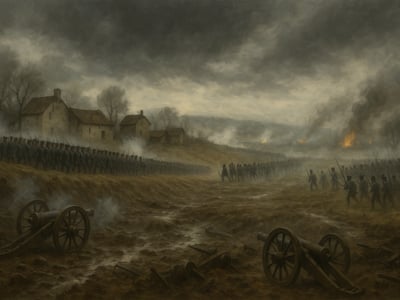
As British troops moved forward, the exposed approach made them vulnerable. Colonial fire struck the advancing lines hard enough to disrupt the first assaults. The defenders in the redoubt and along the nearby fence line benefited from cover and from the simple advantage of elevation. The British still had the resources to continue, but each attempt demanded that soldiers keep moving under increasingly punishing conditions.
The fighting became more intense as repeated British assaults were organized. Among those present with the colonial forces was Joseph Warren, a prominent Massachusetts leader who fought as a volunteer. He was killed during the battle, becoming one of its best-known dead. His death added political and emotional weight to an engagement that was already being closely watched on both sides of the siege.
For the colonial defenders, the central challenge was not only to hold their ground but to do so with limited ammunition. Earthworks and resolve could slow an attacker, but they could not replace powder and shot. For the British, the challenge was the opposite: they had to maintain order and momentum despite losses that mounted with each advance. The contest became a test of whether a fortified militia position could stop regular troops before supplies ran short.
In the end, repeated assaults gave the British the result they sought. On June 17, British forces overran the redoubt on Breed's Hill and took the position. That made the battle a tactical British victory. But it was not an easy or reassuring one. British official casualty returns for the engagement reported 226 killed and 828 wounded, figures that have often been summarized somewhat differently in later accounts but that clearly indicate the scale of the losses.
Those losses mattered immediately. The battle showed that colonial forces, even without the training and structure of a regular European army, could defend fieldworks effectively and inflict major damage on attacking troops. It also demonstrated that seizing a fortified height by direct assault could come at a very high price. Around Boston, both sides had learned something important about the kind of war they might be entering.
Why it still matters
The Battle of Bunker Hill remains important partly because it is such a clear example of how terrain and fortifications shape combat. A force attacking uphill across open ground faces severe disadvantages, even when it is better trained and ultimately successful. Military historians and students return to the battle because the physical layout of the field helps explain the outcome almost as much as the decisions of the commanders.
It also mattered because of what its casualties suggested during the Siege of Boston. British commanders had regained the heights, but at a cost high enough to affect how colonial resistance was judged. The battle made it harder to dismiss the armed opposition around Boston as temporary or easily scattered. For the colonists, the engagement offered evidence that prepared defenses could offset some of the advantages held by regular troops.
The battle also remains a lesson in historical memory. Although it is commonly called the Battle of Bunker Hill, the main action occurred on Breed's Hill. The difference is not trivial, but public memory often favors the simpler or earlier name. Maps, reports, and retellings can preserve a title even when it only partly matches the geography. That naming confusion is one reason the battle continues to attract attention: it shows how history is remembered as well as how it happened.
When the smoke cleared on June 17, 1775, the British held the ground, while the colonists retained something less visible but equally consequential: proof that the struggle around Boston would not be settled quickly. The engagement near Charlestown did not end the siege, and it did not resolve the larger conflict. What it did was reveal, in stark form, the costs both sides were prepared to bear and the difficulty of the war that had only just begun.
Timeline
- Siege of Boston
- Battles of Lexington and Concord
- Colonial fortification of Breed's Hill
- Battle of Bunker Hill
- Evacuation of Boston
What you uncovered
A Name That Stuck
You didn't just… finish a puzzle; you traced a battle whose enduring name shaped how later generations pictured the ground and the struggle near Boston.
The engagement is still widely known as Bunker Hill, even though most of the main fighting took place on Breed's Hill. That mismatch shows how public memory often settles on the clearest or earliest label rather than the most precise geography. In fast-moving wartime reporting, names that are easy to repeat can outlast maps, and those habits can shape how an event is understood long after the fighting ends.
Colonial forces under William Prescott built the main fortifications overnight on Breed's Hill before the British assaults began on 1775-06-17.
FAQ
When was the Battle of Bunker Hill fought?
The battle was fought on 1775-06-17, during the early phase of the American Revolutionary War. Colonial forces had begun fortifying Breed's Hill the night before, on 1775-06-16.
Who led the British assault at Bunker Hill?
Major General William Howe led the British assaults from Boston against the colonial position on the Charlestown Peninsula. British forces attacked the colonial works on Breed's Hill after the fortifications were discovered.
Who defended Breed's Hill during the battle?
Colonial forces under William Prescott constructed and held the fortifications on Breed's Hill. Other figures associated with the battle include Israel Putnam and John Stark.
Why is it called Bunker Hill if the main fighting was on Breed's Hill?
The engagement became commonly known as the Battle of Bunker Hill, but most of the combat took place on Breed's Hill. The popular name remained even though the colonial works were built and attacked on Breed's Hill.
What were the British casualty figures at Bunker Hill?
British official returns for the engagement reported 226 killed and 828 wounded. Later accounts sometimes summarize the totals differently.