
About this story
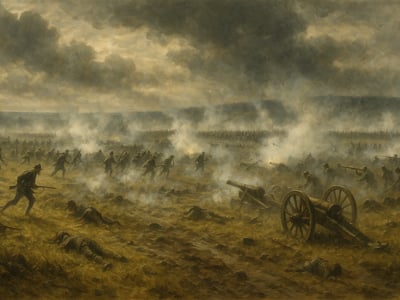
Battle of Königgrätz near Hradec Králové, decisive clash of the Austro-Prussian War in 1866.
On 3 July 1866, near Königgrätz, also known as Sadowa, in Bohemia near present-day Hradec Králové, the main armies of Austria and Prussia fought the decisive battle of the Austro-Prussian War. By the end of the day, Prussian forces had broken the Austrian position and forced a retreat. The result did not simply settle one campaign. It altered the balance of power in Central Europe and helped set in motion political changes within the Habsburg monarchy that would shape the framework of government across territories that included present-day Slovakia.
The battle grew out of a longer rivalry between Austria and Prussia within the German Confederation. Both powers claimed leading influence in German affairs, and by 1866 that competition had moved from diplomacy to war. The campaign in Bohemia became the central test. Austria's main field army, commanded by Ludwig von Benedek, faced Prussian forces advancing along separate lines. This created both danger and opportunity. If the Prussians failed to coordinate, Austria might defeat them in parts. If they joined effectively, Benedek's army could be overwhelmed.
That problem shaped the Austrian decision to stand and fight. Benedek took up a defensive position near Königgrätz, hoping to resist long enough to blunt the converging Prussian attack. On the Prussian side, King Wilhelm I was present with the army, while Helmuth von Moltke the Elder directed overall operational planning. Moltke accepted the risk of bringing separated armies into a common battle on a timetable that depended on movement, communication, and timing. In an age when rail mobilization and rapid concentration of forces were becoming more important, coordination itself had become a battlefield weapon.
The fighting on 3 July unfolded in stages rather than in a single dramatic moment. Early action was hard and uncertain. Before all Prussian forces were fully in place, Austrian troops were still contesting the field from defensible ground. This opening phase mattered because it was the period in which Austria still had a chance to hold the battle to a more limited outcome. The basic Austrian hope was not necessarily a sweeping victory, but a successful resistance that would prevent the Prussians from turning a campaign advantage into a decisive military and political result.
As the battle continued, that hope depended more and more on whether the Prussian armies would arrive and act together. Moltke's plan required separated formations to converge effectively on the battlefield. Such plans carried obvious risks. Delays, confusion, or misreading of the situation could leave one part of an army exposed before the rest came up. In nineteenth-century warfare, even a well-designed operation could fail through poor timing.
At Königgrätz, however, the crucial movement did arrive. The Prussian Second Army entered the battle and attacked in a way that increased pressure on the Austrian flank. This was the turning point identified by contemporaries and later historians alike. What had been a severe contest became an increasingly untenable situation for Benedek's army. Austrian formations, already under strain, now faced pressure that defensive steadiness alone could not resolve.
Once the balance shifted, the consequences spread quickly across the field. The Austrian position could no longer be held securely, and Benedek's army was forced into retreat. The scale of the battle and the number of forces engaged gave the result unusual weight. This was not a frontier skirmish or an isolated clash; it was the central military decision of the war. A campaign that had still contained uncertainty now produced a clear strategic answer.
The political settlement followed with unusual speed. The Peace of Prague, signed on 23 August 1866, formally ended the war between Austria and Prussia. Its broader meaning was that Austria was excluded from leadership in German affairs, while Prussia emerged in the stronger position. That change helped clear the way for a new political order in the German world under Prussian leadership. For Austria, the defeat was not only external. It also exposed the need to rethink how the Habsburg state was organized and governed.
Why it still matters
Königgrätz remains important because it shows how modern war in the nineteenth century was being reshaped by mobilization, rail movement, and operational timing. The battle is often remembered for its immediate outcome, but its deeper significance lies in the way military organization and decision-making could alter the political map. A state could lose not only a battle, but also its place within a larger system of power.
The consequences were especially far-reaching for the Habsburg monarchy. After defeat in 1866 and Austria's exclusion from German political leadership, the empire moved toward internal constitutional reorganization. In 1867, the Austro-Hungarian Compromise created the Dual Monarchy of Austria-Hungary under Franz Joseph I. That restructuring did not arise from Königgrätz alone, but the military shock of 1866 formed an essential part of the context in which it became possible and urgent.
For the history of present-day Slovakia, the relevance is indirect but real. The battle was not fought on Slovak territory, and its main actors were operating in the wider imperial and German political sphere. Yet the state framework that emerged after 1866 and 1867 shaped administration and political life across lands within the monarchy, including Upper Hungary. In that sense, a battlefield in Bohemia influenced how power would be organized far beyond the immediate scene of the fighting.
Königgrätz is therefore remembered not only as a Prussian victory or an Austrian defeat, but as a moment when military events accelerated structural political change. Different national histories may place the emphasis differently, on victory, loss, reform, or regional consequence. Even so, the battle's place in European history is clear: it marked the decisive end of one rivalry and helped open the way to a new order in Central Europe.
Timeline
- Battle of Königgrätz
- Peace of Prague
- Austro-Hungarian Compromise
What you uncovered
Defeat and Reordering
You didn't just complete a puzzle; you traced a battle whose outcome helped push the Habsburg monarchy toward a new political structure.
Königgrätz mattered not only because Austria lost a decisive battle, but because the defeat exposed how military weakness could quickly become a constitutional problem. The aftermath helped speed Austria's exclusion from leadership in German affairs and made internal reorganization more urgent. That is why the battle also belongs to the story of the 1867 Dual Monarchy and the governing framework that later applied over territories including present-day Slovakia.
The Peace of Prague, signed on 23 August 1866, formally ended the war between Austria and Prussia.
FAQ
What happened at the Battle of Königgrätz on 3 July 1866?
On 3 July 1866, Prussian forces defeated the Austrian army near Königgrätz, also known as Sadowa, in Bohemia. It was the main battle of the Austro-Prussian War.
Who commanded the armies at Königgrätz?
The Austrian forces in the field were commanded by Ludwig von Benedek. On the Prussian side, King Wilhelm I of Prussia was present, and Helmuth von Moltke the Elder served as chief of staff.
Why was the Battle of Königgrätz decisive?
It was the decisive engagement of the Austro-Prussian War because the arrival and attack of the Prussian Second Army helped turn the battle against Austria. The result was followed by the Peace of Prague on 23 August 1866.
What was the result of the battle for Austria?
Austria was defeated, and the war ended with the Peace of Prague on 23 August 1866. The defeat also helped set the stage for the Austro-Hungarian Compromise of 1867 under Franz Joseph I.