
About this story
Amelia Earhart and Frederick Noonan on the 1937 Lae-to-Howland flight.
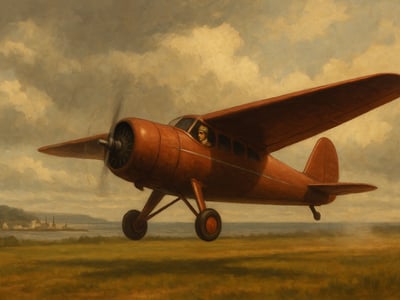
On July 2, 1937, Amelia Earhart and navigator Frederick Noonan were reported missing during one of the most demanding legs of an around-the-world flight. They had departed Lae, in the Territory of New Guinea, in a Lockheed Model 10E Electra and were headed for Howland Island, a tiny target in the central Pacific. The planned route covered roughly 2,500 miles, almost all of it over open water, with little margin for navigational error and no practical nearby alternate landing field.
By that point, Earhart was already one of the best-known aviators in the world. Her flights had made her a public figure far beyond aviation circles, and her around-the-world attempt drew close attention from newspapers and radio audiences. But fame did not make the Pacific crossing easier. The Lae-to-Howland leg was widely understood as one of the most difficult parts of the journey because it required precise navigation to reach a very small island after many hours over ocean.
Noonan's role was central to that task. A highly experienced navigator, he worked with the methods available at the time: dead reckoning, celestial navigation when conditions allowed, and coordination by radio. In principle, these methods could bring an aircraft to its destination across long distances. In practice, they depended on timing, weather, visibility, instrument use, and clear communication. On a route like this one, even a small position error could grow into a serious problem by the end of the flight.
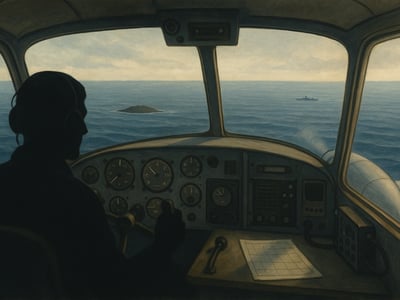
Howland Island itself made the challenge sharper. It was not a large landmass that could easily be spotted from far away. It was a narrow objective in a vast area of ocean, and reaching it depended not only on calculating the route but also on making the final approach successfully. The U.S. Coast Guard cutter *USS Itasca* was stationed off Howland to assist, and radio contact was expected to help the aircraft refine its position near the end of the leg.
That final stage is where the record becomes most important. During the flight, Earhart transmitted messages indicating difficulty with communication and position finding in relation to *Itasca*. The basic facts are clear: radio coordination was not working as smoothly as hoped, and the aircraft did not arrive at Howland Island as planned. The precise technical interpretation of every transmission has been debated by historians and researchers, but the historical record consistently points to trouble turning radio contact into a reliable fix close to the island.
This mattered because the margin for recovery was narrow. A crew that could not confidently establish its position near Howland might still be close to the island without being able to see it. Searching from the air over open ocean consumes time and fuel, and each additional pass increases uncertainty rather than reducing it if no dependable bearing is available. Exhaustion also becomes a factor after many hours in flight. In such conditions, a problem in communication could quickly become a problem in navigation, and a problem in navigation could become a matter of survival.
As the aircraft became overdue on July 2, concern quickly turned into a missing-flight incident centered on Howland Island and the surrounding waters. The event did not remain a private emergency for long. Earhart's prominence ensured immediate public attention, but official concern was rooted in the practical facts: an aircraft on a long overwater route had failed to arrive, and the last known phase of the flight suggested difficulty locating its destination.
In response, the United States launched a major search effort. U.S. Coast Guard and Navy units covered a large area of the central Pacific in July 1937. Search operations focused first on Howland Island and nearby waters, then expanded more broadly. For the period, it was a substantial effort, reflecting both Earhart's public importance and the seriousness with which authorities treated the disappearance. Yet the central Pacific was immense, and search technology in 1937 lacked the tools that later generations would take for granted. There was no satellite tracking, no emergency locator beacon in the modern sense, and no automatic stream of positional data to reconstruct the aircraft's last movements.
No confirmed trace of Earhart, Noonan, or the Electra was found during the search. Over time, many theories emerged to explain what happened. Some have focused on a crash at sea after fuel was exhausted; others have proposed alternative scenarios. But the disappearance itself remains unresolved, and the most careful historical accounts distinguish between what is documented and what is inferred. What is firmly established is the route, the intended destination, the difficulties in radio communication and position finding, the aircraft's failure to arrive, and the large search that followed.
Why it still matters
Earhart's disappearance still matters because it sits at the intersection of aviation history, navigation, and public memory. Technically, it remains a powerful example of the limits of long-distance flight in an era before later advances in tracking and search systems. The Lae-to-Howland leg showed how much depended on a fragile chain: accurate navigation over ocean, successful radio procedure, timely position fixing, and a final visual approach to a tiny island. If one part of that chain failed, there were few backups.
The event also remains important in the history of radio communication and flight operations. It illustrates that aviation progress was not only about building aircraft capable of long range. It was also about developing dependable systems around the aircraft: communication protocols, navigational aids, search methods, and better understanding of how crews manage fatigue and uncertainty during long flights.
There is another reason the story endures. Earhart was not simply a pilot who vanished on a difficult route; she was one of the most visible women in aviation at a time when flying still carried an aura of technical daring and public spectacle. News coverage of her career helped shape how many people understood modern flight itself. Because of that role, her disappearance became more than an operational mystery. It became part of the broader history of who was seen in the cockpit, how aviation heroes were presented to the public, and why certain journeys captured international attention.
The unanswered question of what happened has kept interest alive, but the lasting significance does not depend on solving the mystery. Even without a final confirmed explanation, July 2, 1937 remains a clear historical moment: a highly skilled crew, a demanding route, a tiny destination in a vast ocean, and a disappearance that exposed the operational limits of its time.
Timeline
- Amelia Earhart around-the-world flight attempt
- Lae to Howland Island flight preparation
- U.S. Navy and Coast Guard search operations
- Amelia Earhart reported missing
- Radio communication with USS Itasca
- Amelia Earhart declared dead
What you uncovered
The Limits of Contact
You didn't just… complete a puzzle; you traced a moment when reaching a destination depended on turning uncertain radio contact into reliable navigation over open ocean.
What makes this disappearance enduring is not only that the aircraft never arrived, but how much depended on coordination between separate systems that were each limited on their own. Radio contact was useful only if it could be turned into a position fix at the right moment, and navigation was useful only if communication supported it when the margin for error had become very small. The event still matters because it shows how long-distance flight once relied on fragile handoffs between people, tools, and timing rather than continuous tracking.
The Lae-to-Howland leg was roughly 2,500 miles, with Howland Island serving as a very small target in the central Pacific.
FAQ
What happened to Amelia Earhart on July 2, 1937?
On 1937-07-02, Amelia Earhart and Frederick Noonan were reported missing during a flight from Lae, Territory of New Guinea, to Howland Island. They were flying a Lockheed Model 10E Electra as part of an around-the-world attempt.
Who was with Amelia Earhart on the flight?
Frederick Noonan was with Amelia Earhart on the flight. He was the navigator on the Lae-to-Howland leg.
Why was the flight to Howland Island difficult?
The route covered roughly 2,500 miles, or about 4,000 kilometers, over the central Pacific. Reaching Howland Island depended on accurate dead reckoning, celestial navigation, and radio coordination to find a very small destination.
Why was USS Itasca important during the flight?
Earhart transmitted radio messages indicating difficulty with position finding and communication with the U.S. Coast Guard cutter USS Itasca near Howland Island. Those exchanges were part of the effort to locate the aircraft on the final approach.
How was Amelia Earhart searched for after she went missing?
On 1937-07-02, the overdue aircraft became a missing-flight incident centered on Howland Island. In July 1937, the U.S. Coast Guard and Navy searched a large area of the central Pacific after the plane failed to arrive.