

About this story
On 4 July 2012, CERN announced the discovery of a new particle consistent with the Higgs boson. The result was a landmark confirmation of a key piece of the Standard Model of particle physics.
CERN announced ATLAS and CMS results on a new particle consistent with the Higgs boson in 2012.
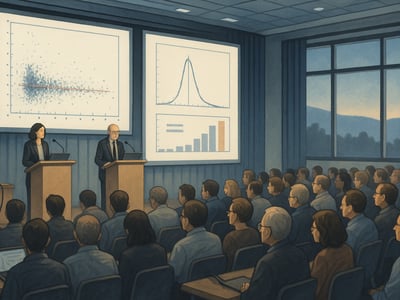
On July 4, 2012, CERN held a seminar near Geneva to present results that had been anticipated for months across the physics community. The ATLAS and CMS experiments, working independently at the Large Hadron Collider, each reported evidence for a new particle with a mass near 125 to 126 GeV. Their measurements reached the statistical threshold commonly used in particle physics for a discovery announcement, and CERN Director-General Rolf Heuer said the experiments had observed a new particle consistent with a Higgs boson.
The statement was both historic and carefully limited. For decades, physicists had been testing the Standard Model, the framework that describes known fundamental particles and several of the forces acting between them. Within that model, the Higgs mechanism had been proposed in 1964 as a way to explain why certain particles have mass. A related particle, the Higgs boson, became one of the most sought-after targets in modern physics. Yet finding it was not a matter of seeing a single unmistakable object. It required sorting through immense quantities of collision data and determining whether a subtle pattern rose clearly above many ordinary background processes.
That challenge shaped the long path to the July 2012 announcement. The Large Hadron Collider had been built to accelerate protons to extremely high energies and bring them into collision, allowing researchers to study rare phenomena that appear only under such conditions. ATLAS and CMS, two large general-purpose detectors, were designed with overlapping goals but separate instruments, software, and analysis teams. This independence mattered. If both experiments saw similar evidence in the same mass range, confidence in the result would be much stronger than if only one detector reported an excess.
During the 2011 and 2012 proton-proton runs, the collaborations accumulated and analyzed vast datasets from collisions at 7 and 8 TeV. The possible Higgs signal was expected to be rare, and the particle itself would decay almost immediately into other particles. That meant researchers could not observe it directly in the ordinary sense. Instead, they looked for characteristic decay products and for excesses in the number of events at particular energies compared with what known background processes would produce.
By early 2012, hints had already begun to attract attention, but hints were not enough. The central question was whether the evidence was strong and consistent enough to justify a public announcement. In particle physics, a result is typically treated as a discovery only when it reaches a significance of about 5 sigma, meaning the probability of the signal arising purely from a statistical fluctuation is very small. Even then, the language used must match exactly what the data show.
At the July 4 seminar, Fabiola Gianotti, speaking for ATLAS, presented results indicating a new particle candidate with a mass around 126 GeV and a local significance of about 5 sigma. Joe Incandela, speaking for CMS, presented an excess near 125.3 GeV. CMS described its local significance as about 4.9 sigma, rising to around 5 sigma with expected sensitivity. The close agreement between the two experiments, despite their independent methods, was the decisive feature of the day.
For outside observers, the event could seem like the end of a long search. Inside the scientific process, it was a major step but not the last one. Rolf Heuer's wording was deliberate: this was a new particle consistent with a Higgs boson. That phrasing reflected the difference between observing a signal and fully characterizing its properties. The data showed that something new had appeared in the expected mass region, but more work was needed to establish its spin, its couplings to other particles, and whether it matched the Standard Model Higgs boson in detail.
That distinction was important not because the claim was weak, but because the standards were strong. Large collaborations had to decide when the evidence crossed the accepted threshold while resisting the temptation to say more than the measurements justified. If the two experiments had produced weaker or inconsistent signals, CERN might have delayed any discovery claim. Instead, the seminar presented a rare combination of statistical strength, independent confirmation, and careful restraint.
The announcement also highlighted the scale of contemporary experimental physics. ATLAS and CMS each involved thousands of scientists, engineers, technicians, and computing specialists from many countries. The result depended not only on theoretical ideas developed decades earlier, but also on detector construction, accelerator performance, calibration, software, and repeated checks against sources of error. Turning collision events into a defensible scientific statement required institutions built for precision and collaboration.
Formal publication followed later that year. On September 17, 2012, the ATLAS and CMS discovery papers appeared in *Physics Letters B*, giving the broader community a detailed account of the analyses behind the July announcement. Subsequent measurements then examined the new particle's properties more closely. In 2013, the Nobel Prize in Physics was awarded to Peter Higgs and François Englert for the theoretical work associated with the mechanism that had guided the search.
Why it still matters
The July 4, 2012 announcement remains important because it illustrates how modern science establishes confidence in difficult results. The discovery did not rest on a single dramatic observation. It came from independent experiments comparing enormous datasets, applying agreed statistical standards, and presenting conclusions in language calibrated to the evidence.
It also reinforced the Standard Model as a powerful working framework. The Higgs boson had occupied a special place in that theory: it was not just another predicted particle, but part of the explanation for how the model hangs together. Finding a particle consistent with it confirmed that a major element of the theory corresponded to nature, even as physicists continued to test its exact details.
Finally, the event remains a useful example of how large scientific facilities produce knowledge. The Large Hadron Collider did not simply generate discoveries by scale alone. Its value lay in the combination of engineering, independent verification, statistical discipline, and peer-reviewed publication. The announcement near Geneva in 2012 showed how a modern collaboration can move from suggestion to observation while preserving caution about what has, and has not yet, been proved.
That balance between excitement and precision is one reason the seminar is still remembered. It marked the arrival of a new particle in the data, but it also demonstrated the method by which science turns a difficult measurement into a widely accepted result.
Timeline
- Higgs mechanism proposed
- Large Hadron Collider proton-proton runs
- CERN announcement of a new particle
- Discovery papers published
- Nobel Prize for Higgs mechanism
What you uncovered
What the Wording Meant
You didn't just complete a puzzle—you traced a moment when physicists had to match public language carefully to what two experiments could actually support.
The caution in CERN's announcement was part of the result, not a sign of uncertainty in the everyday sense. Observing a new particle at discovery-level significance is different from fully establishing all of its properties, so the phrasing marked a boundary between strong evidence and complete characterization. That distinction shows how particle physics turns statistical signals into durable knowledge: first by independent observation, then by repeated measurement, comparison, and publication.
The ATLAS and CMS discovery papers were published together in Physics Letters B on 17 September 2012.
FAQ
What did CERN announce on 4 July 2012?
On 4 July 2012, CERN announced that the ATLAS and CMS experiments had observed a new particle. CERN said it was consistent with the Higgs boson predicted by the Standard Model.
Where was the announcement made?
The announcement was made at CERN in Geneva, near the France-Switzerland border. It was presented during a CERN seminar.
What did ATLAS and CMS each report?
ATLAS reported a new particle candidate with a mass around 126 GeV and a local significance of about 5 sigma. CMS reported a new particle near 125.3 GeV with local significance of about 4.9 sigma, rising to about 5 sigma with expected sensitivity.
Why was it described as consistent with the Higgs boson?
The data showed a new particle with properties and mass near the range expected for the Higgs boson, but the announcement was limited to what the measurements supported. Full characterization came later.
What happened after the discovery announcement?
The ATLAS and CMS discovery papers were published in Physics Letters B on 17 September 2012. The announcement was then followed by further measurements of the particle's properties.