
About this story
Dolly at the Roslin Institute, linked to adult-cell nuclear transfer research in 1996
On July 5, 1996, a lamb named Dolly was born at the Roslin Institute near Edinburgh, Scotland, in an experiment that would soon become one of the most discussed events in modern biology. At the time of her birth, she was simply the live result of a long and technically difficult research process. What made that result so important was not that she was a sheep, but how she had been produced: from the nucleus of an adult body cell, transferred into an egg cell whose own nucleus had been removed.
The work behind Dolly brought together researchers at the Roslin Institute and PPL Therapeutics. Among the figures most closely associated with the experiment were Ian Wilmut, Keith Campbell, and Bill Ritchie. Their aim was to test a question that had major implications for developmental biology: could the genetic material inside an adult somatic cell still direct the development of an entire animal if placed in the right conditions?
That question may seem straightforward in hindsight, but it ran against a longstanding practical and scientific difficulty. As animals develop, their cells become specialized. A mammary gland cell does a very different job from a nerve cell or a muscle cell. For decades, biologists had been trying to understand whether specialization was a one-way path. In other words, once a cell had taken on a specific role in the body, had it permanently lost the broader developmental potential present in the earliest stages of life?
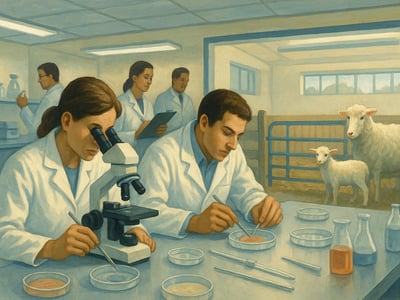
Earlier cloning experiments had already shown that nuclei from embryonic cells could support development under certain conditions. But an embryonic cell is still relatively unspecialized. Dolly's significance lay in the decision to use an adult donor cell instead. The donor nucleus came from a mammary gland cell taken from an adult Finn Dorset ewe. Researchers then removed the nucleus from an egg cell and inserted the adult donor nucleus into that enucleated egg.
This process is known as somatic cell nuclear transfer. The phrase describes a sequence of careful laboratory steps, but the basic concept is simple enough: the egg cell provides the environment, while the transferred nucleus provides the genetic material. If the process works, the reconstructed embryo begins developing as if it were a newly formed embryo. In practice, however, many things can go wrong. The transferred nucleus may fail to reset properly. The embryo may stop dividing. Implantation may fail. A pregnancy may not continue to term.
Dolly's birth therefore represented the successful end point of many attempts in which the central challenge was not merely transfer, but reprogramming. For development to proceed, the adult nucleus had to function in a radically different way from the one it had carried out in the donor sheep's mammary tissue. It had to support the full developmental sequence required to form a living lamb.
The pregnancy that led to Dolly was carried by a Scottish Blackface ewe, which served as the surrogate. This detail mattered scientifically as well as practically. Because the donor cell came from a Finn Dorset sheep and the surrogate belonged to a different breed, the resulting lamb's characteristics helped confirm that the genetic source was the donor nucleus rather than the surrogate. Dolly's white face matched the Finn Dorset donor line, not the darker-faced Scottish Blackface carrier.
Even after Dolly was born, the event did not become globally famous overnight. The broader scientific world learned of the work through the research report published in *Nature* in 1997, naming Ian Wilmut, Keith Campbell, and colleagues. That publication presented Dolly not as a symbolic breakthrough, but as the documented outcome of an experimental system. It described the methods and placed the result within ongoing efforts to understand development, cell differentiation, and the possibilities of nuclear transfer.
Public attention, however, quickly expanded beyond the technical paper. Many people saw Dolly as proof that cloning had entered a new phase. The distinction between cloning from embryonic material and cloning from an adult somatic cell was crucial to scientists, but to the wider public the image was simpler and more immediate: a mammal had been produced from the genetic material of an adult animal. That compressed summary traveled quickly through newspapers, television reports, policy discussions, and classrooms.
The reactions were mixed. Some observers focused on the biological achievement and on what it might reveal about how cells work. Others immediately raised questions about regulation, animal welfare, and the future uses of cloning technologies. Those concerns were not separate from the science; they were part of the reason Dolly became such a landmark. Her birth forced institutions, governments, and research organizations to explain what had been done, what had not been done, and what boundaries might be needed.
What is easy to miss in retrospect is how narrow the original experiment was compared with the size of the discussion it triggered. The researchers were addressing a precise developmental question through animal experimentation. Yet the result touched a much larger set of issues because it suggested that the apparent finality of cell specialization was more flexible than many people had assumed.
Why it still matters
Dolly remains a reference point in biotechnology because her birth changed how scientists and the public talked about the potential of cells. The experiment did not mean that any adult cell could easily be turned into any organism, nor did it erase the many technical limits of cloning. But it showed that the nucleus of an adult somatic cell could, under laboratory conditions, be reprogrammed to support full development.
That finding mattered for basic science. It helped reinforce the idea that specialized cells retain a complete genome, even if only part of it is active in their ordinary role. The key problem was not missing genetic information, but how that information was controlled. In that sense, Dolly became part of a larger story about gene expression, cell identity, and nuclear reprogramming.
Her birth also shaped discussions about oversight. Research institutions, regulators, and ethics bodies had to consider how animal cloning should be monitored and what standards should govern related work. Debates in the late 1990s often reached beyond the actual experiment, but they nevertheless influenced policy and public communication around biotechnology.
Dolly's place in history also endures because she provides a clear example of how one experimental success can reorganize a field's central question. Before Dolly, a major uncertainty was whether an adult cell nucleus could ever direct the creation of a whole mammal. After Dolly, the question was no longer simply whether it was possible, but how reprogramming worked, how often it could succeed, and what such methods could be used to study.
For those reasons, Dolly is remembered not only as a sheep born in Scotland, but as a turning point in the study of development. Her birth connected a specific laboratory procedure to a much broader reconsideration of what a mature cell can still become.
Timeline
- Dolly the sheep born at Roslin Institute
- Nature publication on Dolly research
What you uncovered
When Cells Changed Meaning
You didn't just… complete a puzzle; you traced the moment when one sheep became evidence that an adult cell could be pushed back into directing full development.
Dolly mattered not only because a lamb was born, but because the experiment shifted a basic assumption about cells. Instead of treating adult specialization as a one-way path, researchers had stronger reason to ask whether cellular identity could be reset under specific laboratory conditions. That helped make nuclear reprogramming a broader scientific question, not just a narrow cloning result. It also pushed institutions to think more seriously about oversight, animal research, and how such techniques should be governed.
The research describing Dolly's production was published in Nature in 1997 and named Ian Wilmut, Keith Campbell, and colleagues.
FAQ
When was Dolly the sheep born?
Dolly was born on 5 July 1996 at the Roslin Institute in Midlothian, Scotland.
Where was Dolly born, and which institute was involved?
She was born at the Roslin Institute near Edinburgh, Scotland. The research involved the Roslin Institute and PPL Therapeutics.
How was Dolly created from an adult cell?
Dolly was produced by somatic cell nuclear transfer. The donor nucleus came from a mammary gland cell of an adult Finn Dorset sheep, and a Scottish Blackface ewe carried the pregnancy.
Why did Dolly matter in cloning research?
Dolly was a key milestone because the research showed that an adult somatic cell could direct the development of a live mammal after nuclear transfer. It became an important reference point for biotechnology and cloning research.