
About this story
On 19 September 1893 in Wellington, Governor Lord Glasgow gave royal assent to New Zealand’s Electoral Act 1893, enfranchising women in parliamentary elections. Kate Sheppard’s campaign and a petition of nearly 32,000 signatures backed the change. Women voted on 28 November 1893; they could not yet stand for Parliament.
Electoral Act 1893 in Wellington extended parliamentary voting rights to women in New Zealand.
On 19 September 1893, in Wellington, Governor Lord Glasgow gave royal assent to New Zealand’s Electoral Act 1893, turning a hard-fought suffrage campaign into law. The measure enfranchised women in parliamentary elections across the colony, allowing adult women who met the electoral qualifications then in force to be placed on the rolls and vote. What had been argued over in petitions, speeches, committee stages, and late parliamentary maneuvering now became part of the legal framework of elections.
A campaign of petitions and bills
The moment is often remembered in broad symbolic terms, but it was also the outcome of a very specific institutional process. Women’s suffrage did not arrive as a single declaration. It emerged through repeated attempts to change election law, through public organization outside Parliament, and through the willingness of enough lawmakers to let the change stand at the decisive moment.
The campaign that led to the 1893 act had been building for years. Earlier suffrage bills had been introduced before 1893, and one of the most persistent parliamentary supporters of the cause was John Hall. His role mattered because reform required more than public sympathy: it needed legislative language, sponsors inside Parliament, and the patience to return to the issue after setbacks. Measures could advance, stall, or be altered beyond recognition. In a parliamentary system, support in principle was not always enough to secure a final vote.
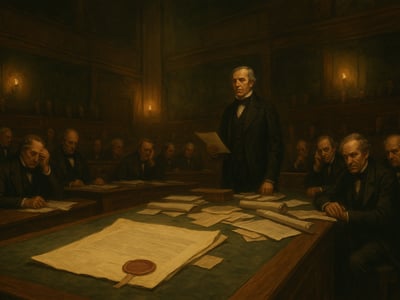
Outside Parliament, campaigners worked to show that women’s suffrage had organized backing. Kate Sheppard became the best-known public face of that effort. Along with allied groups, especially within organized reform networks, she helped coordinate petitioning on a large scale. In 1893, a suffrage petition with nearly 32,000 signatures was presented to Parliament. That number did not itself change the law, but it demonstrated reach, discipline, and persistence. It also made it harder to treat the matter as marginal or temporary.
Parliament under pressure
Petitions had a practical as well as moral function. They gathered names, linked local supporters to a colony-wide campaign, and gave legislators visible evidence that the issue extended beyond a few urban activists or a single pressure group. In an era when political legitimacy was often measured through formal submissions and parliamentary records, the petition translated advocacy into a format the legislature could not easily ignore.
Even so, the final stages remained contested. Richard Seddon, the premier, was a central figure during the parliamentary struggle of 1893. As with many major reforms, the contest was not simply between clear supporters and clear opponents. It involved calculations about timing, control of legislation, amendments, and the consequences of enlarging the electorate. A bill could be delayed until it was useless for the coming election, or adjusted in ways that weakened its effect. The question was not only whether women should vote, but whether the measure would survive the legislative process intact.
Royal assent in Wellington
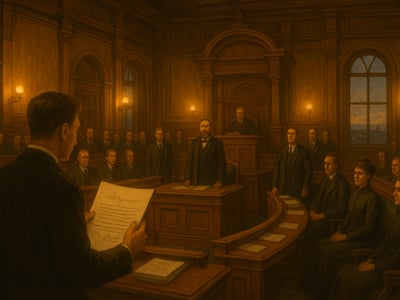
That process required passage through both houses of Parliament. In New Zealand’s system at the time, reformers had to secure enough support in the House of Representatives and then overcome resistance or hesitation in the Legislative Council. The bill’s progress therefore depended on a chain of decisions rather than one dramatic vote alone. Any break in that chain could have ended the effort for that session.
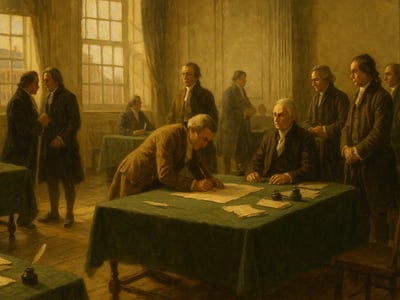
When Lord Glasgow assented to the Electoral Act on 19 September, the legal uncertainty ended. Royal assent was the final constitutional step required to make the legislation operative. This mattered because suffrage campaigns often generated public expectations before the law was actually complete. Until assent was given, the measure was still vulnerable. Once it was signed, election officials could move from debate to administration: rolls had to be prepared, procedures followed, and the enlarged electorate incorporated into the machinery of the next general election.
That next test came quickly. Women were able to vote in New Zealand’s general election on 28 November 1893, only a little over two months after the act became law. The short interval underscored how consequential the September decision had been. Had the bill failed, stalled, or been stripped of its suffrage provisions, the opportunity for women to participate in that election would have been lost.
From law to the November rolls
It is also important to describe the 1893 change precisely. The Electoral Act granted women the right to vote in parliamentary elections; it did not yet give women the right to stand for Parliament. That later extension came afterward. The distinction matters because franchise expansion often happened in stages. Gaining recognition as voters was a major constitutional change, but it was not identical to full eligibility for elected office.
The event is frequently cited in global suffrage history, and with good reason. Yet the significance of 19 September 1893 lies not only in being an early and influential example of franchise expansion. It also lies in how the change was achieved: through organized civic pressure, formal petitioning, legislative sponsorship, parliamentary endurance, and final executive assent.
Why it still matters
New Zealand’s 1893 suffrage law remains important because it shows, very clearly, how democratic reform becomes real. Public campaigns can generate pressure and visibility, but signatures alone do not rewrite election law. Legislators must draft and pass a measure, political leaders must decide whether to resist or permit it, and constitutional formalities must be completed. The history of women’s suffrage in New Zealand is therefore also a history of institutions at work.
It also remains a reference point in the broader history of franchise expansion within parliamentary systems. The case illustrates that electoral rights can widen not through revolution or constitutional collapse, but through persistent organizing combined with procedural success. For historians of voting rights, that combination is as important as the final result.
Finally, the 1893 act continues to matter because it demonstrates the power of coordinated civic action. The petition associated with Kate Sheppard and her allies did not replace Parliament, but it helped shape what Parliament had to confront. In that sense, the law stands as an example of how citizens, organizers, lawmakers, and constitutional officers together can alter the definition of who counts as an elector.
By the time women voted in the November 1893 general election, the change was no longer an argument about principle alone. It had become an administrative and political fact. That is why 19 September 1893 endures in historical memory: it marks the moment when a campaign crossed the threshold into law.
Timeline
- Suffrage petition with nearly 32,000 signatures presented
- Governor Lord Glasgow gives royal assent to the Electoral Act
- Women vote in New Zealand’s general election
What you uncovered
How a Petition Became Law
You didn't just… complete a date and place puzzle; you traced the moment when a political demand was turned into electoral law.
The significance of 1893 lies not only in support for women's suffrage, but in the institutional path that made that support legally effective. Petitions could demonstrate scale, yet they did not change the franchise on their own; legislation had to survive debate, passage, and formal assent. That sequence shows how democracies often change through an interaction between organized civic pressure and procedural gatekeeping.
Women were able to vote in New Zealand's general election just over two months later, on 28 November 1893.
FAQ
What did New Zealand's Electoral Act 1893 change?
It enfranchised women in parliamentary elections across New Zealand, extending the vote to adult women who met the electoral qualifications then in force. The act was assented to on 19 September 1893 in Wellington.
Who were the key figures in the 1893 suffrage campaign?
Kate Sheppard helped organize the petition campaign, while John Hall had introduced earlier suffrage legislation in Parliament. Premier Richard Seddon was also a central parliamentary figure during the debate.
When did women first vote in a New Zealand general election?
Women voted for the first time in New Zealand's general election on 28 November 1893. That followed the passage of the Electoral Act 1893 earlier that year.
Why is the 1893 New Zealand suffrage law often cited?
It is a major reference point in the history of franchise expansion because it shows how petitions, parliamentary action, and executive assent could combine to change election law. It is also frequently discussed in the broader history of women's suffrage.