
About this story
On 6 October 1908 Emperor Franz Joseph proclaimed the annexation of Bosnia and Herzegovina, turning thirty years of Austro-Hungarian occupation into a claim of sovereignty. The Treaty of Berlin of 13 July 1878 had left formal sovereignty with the Ottoman Empire. Serbia protested, and Russia, after the 16 September meeting at Buchlau, was pushed into a retreat. On 31 March 1909 Russia accepted a revised settlement. The crisis stopped short of war, but it deepened the distrust that fed the path toward 1914.
Bosnia and Herzegovina at the time of Austria-Hungary's annexation proclamation in 1908.
On October 6, 1908, Emperor Franz Joseph publicly proclaimed the annexation of Bosnia and Herzegovina to Austria-Hungary, turning a long-standing occupation into a formal claim of sovereignty. The announcement did not mark the arrival of Austro-Hungarian power in the provinces; that had begun three decades earlier. What changed on that October day was the legal and diplomatic status of two Balkan territories that Austria-Hungary had administered since 1878 but that had, on paper, remained under Ottoman sovereignty.
Occupation was not sovereignty
That distinction between control and recognized ownership was not a technical detail. It was the heart of the crisis. Since the Treaty of Berlin of July 13, 1878, Austria-Hungary had been authorized to occupy and administer Bosnia and Herzegovina while the Ottoman Empire retained formal sovereignty. The arrangement reflected the unstable balance of power in southeastern Europe at a time when the Ottoman state was weakening but the other great powers still wanted to avoid a direct struggle over its lands.
For Vienna, the settlement had always been incomplete. Austria-Hungary governed the provinces, invested in administration and infrastructure, and stationed troops there, yet its legal position remained limited by an international agreement. For the inhabitants of Bosnia and Herzegovina, the arrangement meant that imperial authority shaped daily life while the ultimate constitutional future of the territory remained unresolved. The monarchy could rule, but it could not claim undisputed legal title.
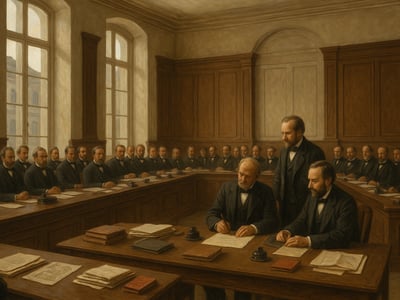
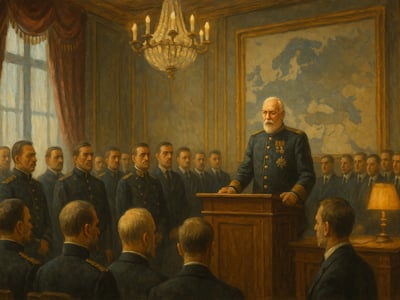
By 1908, Austro-Hungarian foreign minister Alois Lexa von Aehrenthal decided to close that gap. His calculation rested on timing as much as principle. The Balkans were already in motion, Ottoman authority was under strain, and diplomacy among the great powers often depended on private understandings as much as public treaties. On September 16, 1908, Aehrenthal met Russian foreign minister Alexander Izvolsky at Buchlau. The exact understandings reached there became one of the most disputed parts of the crisis, but the meeting clearly formed part of the diplomatic maneuvering that preceded annexation.
A disputed meeting at Buchlau
Aehrenthal appears to have believed that Russia would object but ultimately accept a revision of the Bosnian settlement, especially if broader questions involving the Turkish Straits were also discussed. Izvolsky, for his part, seems to have expected that any change would be handled through a wider international process rather than by a sudden unilateral announcement. That difference in expectations became one of the central diplomatic failures of the episode.
Events then moved quickly. On October 5, 1908, Bulgaria declared its independence from the Ottoman Empire. That development altered the atmosphere in the Balkans and made treaty revision seem less unthinkable than it had only days before. The next day, Franz Joseph issued the annexation proclamation. Austria-Hungary was no longer presenting itself merely as administrator of Bosnia and Herzegovina. It was declaring them part of the monarchy.
The reaction was immediate and sharp. The Ottoman Empire protested because the annexation swept aside the legal sovereignty it had retained since 1878. Serbia protested because the move strengthened its powerful neighbor and blocked Serbian hopes of expanding influence among South Slavs in the region. In Belgrade, the annexation was seen not just as a diplomatic setback but as a direct blow to national ambitions. Russia, which regarded itself as a protector of Slavic interests and had its own stake in Balkan affairs, also objected. What might have looked in Vienna like the regularization of an existing reality looked elsewhere like a dangerous and unilateral alteration of the European balance.
Bulgaria, then the proclamation
The issue was larger than Bosnia and Herzegovina alone. The annexation raised a broader question that haunted pre-1914 diplomacy: could a great power simply convert long-term occupation into recognized sovereignty when conditions seemed favorable? If so, treaties became vulnerable whenever one state judged the moment ripe and others seemed too weak or divided to resist. The crisis therefore touched nerves far beyond the provinces themselves.
Yet the annexation did not lead directly to war in 1908. Instead, it opened months of intense diplomatic pressure. Serbia was angry but constrained. Russia, still weakened by the aftermath of the Russo-Japanese War and the 1905 revolution, was in no position to force a military showdown. The Ottoman government protested and negotiated but lacked the leverage to reverse the act by force. Germany backed Austria-Hungary, and that support mattered. It strengthened Vienna’s position and narrowed the room for a successful challenge.
Through the winter of 1908 and into 1909, Europe watched a dangerous test of credibility unfold. No government wanted humiliation, but not every government could afford escalation. On March 31, 1909, after sustained pressure and faced with the realities of the balance of power, Russia accepted the revised settlement surrounding the annexation crisis. The immediate confrontation ended, though resentment did not.
Pressure that stopped short of war
For Austria-Hungary, the outcome looked like a diplomatic success. It had taken a legally ambiguous occupation and made it formal. But the price was high. Serbia emerged more embittered. Russia was angered by the way the crisis had unfolded and by its own forced retreat. Trust among the powers was further reduced. In that sense, the annexation solved one problem for Vienna while worsening the wider atmosphere in which European diplomacy operated.
The people of Bosnia and Herzegovina had little say in any of this. Their political future was redefined by imperial decision, treaty law, and great-power bargaining conducted in capitals such as Vienna, Belgrade, Istanbul, and St. Petersburg. However one interpreted the legal arguments, the population of the provinces had to live with the consequences of decisions made above them.
Why it still matters
The annexation of Bosnia and Herzegovina remains important because it demonstrates how dangerous the gap can be between de facto control and de jure sovereignty. Austria-Hungary had governed the provinces for thirty years, yet the act of formally claiming them still triggered an international crisis. Control alone had not settled the question.
The episode also offers a clear example of how misread diplomacy can magnify risk. Informal conversations, uncertain assurances, and different assumptions about procedure all helped turn a regional dispute into a major confrontation. No single misunderstanding explains the crisis by itself, but the events of 1908 show how easily states could convince themselves that rivals would accept faits accomplis.
It matters as well because it helps explain why Balkan disputes carried such weight in pre-1914 Europe. The region was not a peripheral stage. It was a place where imperial ambition, nationalist politics, treaty law, and great-power rivalry overlapped. The annexation crisis did not cause World War I on its own, but it deepened grievances and sharpened alignments that would matter again in 1914.
Looking back, the proclamation of October 6, 1908, stands as more than a change on a map. It was a test of how far a state could push legal revision under diplomatic pressure, and a warning that unresolved status questions in contested regions can have consequences far beyond their borders.
Timeline
- Treaty of Berlin authorizes Austro-Hungarian occupation
- Aehrenthal meets Izvolsky at Buchlau
- Bulgaria declares independence from the Ottoman Empire
- Franz Joseph proclaims the annexation
- Russia accepts the revised settlement
What you uncovered
When Control Becomes Sovereignty
You didn't just complete a puzzle—you retraced the moment when long-standing control was turned into a legal claim that unsettled the European balance.
One reason this episode mattered so much is that it exposed the gap between ruling a place in practice and possessing an accepted legal right to it. For years, that ambiguity had been managed within diplomacy, but once Austria-Hungary tried to convert administration into recognized sovereignty, the dispute became harder to contain. The crisis also showed how much pre-1914 politics depended on assumptions, private understandings, and pressure rather than stable agreement.
Under the 1878 Treaty of Berlin, Austria-Hungary was allowed to occupy and administer Bosnia and Herzegovina while the provinces formally remained under Ottoman sovereignty.
FAQ
What happened on 6 October 1908 in Bosnia and Herzegovina?
On 6 October 1908, Emperor Franz Joseph publicly proclaimed the annexation of Bosnia and Herzegovina to Austria-Hungary. The provinces had been administered by the monarchy since 1878, but they had remained formally under Ottoman sovereignty until that announcement.
Why did Austria-Hungary annex Bosnia and Herzegovina in 1908?
Austria-Hungary had governed Bosnia and Herzegovina for years, but it did not yet have internationally recognized full sovereignty. The annexation turned that long-standing occupation into formal rule.
What was the Buchlau meeting between Aehrenthal and Izvolsky?
On 16 September 1908, Austro-Hungarian foreign minister Alois Lexa von Aehrenthal and Russian foreign minister Alexander Izvolsky met at Buchlau. The meeting took place during the diplomacy that preceded the annexation crisis.
How did Russia respond to the Bosnian Crisis?
Russia protested during the crisis, but on 31 March 1909 it accepted the revised international settlement. That followed German backing for Austria-Hungary and strong diplomatic pressure.
Why did Serbia oppose the annexation of Bosnia and Herzegovina?
The annexation triggered diplomatic protests from Serbia, along with Russia and the Ottoman Empire. It altered the status of a neighboring Slavic region and became part of the wider Bosnian Crisis of 1908-1909.