
About this story
On 14 October 1962 a U.S. Air Force U-2 photographed Soviet missile sites in western Cuba. Analysts at the National Photographic Interpretation Center read the film the next day, and President John F. Kennedy was briefed on 16 October. The pictures led to his 22 October quarantine speech and to Adlai Stevenson’s display of the photographs at the United Nations on 25 October.
U-2 photographs from western Cuba documented missile-site construction near San Cristóbal in October 1962.
On October 14, 1962, a U.S. Air Force U-2 reconnaissance aircraft flew over western Cuba and returned with photographs that would quickly become some of the most consequential images of the Cold War. The mission passed over areas including San Cristóbal in Pinar del Río Province, where Soviet missile-related installations were under construction. What the cameras recorded that day did not by itself resolve the crisis that followed, but it provided the visual evidence U.S. officials needed to conclude that offensive Soviet missiles were being deployed on the island.
A flight in a worsening crisis
The flight took place in a tense political setting. Relations among the United States, Cuba, and the Soviet Union had sharply deteriorated in the years before 1962. After the Cuban Revolution and the failed Bay of Pigs invasion, Washington viewed developments on the island with increasing alarm, while Moscow sought ways to strengthen its position and support the Cuban government. By the autumn of 1962, suspicions about Soviet military activity in Cuba were growing, but suspicion alone was not enough. Before senior officials could act with confidence, they needed evidence that could be interpreted, checked, and presented within government.
That made reconnaissance essential. The central problem was practical as much as political: if missile sites were present, they had to be located and identified before they became operational. High-altitude U-2 flights carried serious risks. Any overflight of Cuba could trigger diplomatic protest, expose U.S. surveillance methods, or intensify an already dangerous confrontation. Yet without fresh imagery, officials risked making decisions in partial ignorance.
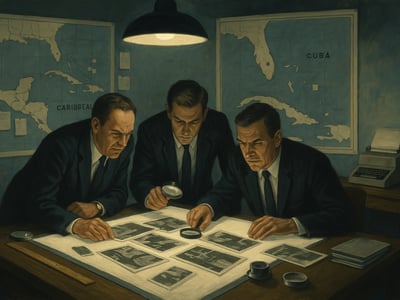
The October 14 mission supplied the raw material for a clearer assessment. The photographs were delivered for analysis to the National Photographic Interpretation Center, or NPIC, in Washington, D.C. There, on October 15, analysts examined the images in detail. Their work required more than simply noticing unusual structures. They compared shapes, spacing, support vehicles, and site layouts against known patterns associated with medium-range ballistic missile deployments. Through that process, the imagery from the San Cristóbal area was identified as evidence of missile-site construction.
From film to a briefing
Among the important figures in this stage was Arthur C. Lundahl, director of NPIC, whose organization played a central role in turning aerial photographs into an intelligence judgment. In a crisis, the value of a photograph depended on disciplined interpretation. A mistaken reading could have carried enormous consequences. Analysts therefore had to determine not just that military activity was visible, but that the equipment and arrangement matched Soviet medium-range ballistic missile sites.
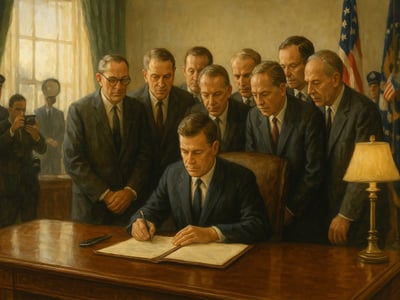
Once the assessment had been made, the information moved rapidly into the highest levels of the U.S. government. On October 16, National Security Adviser McGeorge Bundy informed President John F. Kennedy of the findings. That briefing marked the beginning of the most intense phase of White House decision-making during the Cuban Missile Crisis. Kennedy and his advisers, often referred to as the Executive Committee or ExComm, now had to decide how to respond to a deployment that directly affected strategic balance and domestic credibility.
Photographs narrow the choices
The photographs did not dictate a single course of action, but they narrowed the range of plausible responses. Without confirmed imagery, the administration would have had weaker grounds for acting and less certainty about what it was confronting. With the images in hand, officials debated military strikes, invasion, and other options before settling on a naval quarantine intended to block further offensive weapons from reaching Cuba while signaling resolve without immediate attack.
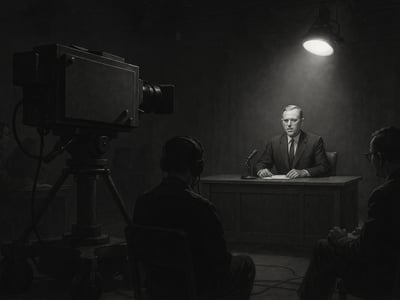
On October 22, Kennedy addressed the nation and announced that the United States had identified missile installations in Cuba and would impose the quarantine. The speech transformed intelligence findings into public policy. What had begun as a reconnaissance mission and an analytical judgment inside government became a matter of open international crisis. In the days that followed, the photographic evidence also strengthened the U.S. position in diplomacy, because it offered something more concrete than accusation alone.
A speech, then the photographs at the UN
That became especially clear on October 25, when U.S. Ambassador Adlai Stevenson II presented reconnaissance photographs at the United Nations Security Council. The images helped the United States make its case before an international audience. In that setting, visual evidence mattered not only because it informed policymakers, but because it could also be used to support public claims in a disputed diplomatic arena.
The event is sometimes remembered mainly as a moment of discovery, but it was equally a demonstration of process. The U-2 flight, the transport of the film, the expert interpretation at NPIC, the briefing of the president, and the later presentation of evidence at the United Nations all formed parts of a chain. If one link had failed—if the aircraft had not captured the relevant sites, if analysts had misread the imagery, or if the findings had arrived too late—the subsequent decisions might have unfolded very differently.
Why it still matters
The October 14 photographs remain important because they show how intelligence becomes action in a crisis. First, they are a clear example of aerial reconnaissance shaping state decisions under extreme pressure. The images did not end disagreement, but they established a documented basis for judgment at a moment when uncertainty could have been dangerous.
Second, the episode is a useful case study in institutional movement: information passed from surveillance aircraft to imagery analysts, then to senior advisers, then to the president, and finally into diplomacy and public explanation. That sequence helps explain how governments translate raw information into policy. It also shows that the authority of intelligence often depends on the credibility of the analytical process behind it.
Third, the photographs illustrate the political value of verifiable visual evidence. In international disputes, claims are stronger when supported by material that can be examined and presented beyond closed rooms. Stevenson’s use of the images at the United Nations showed how intelligence could serve not only private decision-making but also public argument.
The broader Cuban Missile Crisis would continue beyond October 14, and its resolution would involve negotiation, military pressure, and further verification. But the turning point in public understanding began with a reconnaissance flight over western Cuba and the careful reading of what its cameras had captured. Those photographs did not merely record a hidden deployment. They changed what leaders could say they knew, and therefore changed what they could do next.
Timeline
- U-2 reconnaissance flight over western Cuba
- NPIC analysis of reconnaissance imagery
- Kennedy briefed on photographic findings
- Kennedy announces quarantine of Cuba
- UN Security Council presentation of photographs
What you uncovered
From Image to Decision
You didn't just… assemble an image; you traced the moment when photographs from over Cuba became evidence that shaped government decisions.
What stands out here is not only what the camera recorded, but how quickly that material had to pass through different institutions. In a matter of days, imagery was captured, interpreted by specialists, briefed to the president, and then presented publicly as proof. The episode remains a useful example of how intelligence only matters politically once it is processed, trusted, and translated into action.
Analysts at the National Photographic Interpretation Center identified the missile sites in the new imagery on 1962-10-15, one day after the U-2 flight.
FAQ
What did the U-2 photos taken on 14 October 1962 show?
They showed Soviet missile-related installations under construction in Cuba, including medium-range ballistic missile equipment and launch-site activity. The imagery provided the evidence used to assess that offensive missiles were being deployed on the island.
Where in Cuba were the missile sites identified?
The reconnaissance flight covered western Cuba, including the San Cristóbal area in Pinar del Río Province. The photos showed missile sites near San Cristóbal.
How were the photographs analyzed before Kennedy was briefed?
On 15 October 1962, analysts at the National Photographic Interpretation Center in Washington, D.C., examined the new imagery. They identified medium-range ballistic missile sites in the photographs.
What happened after the photo evidence was confirmed?
On 16 October 1962, McGeorge Bundy informed President John F. Kennedy of the findings. Kennedy later addressed the nation on 22 October and announced a naval quarantine of Cuba.
How were the images used at the United Nations?
On 25 October 1962, U.S. Ambassador Adlai Stevenson II presented reconnaissance photographs at the United Nations Security Council. He used them to support the U.S. case about the missile sites in Cuba.