
About this story
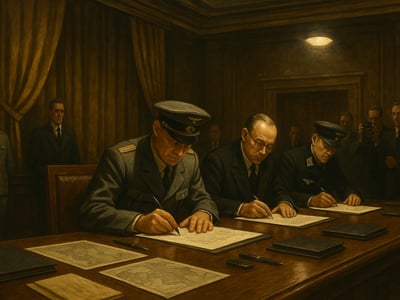
On 2 September 1945 Japanese representatives signed the Instrument of Surrender aboard USS Missouri in Tokyo Bay, turning Emperor Hirohito’s 15 August announcement into a binding state act. Foreign Minister Mamoru Shigemitsu and General Yoshijiro Umezu signed for Japan while General Douglas MacArthur presided for the Allies. The ceremony closed World War II in documentary form and opened the occupation that followed.
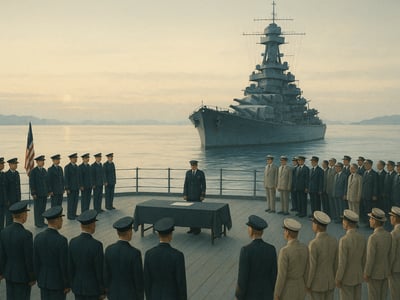
Formal signing of Japan’s surrender aboard USS Missouri, Tokyo Bay, 2 September 1945
On September 2, 1945, representatives of Japan signed the Instrument of Surrender aboard the battleship *USS Missouri* in Tokyo Bay, formally bringing World War II to its close. The ceremony came more than two weeks after Emperor Hirohito had announced, on August 15, that Japan would accept the terms of the Potsdam Declaration. That earlier announcement told the Japanese public and the wider world that the war was ending. The signing on *Missouri* turned that decision into a formal state act, witnessed and recorded in front of Allied representatives.
From an imperial broadcast to a signed instrument
The distinction mattered. An announcement of acceptance could halt fighting in practice, but governments and militaries still required a recognized legal document to establish the transfer from war to surrender. In the final weeks of August 1945, the task was to move from a moment of dramatic broadcast and political decision to a procedure that multiple Allied governments would accept as binding. Given the scale of the war, and the number of states involved in defeating Japan, the form of the ending carried unusual importance.
The ceremony took place in Tokyo Bay, a location that combined practicality and symbolism. The *USS Missouri*, an American battleship, served as the site for the proceedings. Allied personnel assembled on deck, and the event was organized under the authority of General Douglas MacArthur, serving as Supreme Commander for the Allied Powers. His role was to preside over a process that was military, diplomatic, and legal all at once.
Tokyo Bay, Missouri, and Allied authority
Japan was represented by two principal signatories. Foreign Minister Mamoru Shigemitsu signed on behalf of the Japanese government. General Yoshijiro Umezu signed for the Japanese Imperial General Headquarters. Their signatures were not ceremonial in a narrow sense; they documented acceptance by both the civil and military sides of the Japanese state. That dual representation helped address one of the central practical concerns at the end of the war: whether the surrender would be carried out across the chain of command.
On the Allied side, MacArthur presided, while representatives of the Allied powers signed in turn. Fleet Admiral Chester W. Nimitz signed as the representative of the United States. The sequence made visible that this was not simply a bilateral arrangement between two commanders. It was the formal conclusion of a conflict fought across vast regions of Asia and the Pacific and involving many governments, armed forces, and occupied territories.
Civil and military signatures for Japan
The event also marked the end of a tense transitional period. After Hirohito's August 15 broadcast, the war was not yet complete in documentary terms. Orders had to be transmitted, accepted, and enforced. A formal act of surrender had to be drafted and signed in a way that left as little ambiguity as possible. In any war, but especially in one of this scale, there was always a risk that announced acceptance might not produce full compliance everywhere. Political resistance, military refusal, or disputes over procedure could have complicated the handover. The ceremony in Tokyo Bay showed that the process had advanced to the point where those risks, while not absent, had been contained.
The Instrument of Surrender itself followed from the Potsdam Declaration, which had set out the terms that Japan was being required to accept. By signing, Japanese representatives acknowledged those terms in a form recognized by the victorious powers. In practical terms, this meant that the war's formal hostilities were over and that the next phase could begin: occupation and administration under Allied authority.
A documentary close that opened occupation
That transition would shape Japan's immediate future. The surrender ceremony did not settle every political question, nor did it erase the destruction already caused across the region. But it established the legal and institutional basis for what followed. Occupation policy, disarmament, and the management of postwar governance all depended on a clear ending to the war as a matter of state action, not only military collapse.
For observers at the time, the scene aboard *Missouri* condensed several meanings into one moment. It was the visible close of the most destructive global conflict in modern history. It was also a demonstration of how governments convert battlefield outcomes into binding agreements. The signatures, the witnesses, and the carefully staged setting all emphasized that wars end not only through force, but through documents that define obligations and authority.
Why it still matters
The signing in Tokyo Bay remains important because it shows that the end of war is often a legal process as well as a military one. Fighting may stop before the paperwork is completed, but states still rely on formal instruments to clarify who has accepted what terms, under whose authority, and with what consequences. The ceremony aboard *USS Missouri* is a clear example of that principle.
It also marked the passage from combat to occupation. After the document was signed, the Allied powers could proceed on an agreed basis with administering Japan's surrender. That made the event more than a symbolic conclusion. It was the starting point for a new political and administrative order in postwar Japan.
More broadly, the ceremony remains a reference point in the history of the postwar international system. It demonstrated the importance of treaty-based and document-based settlements in bringing hostilities to a recognized close. For historians, legal scholars, and the public, September 2, 1945 stands as a reminder that even after decisive military events, the formal ending of war still depends on acts that are written, signed, and acknowledged.
Timeline
- Potsdam Declaration sets surrender terms for Japan
- Hirohito announces acceptance of the terms
- Instrument of Surrender signed aboard USS Missouri
- Allied representatives complete the Tokyo Bay ceremony
What you uncovered
From Announcement to State Act
You didn't just… complete a historical scene; you traced the moment when an announced surrender became a binding state act marking the formal end of the war.
The gap between 15 August and 2 September shows that ending a war is not only a military fact but also a legal and administrative process. Public declarations can signal intention, yet governments still rely on signed instruments to fix responsibility, authority, and next steps. That is why this ceremony mattered beyond symbolism: it turned a political decision into an internationally recognized settlement.
The surrender instrument was signed by Mamoru Shigemitsu for the Japanese government and by Yoshijiro Umezu for the Imperial General Headquarters.
FAQ
What happened on 2 September 1945?
On 2 September 1945, Japan formally signed the Instrument of Surrender aboard the battleship USS Missouri in Tokyo Bay. The ceremony marked the end of the war's formal hostilities.
Who signed the Japanese Instrument of Surrender?
Japanese Foreign Minister Mamoru Shigemitsu signed for Japan, and General Yoshijiro Umezu signed for the Japanese Imperial General Headquarters. On the Allied side, General Douglas MacArthur presided and Fleet Admiral Chester W. Nimitz signed for the United States.
Why was the surrender signed on USS Missouri?
The ceremony was held aboard USS Missouri in Tokyo Bay as the formal setting for the Allied surrender proceedings. It took place under the authority of Supreme Commander for the Allied Powers Douglas MacArthur.
How did 15 August 1945 differ from 2 September 1945?
On 15 August 1945, Emperor Hirohito announced Japan's acceptance of the Potsdam Declaration. The 2 September ceremony was the later formal signing that documented that surrender.