
About this story
On 5 August 1914, German forces began the assault on Liège, a fortified Belgian city blocking the Schlieffen Plan advance into France. The battle opened Germany’s western campaign in World War I and showed that modern fortresses could not stop heavy siege artillery.
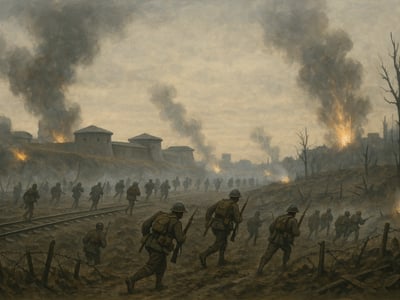
Liège's fortified defenses during the opening German assault of 5 August 1914
On 5 August 1914, German forces began their assault on Liège in eastern Belgium, one of the first major military actions on the Western Front in the opening days of the First World War. The attack came just one day after German troops crossed the Belgian frontier on 4 August, and it immediately turned questions of mobilization, planning, and treaty law into a concrete battle over roads, railways, and forts. Liège mattered not only because of its location near the German border, but because it stood across the routes needed for a rapid westward advance.
Belgian neutrality and the German plan
Belgium was a neutral state under the framework established by the 1839 Treaty of London, and the German advance violated that status. In military terms, however, German planners saw passage through Belgium as essential to the opening phase of their campaign in the west. That decision created both a diplomatic crisis and an operational problem. If the advance was meant to move quickly, then any delay at a fortified bottleneck could carry consequences far beyond the city itself.
Liège was not an open road. Its defenses formed the Fortified Position of Liège, a ring of modern forts designed to protect the approaches to the city. These works guarded the main lines of communication through eastern Belgium. The Belgian defense was commanded by General Gérard Leman, who was responsible for organizing resistance with limited means against a far larger invading army. His task was not simply to hold ground in the abstract, but to make the forts, terrain, and transport routes impose time costs on an enemy whose plan depended heavily on speed.
Fortified Liège under assault
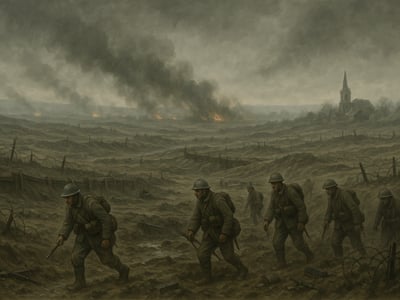
The German assault on 5 August was led by forces under General Otto von Emmich. The opening attacks began before the heaviest siege artillery had arrived, which meant German troops first had to confront the defenses more directly than later accounts of the battle sometimes suggest. This was a risky choice. German commanders were trying to force passage quickly rather than wait for every element of a slower, more methodical siege. In that sense, the battle at Liège exposed a central tension of the war's opening week: planning favored momentum, but the reality on the ground imposed friction.
Early resistance was stronger than German commanders had expected. The Belgian forts, along with field defenses and local military resistance, complicated the first assaults. Liège did not represent a large state confronting a larger one on equal terms; it represented a smaller neutral country trying to slow a major power by using fixed defenses and local knowledge to maximum effect. For Germany, the obstacle was not simply military opposition, but the danger that schedules could begin slipping at the very start of the campaign.
Unexpected resistance and early delays
That concern helps explain why Liège acquired significance so quickly. In August 1914, rail movement, timetables, and sequencing mattered enormously to military operations. Troops, supplies, and follow-on movements were arranged according to strict assumptions about how long each phase would take. A fortified city blocking key approaches could therefore become more than a local battle. It could affect the pace at which forces entered Belgium and moved toward France.
The opening struggle around Liège also brought individual names into wider notice. Gérard Leman became associated with Belgian resistance in the city's defenses. On the German side, Erich Ludendorff emerged prominently during the fighting, at a moment when aggressive action and rapid decisions were rewarded within the invading command structure. Belgium's King Albert I, meanwhile, became an important national figure in the decision to resist rather than accept passage without a fight. These figures would all be remembered differently in later national histories, but in early August 1914 they were tied together by one immediate question: whether Liège would fall quickly enough to preserve the momentum of Germany's western offensive.
Broken neutrality and wider consequences
The first days of the battle showed that the answer was not simple. German forces did make progress, and the invasion was not stopped at Liège. But the resistance disrupted expectations. Fort de Barchon, one of the Liège forts, was captured by German forces on 8 August 1914, illustrating both that the defenses were vulnerable and that reducing them took time and effort. As heavier siege artillery arrived, the balance shifted more decisively against the Belgian positions. Yet by then Liège had already established its place in the story of the war's opening: not as a final barrier, but as an early test of whether a carefully timed campaign could remain on schedule once it encountered determined resistance.
The attack also had political consequences beyond the battlefield. The violation of Belgian neutrality was not a side issue but a central international fact of the invasion. It shaped how the conflict was understood abroad and contributed to the broader alignment of powers in the opening month of the war. Historians in Belgium, Germany, Britain, and elsewhere have interpreted the legal, political, and strategic meaning of that decision in different ways, but there is broad agreement that the move into Belgium transformed the war's diplomatic context as well as its military one.
Why it still matters
Liège is still studied because it sits at the intersection of military planning, international law, and political consequence. The battle showed how quickly abstract commitments could become urgent realities once armies moved. Belgian neutrality had been recognized by treaty, but the events of early August 1914 demonstrated that legal status alone did not protect territory when great powers judged other priorities more pressing.
The opening assault also remains a clear example of the gap between war plans on paper and operations in practice. On maps and in schedules, movement could appear straightforward. On the ground, forts, transport chokepoints, local resistance, and uncertainty slowed events. Liège therefore helps explain why the opening campaigns of wars often depart from planners' expectations even before larger strategic patterns have fully emerged.
Finally, the battle continues to matter because it highlights how a relatively short delay at a key position can have effects out of proportion to its size. Liège did not prevent the invasion of Belgium, but it imposed friction at a critical moment and gave the opening days of the war a different character than a purely unopposed advance would have done. For that reason, 5 August 1914 is remembered not only as the beginning of an assault on a fortified city, but as one of the first demonstrations that the war in Europe would not unfold exactly as its planners imagined.
Timeline
- Treaty of London guarantees Belgian neutrality
- German invasion of Belgium begins
- Assault on Liège begins
- Fort de Barchon captured
What you uncovered
Timetables, Treaties, and Forts
You didn't just… complete a puzzle; you traced the moment when a timetable-driven invasion met both the legal reality of Belgian neutrality and the physical barrier of Liège's forts.
Liège mattered not only because it stood in the way, but because it showed how much modern war planning depended on assumptions holding together at once. A route that looked efficient on a map was also a legal boundary, a transport corridor, and a defended landscape. The opening assault revealed how even a short disruption at such a point could carry both military and political consequences beyond the immediate battlefield.
The Liège defenses in August 1914 were commanded by Belgian General Gérard Leman.
FAQ
What happened at Liège on 5 August 1914?
On 5 August 1914, German forces began the assault on the Fortified Position of Liège in eastern Belgium. The attack was part of Germany's opening westward campaign at the start of World War I.
Who defended Liège during the German assault?
The defenses of Liège were commanded by Belgian General Gérard Leman. His forces relied on the ring of forts around the city to resist the advance.
Why was Liège strategically important in 1914?
Liège blocked the main rail and road routes needed for a rapid German advance into Belgium and France. German commanders chose to force passage through Belgium despite the city's defenses and Belgium's neutrality.
How did the attack on Liège affect Belgian neutrality?
The German advance violated Belgian neutrality, which had been recognized and guaranteed by the 1839 Treaty of London. The fighting brought combat into a neutral state protected by international treaty obligations.
What happened in the first days of the Battle of Liège?
German troops crossed the Belgian frontier on 4 August 1914, and Fort de Barchon was captured on 8 August 1914. The initial attacks met strong resistance and delayed the opening campaign.