
About this story
On 27 September 1940 Germany, Italy, and Japan signed the Tripartite Pact in Berlin. Joachim von Ribbentrop, Galeazzo Ciano, and Saburō Kurusu put names to a text that framed spheres of influence and, in Article 3, a warning to outside powers. Hungary joined on 20 November 1940; Romania on 23 November.
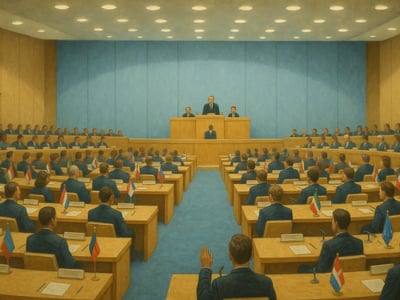
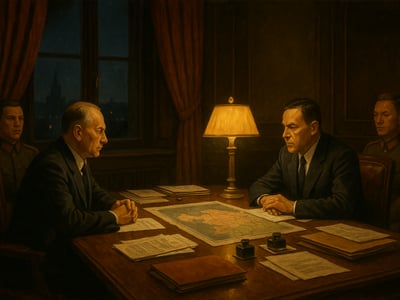
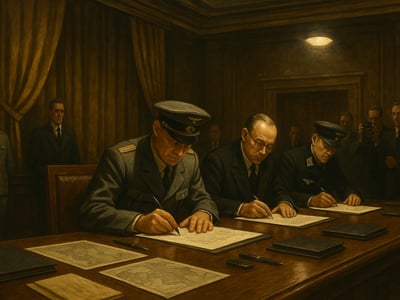
Tripartite Pact signing in Berlin, where Germany, Italy, and Japan formalized the treaty in 1940.
On September 27, 1940, Germany, Italy, and Japan signed the Tripartite Pact in Berlin, giving formal treaty shape to a political alignment that had already been taking form across separate war zones. The agreement was signed at the Reich Chancellery by German Foreign Minister Joachim von Ribbentrop, Italian Foreign Minister Galeazzo Ciano, and Japanese ambassador Saburō Kurusu. Although the three states were already engaged in conflict or expansion in different regions, they had not previously bound those parallel efforts together in a single public framework.
Parallel wars, one diplomatic frame
The moment mattered because it linked the European war and the conflict in East Asia at the level of diplomacy. Germany and Italy were already closely associated through the Pact of Steel signed in 1939. Japan, meanwhile, had been pursuing expansion in China before 1940 and was operating in a different strategic environment, with different military priorities and no unified command structure with the European powers. The Tripartite Pact did not erase those differences. Instead, it announced that the three governments saw value in declaring a common political position despite them.
Its wording made that position clear. The pact stated that Germany and Italy would recognize Japanese leadership in the establishment of a new order in East Asia, while Japan would recognize the leadership roles of Germany and Italy in Europe. In that sense, the agreement was not simply a promise of friendship. It was also a statement about spheres of influence and about the order the signatories claimed the right to shape.
Spheres of influence in the text
Even so, the most closely watched part of the pact was Article 3. That clause stated that the parties would assist one another if one of them was attacked by a power not then involved in the European war or the Sino-Japanese conflict. The phrasing was careful. It did not simply describe the wars already under way. It looked outward, toward governments that had not yet entered those conflicts. Because of that, the article functioned as more than routine alliance language. It was a public signal aimed at influencing the calculations of outside powers.
That signal was important partly because the three governments had different immediate concerns. Germany was focused on the war in Europe. Italy was tied to that European struggle but had its own military and political limitations. Japan was pursuing objectives in East Asia and watching developments involving the United States and other powers with interests in the Pacific. Reaching treaty language acceptable to all three therefore required a formula broad enough to unite them politically without pretending that they had become a fully integrated military coalition.
Article 3 as a warning
The signing ceremony in Berlin helped present that formula as a display of unity. Ribbentrop, Ciano, and Kurusu were not merely exchanging diplomatic courtesies. By putting their names to the agreement in public, they committed their governments to a text that was meant to be read abroad as well as at home. The pact linked three major belligerent states in a way that could be understood immediately by diplomats, journalists, and military planners outside the alliance.
Yet the pact also exposed a limit that would remain important throughout the war: formal alignment is not the same as operational coordination. The agreement created a recognizable treaty framework, but it did not produce a single command system or harmonize the distinct priorities of Berlin, Rome, and Tokyo. That gap between legal commitment and practical coordination was present from the start. The treaty gave the alliance a clearer public identity, but it did not solve the deeper problem of conducting war across widely separated theaters with different political aims.
Alignment without a single command
Its wider diplomatic meaning became visible soon afterward, as additional states including Hungary, Romania, and Slovakia joined the pact later in 1940. Those accessions expanded the treaty's formal reach, but the original signing in Berlin remained the central act. It was the point at which the major Axis powers in Europe and Asia publicly defined their association in a common document.
Why it still matters
The Tripartite Pact still matters because it offers a clear example of how treaty language can be used not only to coordinate allies but also to influence states outside an alliance. Article 3 is especially useful for understanding deterrence signaling: a clause can be written to shape the expectations of governments that are not party to the agreement, by raising the apparent cost of intervention.
It also helps explain how separate regional wars can become politically linked before they are fully joined in military practice. In September 1940, the European war and the conflict in East Asia were not identical struggles under one command, but the pact drew them into a shared diplomatic frame. That makes it a useful case for studying how alliances can connect distant theaters without removing the differences between them.
Finally, the pact remains instructive because it shows the distance that can exist between formal promises and real capabilities. The signatories could present a united front in Berlin, and the text could send a warning abroad, but the practical problems of coordination did not disappear. For historians and students of international relations, that combination of public commitment and built-in limitation is one reason the document continues to be closely studied.
Seen in that light, the Tripartite Pact was both a declaration of alignment and a test of what such declarations could actually achieve. Its signing on September 27, 1940, did not merge three wars into one command structure, but it did reshape how those wars were presented to the world.
Timeline
- Pact of Steel signed
- Tripartite Pact signed in Berlin
- Hungary joins the pact
- Romania joins the pact
What you uncovered
A Treaty as a Signal
You didn't just… complete a date puzzle; you traced how a formal treaty was used to send a diplomatic warning beyond the states that signed it.
What made the pact strategically significant was not only that Germany, Italy, and Japan signed it, but how Article 3 was framed for outside audiences. Its language turned the treaty into a public signal meant to influence calculations in capitals that were not yet directly involved in those wars. That makes it a useful example of how alliances can serve as instruments of deterrence even when military coordination among the partners remains limited.
The Tripartite Pact was signed in Berlin on 27 September 1940 by Joachim von Ribbentrop for Germany, Galeazzo Ciano for Italy, and Saburō Kurusu for Japan.
FAQ
What happened on 27 September 1940 in Berlin?
On 27 September 1940, Germany, Italy, and Japan signed the Tripartite Pact in Berlin. It was a formal treaty linking their wartime positions.
Who signed the Tripartite Pact for each country?
German Foreign Minister Joachim von Ribbentrop signed for Germany, Italian Foreign Minister Galeazzo Ciano signed for Italy, and Japanese ambassador Saburō Kurusu signed for Japan.
What did Article 3 of the Tripartite Pact say?
Article 3 stated that the parties would assist one another if attacked by a power not then involved in the European war or the Sino-Japanese conflict. It was the pact’s main mutual-assistance clause.
Where was the Tripartite Pact signed?
The Tripartite Pact was signed in Berlin, Germany, at the Reich Chancellery.