
About this story
On 7 October 1944 Sonderkommando prisoners at Auschwitz II-Birkenau used gunpowder smuggled from the Union munitions factory to damage Crematorium IV, set it on fire, and attack SS personnel. The revolt was quickly suppressed and many prisoners were killed. On 6 January 1945 Roza Robota, Ala Gertner, Estusia Wajcblum, and Regina Safirsztajn, linked in postwar accounts to that smuggling network, were publicly hanged at Auschwitz.
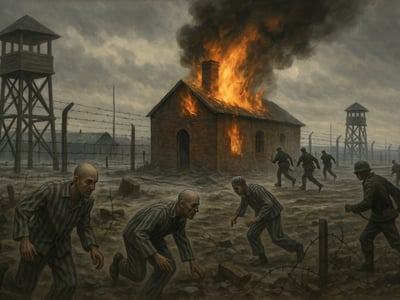
Auschwitz II-Birkenau after the 7 October 1944 Sonderkommando uprising.
On October 7, 1944, prisoners in the Sonderkommando at Auschwitz II-Birkenau carried out an uprising centered on Crematorium IV in the Birkenau camp complex near Oświęcim in German-occupied Poland. Using explosives made from smuggled gunpowder, they damaged the building, set it on fire, and attacked SS personnel before the revolt was suppressed. Many prisoners were killed during the action and in the manhunt that followed.
Forced labor at the crematoria
The revolt took place inside one of the most tightly controlled parts of the Nazi camp system. The Sonderkommando were prisoner labor units forced to work in and around the crematoria and gas chambers. Their tasks were imposed under coercion and within a system designed for mass murder. Because these prisoners had direct knowledge of the extermination process, they lived under constant surveillance and faced an especially precarious existence. Historians have documented that members of these units understood that survival was uncertain and that they could be killed or replaced at any time.
That setting shaped the significance of the uprising. Any effort to resist in Auschwitz-Birkenau faced immediate obstacles: armed guards, fences, restricted movement, informers, and the near impossibility of obtaining weapons. Even small acts of planning could bring execution. Yet under those conditions, prisoners began organizing. The aim was not based on a realistic expectation of defeating the camp authorities outright. Rather, it was an attempt to strike back, damage the killing machinery, and seize a brief moment of agency within a system built to deny it.
Gunpowder from the Union factory
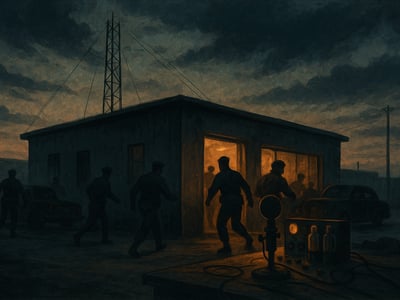
A crucial part of that effort depended on a clandestine network inside the camp. Small amounts of gunpowder were smuggled from the Union munitions factory at Auschwitz, where prisoners were used as forced laborers. According to camp investigations, survivor testimony, and later historical research, women working within that labor system helped pass the material through prisoner contacts until it reached members of the Sonderkommando. The process was slow and dangerous. The quantities were small, discovery could have meant immediate death, and the network relied on trust across separate work details and camp sectors.
Four names are especially associated with that smuggling network in postwar accounts and memorial history: Roza Robota, Ala Gertner, Estusia Wajcblum, and Regina Safirsztajn. Their exact individual roles are not always described in identical terms across sources, but they are consistently remembered as part of the prisoner network that helped move gunpowder to the men preparing the revolt. Their involvement shows how resistance at Auschwitz could depend not on a single dramatic act, but on repeated, concealed decisions made by prisoners under extraordinary pressure.
Crematorium IV is set alight
The uprising broke out around Crematorium IV. Members of the Sonderkommando used the smuggled material to damage the building and set it on fire. They also attacked SS personnel with the limited means available to them. For a short time, the action disrupted the operation of that part of the camp. Crematorium IV was damaged in the revolt and did not return to operation afterward, making the uprising one of the few instances in which prisoners at Auschwitz physically damaged the extermination infrastructure itself.
The revolt did not spread into a successful mass escape or a wider takeover of the camp. SS forces and guards responded quickly, isolating the area and suppressing the action. Many participants were killed during the fighting or immediately afterward. Sources differ on the total number of prisoners killed that day and in the ensuing manhunt, and historians are careful about exact figures. What is clear is that the repression was swift and severe. The camp authorities then sought to identify those who had supplied the gunpowder and those linked to the planning.
The hangings of 6 January 1945
The aftermath lasted for months. Investigations, interrogations, and punishments followed the revolt. On January 6, 1945, as the Nazi camp system was already nearing collapse in the face of the advancing Soviet army, Roza Robota, Ala Gertner, Estusia Wajcblum, and Regina Safirsztajn were publicly hanged at Auschwitz. Their execution connected the October revolt to the final weeks of the camp's operation and underscored how seriously the authorities treated even limited organized resistance.
The timing of the uprising also matters. In 1944, Auschwitz was under immense pressure from the deportation and murder of Hungarian Jews, which intensified activity at Birkenau. The camp's labor systems, extermination facilities, and prisoner movements were all part of a larger machinery of destruction. The revolt emerged from within that machinery itself. It was possible only because prisoners understood the camp's routines in detail and used the narrow opportunities created by labor assignments and personal contact to move forbidden materials across heavily controlled spaces.
Why it still matters
The Sonderkommando revolt remains important because it is a documented case of organized resistance inside the Nazi camp system, including within an extermination site built to make resistance nearly impossible. It does not erase the extreme asymmetry of power between prisoners and their captors, nor does it simplify the coercion under which the Sonderkommando lived. Instead, it helps historians explain how prisoner networks functioned within Auschwitz and how acts of resistance could emerge even under relentless surveillance.
The event is also significant because of how it is known. Its history has been reconstructed through survivor testimony, camp records, postwar investigations, and the work of Holocaust museums and archives. That layered record matters in itself. It shows how historians piece together events when the evidence is fragmented, some details remain disputed, and many participants were killed.
Finally, the revolt helps place Auschwitz-Birkenau in fuller context. It connects the extermination process, the camp's forced-labor economy, and the social networks among prisoners. Remembering the uprising does not change the overall reality of Nazi control at Auschwitz, but it does preserve evidence that prisoners observed, planned, transmitted information and materials, and, in one brief and costly moment, struck directly at the camp's killing apparatus.
Timeline
- Sonderkommando prisoners set fire to Crematorium IV
- SS forces suppress the revolt
- Robota, Gertner, Wajcblum, and Safirsztajn are hanged
What you uncovered
Resistance Within the System
You didn't just complete a puzzle—you traced a moment when prisoners under near-total control still managed to organize across the structures imposed on them.
What makes this uprising historically revealing is not only the act itself, but the system it exposed. Resistance here depended on work assignments, hidden exchanges, and coordination between prisoners who were deliberately isolated and watched. That shows how extermination, forced labor, and camp administration were tightly linked—and how even small breaks in that system could create narrow possibilities for action.
Crematorium IV at Birkenau was damaged during the revolt on 1944-10-07 and did not return to operation afterward.
FAQ
What happened at Auschwitz-Birkenau on 7 October 1944?
On 7 October 1944, members of the Sonderkommando at Auschwitz II-Birkenau revolted and set Crematorium IV on fire. They used explosives made from smuggled gunpowder, and the uprising was later suppressed.
What was the Sonderkommando at Auschwitz-Birkenau?
The Sonderkommando were prisoners at Auschwitz II-Birkenau who were forced to work in and around the crematoria. They lived under armed guard and constant surveillance inside the camp system.
How was gunpowder brought to the prisoners involved in the revolt?
The gunpowder was smuggled from the Union munitions factory inside Auschwitz through a prisoner network. That network included women later identified in camp investigations and postwar accounts.
Who were the women executed after the uprising?
After camp authorities investigated the revolt, Roza Robota, Ala Gertner, Estusia Wajcblum, and Regina Safirsztajn were publicly hanged at Auschwitz on 6 January 1945. They were punished in connection with the smuggling network.
Why is the Sonderkommando uprising historically significant?
It is a documented case of organized resistance inside the Nazi camp system under extreme conditions. It also helps show how Auschwitz’s extermination facilities, forced labor, and prisoner networks were connected.