
About this story
On 29 September 1938 Germany, Italy, Britain, and France concluded the Munich Agreement, transferring Czechoslovakia’s Sudetenland to Germany. Hitler, Mussolini, Chamberlain, and Daladier signed; Czechoslovak representatives did not. German occupation of the specified borderlands began on 1 October. In March 1939 Germany occupied Prague, showing that the territorial settlement had not held.
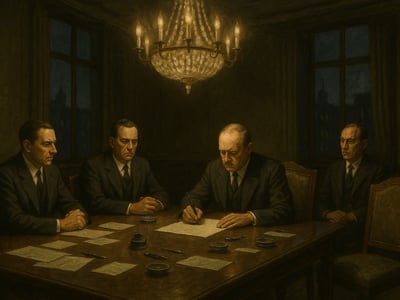
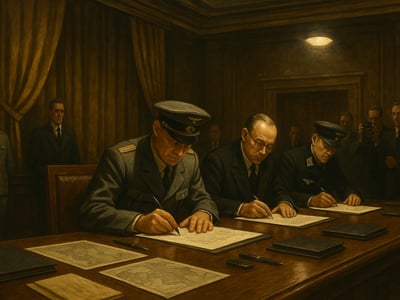
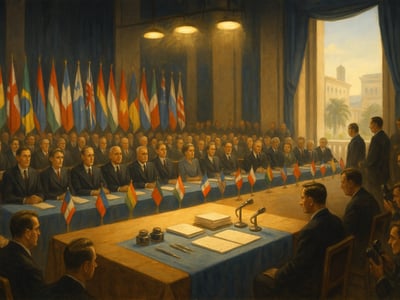
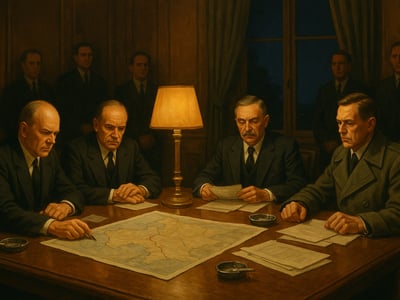
Munich conference delegates concluded the 1938 agreement on the Sudetenland.
On 29 September 1938, the leaders of Germany, Italy, Great Britain, and France gathered in Munich, Germany, to address a crisis that had been building across Central Europe. By the end of the night of 29-30 September, Adolf Hitler, Benito Mussolini, Neville Chamberlain, and Édouard Daladier had concluded what became known as the Munich Agreement. Its immediate effect was to authorize the transfer of Czechoslovakia's Sudeten borderlands to Germany, with German occupation of specified areas to begin on 1 October. Czechoslovakia, although directly affected by the decision, was not a signatory to the agreement reached there.
A crisis over the Sudetenland
The dispute centered on the Sudetenland, a frontier region of Czechoslovakia with a large ethnic German population. But the issue was not only about ethnicity or local administration. The borderlands also mattered strategically. They included fortified frontier zones and formed part of the defensive system of the Czechoslovak state. Any decision about their future therefore carried consequences far beyond the immediate map. It affected military planning, alliances, and the balance of power in Europe.
The Munich meeting did not arise suddenly. Earlier in 1938, Germany had already expanded through the Anschluss with Austria in March. That same year, pressure over the Sudeten question intensified. German demands concerning the territory escalated through a series of diplomatic encounters in September, including Hitler's meetings with Chamberlain at Berchtesgaden on 15 September and at Bad Godesberg on 22-23 September. Each stage increased uncertainty about whether negotiations would succeed or whether Europe was moving toward a wider armed conflict.
Meetings before the conference
By the time the Munich conference opened, the immediate tension was acute. Governments were trying to avoid war while facing mobilization, threats, and rapidly changing demands. The central decision made by British and French leaders was to continue negotiating directly with Hitler, with Mussolini acting as one of the principal participants, rather than force the crisis into military confrontation. This was diplomacy under pressure, conducted in the shadow of possible war.
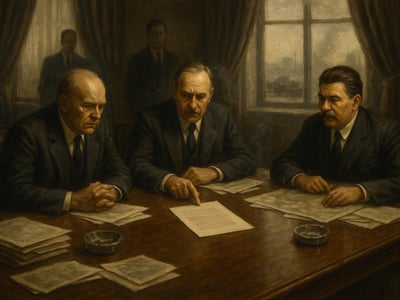
Yet the structure of the conference was as important as its outcome. Czechoslovak representatives were present in Munich, but they did not sign the settlement concluded by Germany, Italy, Great Britain, and France. The state whose frontiers were to be altered was therefore not among the powers that finalized the terms. That procedural fact became one of the defining features of the event in later historical discussion.
A settlement Czechoslovakia did not sign
The agreement itself provided for the German occupation of designated Sudeten areas beginning on 1 October 1938. In practical terms, it redrew borders in Central Europe through an international conference dominated by larger powers. For supporters of the settlement at the time, the arrangement appeared to offer a way to contain a dangerous crisis without immediate war. For critics, it demonstrated how a smaller state could be pressed aside when stronger neighbors and major powers decided that rapid compromise was preferable to confrontation.
The conference has often been associated with the wider policy later described as appeasement, but the event also needs to be understood in its own sequence of decisions. Leaders in London and Paris were operating in a climate shaped by the memory of the First World War, uncertainty about military readiness, and concern that a breakdown in talks might produce general conflict. None of that changed the direct effect of the agreement on Czechoslovakia's territory, but it helps explain why the settlement was made in the form it was.
Borders changed, then Prague
Events moved quickly after Munich. German occupation of the specified Sudeten territories began on 1 October, as the agreement had set out. What had been negotiated in a conference room was soon translated into changes on the ground. The settlement did not end the instability surrounding Czechoslovakia. In March 1939, Germany occupied Prague, a development that made clear that the territorial concessions of late 1938 had not resolved the broader European crisis.
Why it still matters
The Munich Agreement remains a common reference point in the study of crisis diplomacy because it brings together several issues at once: negotiations under military pressure, the redrawing of borders, and the unequal position of states at the conference table. It is frequently examined not only for what was decided, but for how the decision was made.
It also continues to matter because it shows how minority claims, strategic calculations, and great-power bargaining can become intertwined. The Sudeten question was presented in terms of national self-determination, but the settlement also involved military geography, alliance politics, and the authority of outside powers to reshape another country's frontiers. That combination makes the agreement important in the history of interwar Europe.
More broadly, Munich is still studied as part of the limits of the European security arrangements of the 1930s. The conference did not simply produce a document; it exposed weaknesses in the systems that were supposed to preserve stability after the First World War. For that reason, the agreement endures as a historical marker of how international negotiations can aim to prevent war in the short term while still leaving deeper conflicts unresolved.
Timeline
- Germany annexes Austria in the Anschluss
- Chamberlain meets Hitler at Berchtesgaden
- Munich Agreement concluded
- German occupation of the Sudetenland begins
- German forces occupy Prague
What you uncovered
Diplomacy Without the Main Party
You didn't just… complete a puzzle; you traced a diplomatic moment in which decisions about a state's borders were finalized without that state becoming a signatory to the settlement.
One of the lasting meanings of the Munich Agreement lies not only in what territory changed hands, but in how the decision was organized. The conference placed major powers at the center while the state most directly affected was kept outside the final act of agreement, turning procedure into part of the outcome itself. That is why Munich still matters in discussions of crisis diplomacy: it shows how negotiation formats can shape power just as much as formal terms do.
The agreement called for German occupation of specified Sudeten areas beginning on 1 October 1938.
FAQ
What happened on 29 September 1938 in Munich?
On 29 September 1938, Adolf Hitler, Neville Chamberlain, Édouard Daladier, and Benito Mussolini met in Munich to negotiate over Czechoslovakia's frontier regions. The Munich Agreement was signed there during the night of 29-30 September 1938.
Which countries signed the Munich Agreement?
The agreement was concluded by Germany, Italy, Great Britain, and France. Czechoslovakia was not one of the signatories.
Was Czechoslovakia represented at the Munich conference?
Yes. Czechoslovak representatives were present in Munich, but they did not sign the agreement.
What did the Munich Agreement require?
The text called for German occupation of specified Sudeten areas beginning on 1 October 1938. It concerned Czechoslovakia's Sudeten borderlands, a fortified frontier region with a large ethnic German population.