
About this story
On 17 October 2002 ESA launched INTEGRAL, the International Gamma-Ray Astrophysics Laboratory, on a Proton-K from Baikonur. Earth’s atmosphere blocks gamma rays, so the observatory had to fly above it. The mission sat in the Horizon 2000 programme and was confirmed in June 1993. Operations ran through ESOC in Darmstadt, and routine science began on 17 December 2002.
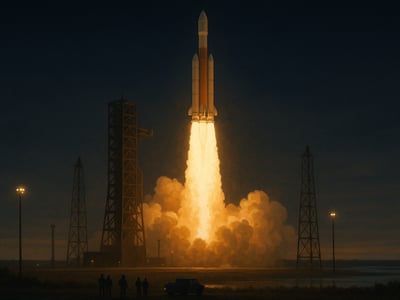
ESA's INTEGRAL observatory launched from Baikonur on 17 October 2002.
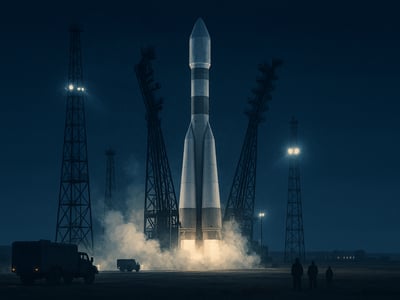
On 17 October 2002, the European Space Agency sent a new observatory into space from the Baikonur Cosmodrome in Kazakhstan. Launched aboard a Proton-K rocket with a Block DM upper stage, INTEGRAL was built to study some of the most energetic phenomena in the universe: gamma rays and X-rays from exploding stars, dense stellar remnants, and regions around black holes. Its full name, the International Gamma-Ray Astrophysics Laboratory, reflected both its scientific purpose and the international planning behind it.
Gamma rays the ground cannot see
The launch was an important step in a field of astronomy that cannot be pursued from the ground alone. Earth's atmosphere protects life by absorbing gamma rays and much of the high-energy radiation coming from space, but that same shield also blocks astronomers from observing these wavelengths directly with ordinary telescopes on the surface. To study gamma-ray bursts, supernova remnants, neutron stars, and black holes, instruments have to be carried above the atmosphere. That requirement makes every such mission dependent not only on scientific design, but on the success of a launch and the careful activation of complex equipment in orbit.
INTEGRAL had been prepared within ESA's Horizon 2000 science programme, a long-term framework that organized major European space-science missions. Under the leadership of ESA science director Roger-Maurice Bonnet, Horizon 2000 helped define a set of ambitious observatories aimed at different parts of the electromagnetic spectrum. In that broader plan, INTEGRAL represented ESA's commitment to high-energy astrophysics, complementing other missions by focusing on the violent and short-lived events that often reveal the most extreme physical conditions in the cosmos.
Building an observatory for that light
That ambition came with practical challenges. A gamma-ray observatory is not simply a camera pointed at the sky. High-energy photons are difficult to detect and to locate precisely, so spacecraft in this field often carry multiple instruments with different strengths. INTEGRAL was equipped with four principal instruments: the spectrometer SPI, the imager IBIS, the X-ray monitor JEM-X, and the optical monitoring camera OMC. Together, they were designed to let scientists compare different signals from the same source. One instrument could help determine where an event occurred, another could analyze its energy in detail, while the X-ray and optical systems added further context.
The launch itself marked only the beginning. Sending a heavy scientific observatory into its intended orbit required coordinated performance from the rocket's stages and from the spacecraft after separation. Any failure in ascent, any error in orbital injection, or any problem during the first phase of spacecraft operations could have sharply limited the mission or ended it altogether. For missions built around specialized detectors, the period after launch is especially important: the observatory must stabilize, establish communications, and begin a carefully sequenced commissioning process before routine science can begin.
Operations after liftoff
Once INTEGRAL was on its way, spacecraft operations were handled through ESA's European Space Operations Centre in Darmstadt, Germany. From there, controllers monitored the spacecraft, checked its systems, and oversaw the early stages of commissioning. These first steps are less visible than the launch itself, but they are where a space mission begins to prove whether years of planning will turn into dependable scientific work. Instruments such as SPI, IBIS, JEM-X, and OMC had to be brought into operation methodically so that the observatory could start making precise measurements.
The mission also reflected the international character of modern space science. Although INTEGRAL was an ESA mission, it depended on partnerships in planning, launch services, and operations. The spacecraft was launched from Baikonur, a site with a long history in spaceflight, while ESA's scientific and technical institutions in places such as Noordwijk in the Netherlands and Darmstadt in Germany formed part of the wider framework that supported the project. Such missions are often remembered for the moment of liftoff, but they are really the product of many interconnected systems: research teams, engineering centres, mission planners, launch providers, and operations specialists.
A sky of bursts and remnants
INTEGRAL's scientific role was to watch a universe that often appears only in flashes, bursts, and energetic outflows. High-energy astronomy focuses on places where matter is accelerated, compressed, or heated to extraordinary levels. Gamma-ray bursts can briefly outshine entire galaxies; supernova remnants preserve traces of stellar explosions; neutron stars compress stellar mass into extremely small volumes; and black holes shape their surroundings through gravity and energetic emissions. By targeting these sources, INTEGRAL joined a line of observatories aimed not at the calm, familiar night sky, but at cosmic events that reveal extreme physics.
Why it still matters
INTEGRAL still matters because it illustrates how space agencies build observatories for very specific scientific questions and then support them through long operational lifetimes. Not every mission is meant to produce broad images for the public or survey the entire sky in the same way. Some, like INTEGRAL, are designed to look at a narrower but essential part of the spectrum, where understanding depends on sustained observation and specialized detectors.
The spacecraft also showed the value of combining several instruments on one platform. By carrying a spectrometer, an imager, an X-ray monitor, and an optical camera, INTEGRAL was built to study high-energy events from more than one observational angle. That approach remains important in astrophysics, where scientists often want to connect timing, location, energy, and counterpart signals when interpreting a source.
Finally, the mission remains a useful example of Europe's role in multinational space science. From its place in the Horizon 2000 programme to its launch partnership and operations from Darmstadt, INTEGRAL demonstrated how long-term planning can turn a specialized scientific goal into a durable research mission. Its launch in 2002 was not just a single technical success; it was part of a larger effort to ensure that Europe had a continuing presence in the study of the high-energy universe.
Seen from that perspective, the significance of INTEGRAL lies not only in one liftoff from Baikonur, but in the infrastructure and commitment required to keep a difficult branch of astronomy open. Missions like it expand what can be observed, and in doing so they widen the range of questions scientists are able to ask about the universe.
Timeline
- INTEGRAL confirmed as a Horizon 2000 medium mission
- Proton launch of INTEGRAL from Baikonur
- Routine science operations begin
What you uncovered
Reading the high-energy sky
You didn't just complete a puzzle; you traced the start of a mission built to catch forms of cosmic radiation that cannot be studied the same way from the ground.
INTEGRAL reflects a basic constraint of high-energy astronomy: much of the radiation from gamma-ray and X-ray sources is absorbed by Earth's atmosphere, so the observatory itself has to go into space. Its design also shows that studying violent cosmic events is rarely about a single signal, because combining gamma-ray, X-ray, and optical observations helps scientists compare different parts of the same event. That multi-instrument approach made the mission part of a broader research infrastructure rather than a one-purpose detector.
INTEGRAL carried four principal instruments: the spectrometer SPI, the imager IBIS, the X-ray monitor JEM-X, and the optical monitoring camera OMC.
FAQ
When did ESA launch INTEGRAL?
ESA launched INTEGRAL on 2002-10-17. The observatory lifted off from the Baikonur Cosmodrome in Kazakhstan aboard a Proton-K rocket with a Block DM upper stage.
What does INTEGRAL stand for?
INTEGRAL stands for International Gamma-Ray Astrophysics Laboratory. It was the name of ESA's space observatory for high-energy astronomy.
Where was INTEGRAL launched from?
INTEGRAL launched from the Baikonur Cosmodrome in Kazakhstan. After launch, operations were handled through ESA's European Space Operations Centre in Darmstadt, Germany.
What did INTEGRAL observe in space?
INTEGRAL was designed to observe gamma rays, X-rays, and visible light from high-energy astronomical sources. These included gamma-ray bursts, supernova remnants, neutron stars, and black holes.