
About this story
On 23 September 1846 Johann Gottfried Galle and Heinrich d'Arrest confirmed Neptune at the Berlin Observatory, using a predicted position in Urbain Le Verrier's letter of 18 September. The object was missing from their star chart. The find showed a planet inferred from Uranus's orbit could be observed, later prompting a priority debate with John Couch Adams.
Neptune’s 23 September 1846 confirmation at the Berlin Observatory in Berlin.
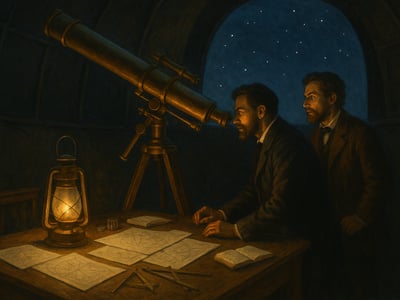
On 23 September 1846, at the Berlin Observatory in Prussia, an astronomical prediction became an observation. Johann Gottfried Galle, working with Heinrich d'Arrest, pointed a telescope toward a position in the sky that the French mathematician Urbain Le Verrier had recently calculated in a letter. Near that predicted location, they found an object that was not marked on the star chart they were using. It was soon recognized as Neptune, a major planet beyond Uranus.
A planet inferred from Uranus
The event quickly became one of the most famous episodes in the history of astronomy because it joined two different kinds of scientific work. One was theoretical: the attempt to explain why Uranus did not seem to move exactly as expected. The other was observational: the practical business of comparing what a telescope showed with the stars already recorded on a chart. On that September night in Berlin, those two lines of work met with unusual speed.
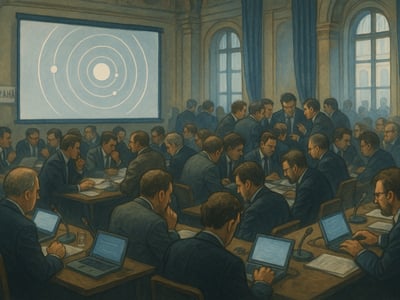
The background lay in the study of Uranus, whose orbit had raised questions among astronomers. Small irregularities suggested that another body might be affecting its motion. Rather than treating those discrepancies as mere errors, Le Verrier used them as the basis for a mathematical argument. If an unseen planet existed beyond Uranus, its gravity could help account for the deviations. From there, the problem was not only to imagine such a planet but to estimate where it should be found.
A letter from Le Verrier
Le Verrier sent Galle a letter dated 18 September 1846 with a predicted position for this suspected planet. That letter gave the Berlin astronomers something unusually specific: not a vague suggestion that a planet might exist, but a practical place to look. Even so, a prediction on paper was not enough. The sky contained countless points of light, and the task was to determine whether one of them was a known star or something else.
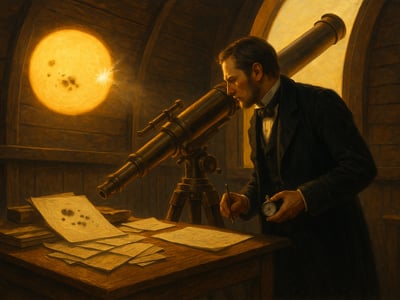
This is where the Berlin Observatory's working methods mattered. Nineteenth-century astronomy depended on instruments, careful record-keeping, and reliable star catalogs. Heinrich d'Arrest, then still young, played an important role by suggesting the use of the Berlin Academy star chart to compare the telescopic field with the printed record. If an object appeared in the telescope but not on the chart, it would stand out as a promising candidate.
Chart, telescope, and recognition
That was the concrete challenge on the night of 23 September. Galle and d'Arrest had to test Le Verrier's position promptly and accurately enough to separate a possible planet from the ordinary background of stars. If the calculation were too far off, or if the observers failed to notice the right point of light, the prediction might remain unconfirmed. Instead, they found an object very close to the calculated position, and the chart comparison showed that it was not cataloged as a fixed star.
The importance of that moment was not that Neptune had never before entered a telescope's field of view. Later historical work showed that the planet had been seen earlier without being recognized for what it was. What happened in Berlin was different: an object was observed and identified in the context of a prediction that it should be there. Recognition, not mere visibility, made the observation decisive.
Credit, theory, and a wider solar system
News of the discovery spread quickly through the scientific world, and with it came discussion over credit. Le Verrier's calculations had led directly to the search in Berlin. Galle made the observation, and d'Arrest's chart comparison was crucial to recognizing the object. At the same time, British discussions soon drew attention to John Couch Adams, who had also made calculations related to a possible outer planet. Those questions of priority have remained part of the story ever since, but they do not alter the basic fact of what happened on 23 September: an unseen planet predicted from its effects was observationally confirmed.
The episode also enlarged the known solar system in a dramatic way. For earlier generations, planets had been bodies known by direct observation, later interpreted through theory. Neptune reversed that order in a striking fashion. Here was a world whose existence had been argued from mathematics before it was securely identified in the sky. That sequence gave the event a special place in scientific memory.
Why it still matters
The discovery of Neptune remains a standard example of theory guiding observation. Scientists often work with traces, disturbances, or indirect effects rather than direct visibility. In that sense, the Berlin observation still feels modern. It showed that careful measurements and mathematical reasoning could point observers toward something not yet seen.
It also highlights the infrastructure of science in the mid-nineteenth century. The result depended not on a single isolated insight, but on a chain of tools and institutions: observations of Uranus, mathematical analysis, a letter sent across Europe, an observatory ready to respond, and a star chart detailed enough to reveal an uncataloged object. The success in Berlin was a product of that network as much as of any one individual.
Astronomy still works in related ways. Researchers infer unseen planets around other stars from tiny effects on starlight or orbital motion. They propose dark matter from gravitational evidence rather than direct sight. Again and again, the pattern is similar: something hidden is first suggested by the behavior of something visible. The Neptune episode remains memorable because it offered an early and unusually clear demonstration of that logic.
For that reason, the observation at Berlin Observatory is remembered not only as the addition of another planet to the map of the solar system, but as a lesson in how science can proceed. A discrepancy led to a calculation, a calculation led to a search, and a search led to a recognized world.
Timeline
- Le Verrier letter to Galle with predicted position
- Galle and d'Arrest observe Neptune at Berlin
- Discovery announced; priority debate with Adams
What you uncovered
When Calculation Met the Sky
You didn't just… complete a puzzle; you retraced the moment when a predicted world was checked against the night sky and recognized as real.
What stands out in this episode is not only the prediction itself, but the system that made a quick test possible. Paper calculations, mailed correspondence, and a detailed star chart linked theorists and observers into a working scientific network. That pattern still matters in astronomy, where unseen objects are often inferred from their effects before instruments confirm them directly.
Urbain Le Verrier's letter to Johann Gottfried Galle was dated 18 September 1846, only five days before Neptune was identified in Berlin.
FAQ
What happened at the Berlin Observatory on 23 September 1846?
On 23 September 1846, Johann Gottfried Galle observed Neptune from the Berlin Observatory after receiving Urbain Le Verrier's predicted position. The object was found very close to the calculated location.
Who was involved in the observation of Neptune in Berlin?
Johann Gottfried Galle carried out the observation, and Heinrich d'Arrest assisted by comparing the telescope view with the Berlin Academy star chart. Urbain Le Verrier had sent the positional prediction in advance.
How did Le Verrier's prediction help identify Neptune?
Le Verrier sent a calculated position for a suspected new planet in a letter dated 18 September 1846. Galle and d'Arrest used that position to check the sky against the charts and found an object that was not listed.
Why was Neptune's discovery important?
The Berlin observation gave rapid confirmation of a predicted planet beyond Uranus. It became a major example of mathematical prediction leading to observational discovery in astronomy.