
About this story
On 15 October 1997 a Titan IVB/Centaur lifted Cassini-Huygens from Cape Canaveral toward Saturn. NASA led the orbiter, ESA supplied the Huygens probe, and ASI contributed. The craft could not fly straight to Saturn, so the path used planetary gravity. Cassini entered Saturn orbit on 1 July 2004, and Huygens landed on Titan on 14 January 2005.
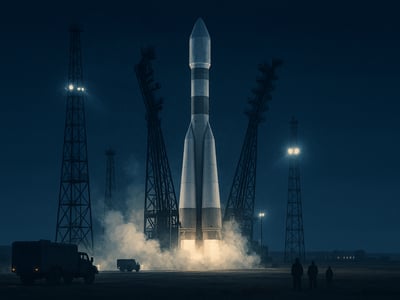
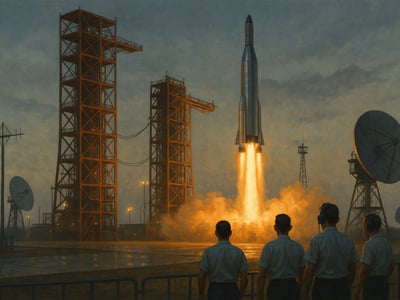
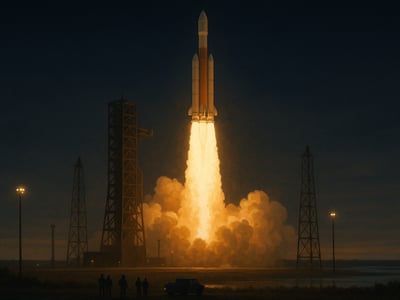
Cassini-Huygens begins its Saturn mission after launch from Cape Canaveral in 1997.
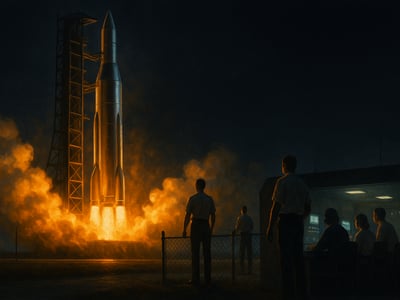
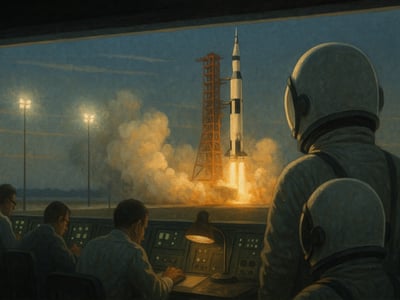
On October 15, 1997, a Titan IVB/Centaur rocket lifted off from Cape Canaveral Air Station in Florida carrying Cassini-Huygens, a spacecraft built for one of the most ambitious planetary missions yet attempted. Its destination was Saturn, still years away, along with the planet’s rings and moons. The launch marked the beginning of a long interplanetary journey for a project shared by NASA, the European Space Agency, and the Italian Space Agency.
Two craft, one departure
The mission’s name reflected both astronomy and history. The orbiter was named for Giovanni Domenico Cassini, the 17th-century astronomer associated with major observations of Saturn and its moons. The probe it carried was named Huygens, after Christiaan Huygens, who discovered Titan and made early studies of Saturn’s ring system. Together, the two parts of the mission were designed to do something no previous Saturn mission had done: remain in orbit around the planet for extended study while also sending a dedicated probe down through the atmosphere of Titan.
That combination made the launch especially important. Cassini-Huygens was not a small scientific instrument riding along on a routine flight. It was a large, complex spacecraft assembled through international cooperation and years of planning. Different agencies had distinct roles, but the entire mission depended on a single successful departure from Earth. If the rocket failed, if the upper stage did not place the spacecraft correctly, or if early spacecraft systems did not check out after separation, the mission could have ended before the cruise phase had truly begun.
A route that borrowed planetary gravity
Mission planners also faced a practical limitation: the spacecraft could not simply fly directly to Saturn using the launch energy available at the time. Instead, they committed to a longer route that relied on gravity assists from other planets. This path, often summarized as a Venus-Venus-Earth-Jupiter trajectory, used carefully planned planetary flybys to build up the speed needed to reach the outer solar system. That meant the launch was not just about getting into space. It had to place the spacecraft on a very precise path so that years of navigation and future flybys would line up correctly.
The launch vehicle chosen for the task was the Titan IVB/Centaur, one of the few rockets capable of sending such a heavy spacecraft onto an interplanetary departure trajectory. After liftoff, the job was not complete until the upper stage delivered Cassini-Huygens onto the proper course away from Earth. Only then could the mission move from launch operations into the long, quieter work of deep-space flight: system checks, trajectory corrections, and preparation for encounters still many years ahead.
A shared mission with a long clock
The mission had been designed with a clear division of labor. NASA led the overall Saturn orbiter mission. ESA provided the Huygens probe that would later descend to Titan. The Italian Space Agency contributed key elements to the spacecraft and mission architecture. This structure made Cassini-Huygens more than a technical exercise. It was also an organizational test of whether multiple space agencies could combine their resources and expertise in a single long-duration planetary mission.
From the moment of launch, the mission’s timescale set it apart. Unlike missions that reached their targets in months, Cassini-Huygens would spend years traveling before it could begin its primary work. That demanded patience from engineers and scientists, and confidence that hardware built in one decade would still perform when it finally arrived at Saturn. The launch therefore represented both an ending and a beginning: the end of design and assembly, and the start of an extended voyage that depended on long-term precision.
The path that later reached Saturn
The success of October 15 preserved that plan. Cassini would continue outward through the solar system and, on July 1, 2004, it entered orbit around Saturn after a main-engine burn at the planet. That step alone fulfilled a central aim of the mission, placing a dedicated spacecraft within the Saturn system for detailed observation. But the mission had also carried a second objective from the day it launched. On January 14, 2005, after separating from Cassini in the Saturn system, ESA’s Huygens probe landed on Titan.
Those later achievements often receive most of the public attention, but they rested on the launch and the departure path established in 1997. Without a successful ascent and correct injection onto its interplanetary route, there would have been no Saturn orbit insertion and no Titan landing. The launch was the narrow gateway through which the entire mission had to pass.
Why it still matters
Cassini-Huygens remains an important example of how major planetary missions are organized and carried out. It showed that a spacecraft could be designed from the start as a shared international project with separate but connected goals: an orbiter to study a planetary system over time, and a probe to investigate one moon directly. That model has influenced how agencies think about cooperation, specialization, and risk-sharing in large scientific programs.
The mission also demonstrated how closely linked different parts of space exploration can be. Launch capability, upper-stage performance, trajectory design, long-distance navigation, spacecraft operations, and atmospheric entry were not separate stories. They were parts of one chain. The launch on October 15, 1997, was the first visible step in that chain, but it only mattered because it had been planned in relation to everything that would follow.
Seen from a distance, the event was a rocket leaving Florida. In practical terms, it was the successful commitment of a multinational spacecraft to a years-long route toward Saturn. That moment connected Earth-based engineering, international cooperation, and deep-space science in a single departure, setting in motion one of the defining planetary missions of its era.
Timeline
- Cassini-Huygens launch
- Saturn orbit insertion
- Huygens landing on Titan
What you uncovered
One Mission, Shared Roles
You didn't just complete a puzzle—you traced the opening moment of a mission that depended on many teams, agencies, and spacecraft functions working as one plan.
The importance of this launch was not only that a spacecraft left Earth, but that a complex division of labor began operating exactly as intended. NASA, ESA, and the Italian Space Agency were not simply contributing parts; they were coordinating separate technical responsibilities into a single mission architecture with both orbital and landing goals. That model helped show how large planetary missions could be organized across institutions without becoming separate projects in practice.
Cassini entered orbit around Saturn on 1 July 2004, and the Huygens probe landed on Titan on 14 January 2005.
FAQ
What happened on 15 October 1997 in the Cassini-Huygens mission?
On 15 October 1997, Cassini-Huygens launched from Cape Canaveral Air Station in Florida aboard a Titan IVB/Centaur rocket. It began its journey toward Saturn as a joint mission of NASA, the European Space Agency, and the Italian Space Agency.
Which space agencies were involved in Cassini-Huygens?
The mission was a joint project of NASA, the European Space Agency, and the Italian Space Agency. They worked together on a spacecraft designed to study Saturn, its rings, and its moons.
Why did Cassini-Huygens need a gravity-assist route?
It could not fly directly to Saturn with the launch performance available at the time. Mission planners therefore used a long Venus-Venus-Earth-Jupiter gravity-assist trajectory to reach the planet.
What was the mission’s main goal at launch?
Cassini was built to orbit Saturn and study the planet, its rings, and its moons. It also carried the Huygens probe for later delivery to Titan.