
About this story
On 10 September 2008 CERN announced that a proton beam had completed a full circuit of the Large Hadron Collider under the French–Swiss border. The lap was an operating milestone after years of construction, not yet a discovery. Nine days later an electrical fault forced a shutdown; later runs, including the 2012 Higgs announcement, depended on that first circulating beam.
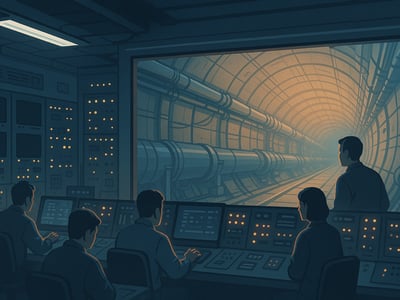
CERN's Large Hadron Collider during the first full beam circuit in 2008
On 10 September 2008, CERN announced that a proton beam had completed a full circuit of the Large Hadron Collider, the new 27-kilometre accelerator installed in a tunnel beneath the French-Swiss border near Geneva. It was not yet a physics discovery, nor a collision result, but it was a crucial operational milestone: after years of design, construction, and testing, the machine had shown that it could guide a beam all the way around its ring.
One lap through a 27-kilometre ring
That achievement mattered because the Large Hadron Collider, or LHC, had been built on a scale and with a precision that left little room for error. The ring passed through thousands of components that had to work together in sequence, including superconducting magnets designed to steer and focus the beam. A circulating proton beam sounds simple when stated in one sentence. In practice, it meant that injection, timing, alignment, control systems, and beam steering all had to function closely enough for the particles to make a complete lap through an underground machine stretching across the borderlands near Geneva.
The first-beam event was therefore a public sign that the collider had moved from being a long construction project to becoming an operating scientific instrument. CERN had spent years preparing for this moment. The LHC was intended to support particle-collision experiments at very high energies, but before any experiment could begin collecting meaningful collision data, the accelerator itself had to be commissioned step by step. A single beam going around the full circumference was one of those steps, basic in one sense, yet essential.
From construction project to operating machine
Lyn Evans, the project leader during the collider's construction and startup phase, had become one of the central figures associated with the machine. His role reflected the organizational challenge behind the technical one. The LHC was not simply a device assembled in one place by one team. It depended on long-term planning, engineering coordination, and contributions from many countries and institutions. By the time the first beam circulated, the accomplishment belonged as much to systems integration and international management as to any one dramatic moment in the control room.
Robert Aymar, CERN's Director-General at the time, represented the institution that had carried the project into this operational phase. Large research infrastructure often advances through long periods that can appear uneventful from the outside: approvals, excavation, installation, calibration, testing. Then a short event suddenly makes those hidden years visible. The first full circuit of the beam was one of those moments. It offered a simple demonstration that a machine of extraordinary scale could now do the thing it had been built to do at the most fundamental level: circulate particles through its ring.
A fault nine days later
There was also tension in the attempt itself. Starting live beam commissioning in a newly completed collider meant accepting the possibility that something might not work as intended. Injection could fail, steering could drift, synchronization could go wrong, or magnet systems might not behave as required. Success depended on details that most observers would never see directly. Even for specialists, a first lap was a test of whether many separate subsystems had become one functioning whole.
The date now stands with an added layer of historical perspective because it came only days before a serious setback. On 19 September 2008, an electrical fault caused significant damage in one sector of the machine. The incident forced a shutdown and delayed the path from commissioning to routine operation. That chronology is important. The first circulating beam was real and significant, but it did not mark a smooth, uninterrupted start to science runs. Instead, it became part of a more complicated story about how difficult it is to bring a frontier machine fully online.
The threshold before discovery
When the LHC restarted in 2009, the first-beam milestone of the previous year looked less like an endpoint and more like a threshold. It had shown that the machine's core concept worked in operation, even if reliability and protection still had to be secured. Only later would the collider move from circulation and commissioning toward sustained collision experiments, and later still would it become widely known to the public through results such as the 2012 announcement of a Higgs boson discovery.
Seen in that longer timeline, 10 September 2008 was the beginning of visible operation rather than the climax of the story. It marked the moment when a vast underground instrument stopped being chiefly a promise and started acting like a machine in motion. The beam's first complete lap did not answer the big scientific questions associated with the LHC. But without that lap, none of the later answers would have been possible.
Why it still matters
The first circulating beam remains important because it shows how major science actually begins: not with an instant breakthrough, but with carefully staged commissioning. Public attention often gravitates toward discoveries, yet those discoveries depend on prior moments that are quieter and more technical. The LHC's first full circuit was one of those enabling moments.
It also illustrates the scale of organization behind international research infrastructure. The LHC required sustained funding, cross-border cooperation, and coordination between scientists, engineers, operators, and institutions over many years. The successful first beam condensed that long effort into a single visible result.
Finally, the event helps explain the connection between accelerator engineering and experimental physics. Before detectors can record collisions that change scientific understanding, the accelerator has to become a reliable tool. On 10 September 2008, CERN demonstrated a foundational step in that process. It was a modest-looking achievement with large consequences: one beam, one full lap, and the beginning of a new operational era in particle physics.
Timeline
- CERN Council approves construction of the LHC
- First proton beam completes a full circuit of the LHC
- Electrical fault damages a sector and forces a shutdown
- CERN announces a particle consistent with the Higgs boson
What you uncovered
One Lap Before Discovery
You didn't just… complete a puzzle; you traced a moment when getting one beam around a 27-kilometre machine showed that years of engineering could begin turning into usable science.
The significance of this milestone was not that it answered a big question about matter on its own. It showed that a vast and delicate system could start working as an integrated whole, which is often the real threshold in large research projects. In that sense, one successful lap was a bridge between construction and experiment. Major scientific results often depend on these quieter stages of testing, calibration, and coordination.
The first circulating beam on 10 September 2008 came before an electrical fault on 19 September that damaged one sector of the collider and delayed further operations.
FAQ
What happened on 10 September 2008 at CERN?
On 10 September 2008, CERN announced that the first beam had completed a full circuit of the Large Hadron Collider. It was an operational milestone in commissioning the machine, not a collision result.
Where is the Large Hadron Collider located?
The Large Hadron Collider is a 27-kilometre particle accelerator in a tunnel beneath the French-Swiss border near Geneva. CERN is based in this area, including Meyrin, Switzerland.
Who was leading CERN during the first-beam event?
Lyn Evans served as project leader for the Large Hadron Collider during its construction and startup phase. Robert Aymar was CERN Director-General at the time.
Why was the first circulating beam important?
It showed that the beam could be injected, steered, and guided around the full ring through the accelerator system. That was a key step before later particle-collision experiments could begin.
What happened to the LHC shortly after the first beam?
The first circulating beam came before the 19 September 2008 incident that caused significant damage in one sector of the machine. That event led to a shutdown.