
About this story
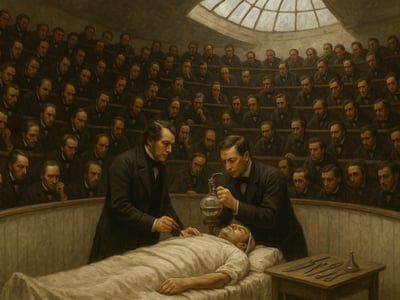
On 16 October 1846 at Massachusetts General Hospital in Boston, William T. G. Morton gave ether while John Collins Warren operated on Gilbert Abbott. Observers in the surgical amphitheater, later called the Ether Dome, watched a public test of whether surgery could proceed without the usual agony. The demonstration, and Henry Jacob Bigelow’s published account, helped anesthesia spread beyond that room.
Ether anesthesia demonstration at Massachusetts General Hospital, Boston, 1846
On October 16, 1846, in Boston, Massachusetts, a surgical procedure at Massachusetts General Hospital became one of the best-known turning points in medical history. That day, William T. G. Morton publicly administered ether while surgeon John Collins Warren operated on a patient named Gilbert Abbott. In the hospital’s surgical amphitheater, later known as the Ether Dome, observers watched closely to see whether a patient could undergo an operation without the usual visible agony that had long defined surgery.
Surgery before reliable pain control
To understand why the moment drew such attention, it helps to remember what surgery often meant in the mid-19th century. Operations could be life-saving, but they were also feared for a simple reason: pain. Surgeons worked as quickly as possible because speed could limit suffering. Patients might be held down, brace themselves, or cry out during procedures. Pain was not a side issue in surgery; it shaped what operations could be attempted, how they were performed, and what patients were willing to endure.
Various attempts to reduce pain had been tried before 1846. Alcohol, opiates, and physical restraint were all familiar tools, but none solved the basic problem of major surgical pain. There had also been important experiments with inhaled substances. Horace Wells had promoted nitrous oxide in dentistry, showing that the search for more reliable pain control was already underway. Even so, the question remained unsettled in hospital surgery: could an inhaled agent work consistently enough, and convincingly enough, in front of experienced witnesses?
That was the test facing Morton on the October morning of the demonstration. He had chosen to use ether before a public audience during a hospital operation, and the risk was obvious. If the patient moved violently, cried out in severe distress, or if the effect proved partial and uncertain, the effort could be dismissed as another failed promise. In a field as practical as surgery, credibility depended not on theory alone but on what respected observers could see for themselves.
Ether in the amphitheater
The patient, Gilbert Abbott, was prepared for an operation on a neck tumor. John Collins Warren, one of Boston’s leading surgeons, would perform the procedure. Morton’s role was to administer ether before the operation began. Around them, physicians and students watched with professional skepticism as well as curiosity. The scene mattered because this was not a private claim or a rumor passed between practitioners. It was a visible trial in a major hospital, carried out before witnesses whose judgment would influence what happened next.
As Warren began to operate, the central question was plain: would the patient show the signs of pain that everyone in the room expected from such a procedure? Contemporary reports indicate that Abbott displayed little or no pain response during the operation. That apparent absence of severe distress was the crucial evidence. It suggested that ether had done something more than calm a patient or dull anxiety. It seemed to create conditions under which surgery itself could proceed without the usual ordeal.
What the witnesses concluded
The response in the room became part of the event’s historical importance. One remark widely associated with Warren after the operation is: “Gentlemen, this is no humbug.” Whether remembered for its plainness or its confidence, the statement captured the mood of a demonstration that had crossed a threshold. What observers believed they had witnessed was not simply a successful case, but a practical method with implications beyond a single patient.
Yet the demonstration alone did not guarantee lasting change. Medical ideas spread when they could be described, repeated, and judged by others. Soon after the event, a contemporaneous published account by Henry Jacob Bigelow helped carry news of ether anesthesia beyond Boston. Publication turned a witnessed local procedure into evidence available to the wider medical world. Other physicians could compare accounts, attempt similar methods, and decide whether the results held up in their own practice.
From one operation to a practice
That step was essential. A hospital amphitheater could persuade those present, but journals and correspondence allowed a technique to move through professional networks. In that sense, the Ether Dome demonstration was both a medical event and a communications event. Its influence came not only from what happened during one operation, but from how quickly the result was recorded and circulated.
The years that followed were not free of argument. Questions of priority became part of the history of anesthesia, especially in relation to Morton, Charles T. Jackson, and Horace Wells. Different figures were credited with different roles in developing, promoting, or anticipating the use of anesthetic agents. Those disputes remain part of the historical record, and they complicate any simple claim about a single discoverer. But they do not erase the significance of October 16, 1846, as a documented public demonstration that helped convince the medical profession that surgical anesthesia could work.
Why it still matters
The event still matters because it marks a documented shift in how surgery was understood and practiced. Before reliable anesthesia, pain set strict limits on what surgeons could do and what patients could endure. After ether began to gain acceptance, surgery could increasingly be organized around control, planning, and technique rather than speed alone. That did not instantly solve every danger of the operating room, but it changed the basic conditions under which operations took place.
It also shows how medicine spreads through observation and publication. Witnesses in Boston mattered, but so did the printed reports that followed. The demonstration became influential not because it was dramatic, but because it was seen, described, and repeated. That pattern remains familiar in medicine: a clinical result gains importance when it can be documented clearly enough for others to evaluate and adopt.
Finally, the 1846 ether demonstration connects directly to later developments in operating-room practice, medical training, and patient management. Modern anesthesia is far more advanced than the methods used in Morton’s day, but the principle that pain can be systematically controlled during surgery traces one of its clearest public milestones to the Ether Dome. The operation on Gilbert Abbott did not end surgical risk or settle every scientific question. What it did show, in a way witnesses could not easily dismiss, was that a different kind of surgery had become possible.
Timeline
- Horace Wells uses nitrous oxide in dentistry
- Public ether demonstration at Massachusetts General Hospital
- Henry Jacob Bigelow publishes the demonstration
What you uncovered
When Surgery Became Repeatable
You didn't just… complete a puzzle; you traced the moment a watched, documented operation helped persuade other doctors that pain control in surgery could be used reliably, not just hoped for.
What made this event matter was not only what happened in one room, but how it could be observed, described, and repeated. A public hospital setting gave witnesses something to evaluate, and publication soon after gave other physicians a model they could test for themselves. That combination helped move ether from a single performance toward a shared medical method.
The operation took place in the surgical amphitheater at Massachusetts General Hospital later known as the Ether Dome.
FAQ
What happened on 16 October 1846 at Massachusetts General Hospital?
On 16 October 1846, William T. G. Morton administered ether during a public surgical demonstration at Massachusetts General Hospital in Boston. The operation was performed by surgeon John Collins Warren on patient Gilbert Abbott.
Who were the main people involved in the ether demonstration?
The main figures were William T. G. Morton, John Collins Warren, and Gilbert Abbott. Morton gave the ether, Warren performed the surgery, and Abbott was the patient.
Why did the ether demonstration matter for surgery?
It showed that surgery could be performed with far less pain and movement than was usual in the mid-19th century. That made it an important step toward anesthesia becoming part of hospital surgery.
How did the news of the demonstration spread?
A contemporaneous published medical account by Henry Jacob Bigelow helped spread news of the demonstration soon afterward. That publication helped turn a single hospital event into information discussed more widely in medicine.
Where did the demonstration take place inside the hospital?
It took place in the surgical amphitheater later known as the Ether Dome at Massachusetts General Hospital. The name reflects the event’s later historical significance.