
About this story
On 28 September 2008 SpaceX Falcon 1 Flight 4 lifted off from Omelek Island in Kwajalein Atoll and reached Earth orbit. The rocket carried a mass simulator called RatSat, not a customer satellite. Flights in 2006, 2007, and on 3 August 2008 had failed. The success showed that a new launch company could turn repeated test failures into an orbital vehicle.
Falcon 1 Flight 4 launched from Omelek Island and reached orbit in 2008.
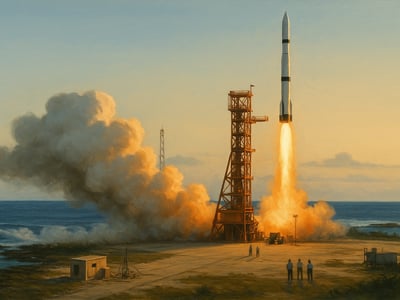
On September 28, 2008, a small two-stage rocket rose from Omelek Island in Kwajalein Atoll in the Republic of the Marshall Islands and did something SpaceX had been trying to do for years: reach orbit. The vehicle was Falcon 1 Flight 4, carrying a mass simulator payload called RatSat rather than an operational satellite. By the standards of later heavy launch campaigns, it was a modest mission. At the time, though, it was the result that mattered. After three earlier failures, SpaceX had finally completed a successful orbital flight.
A rocket the company had to prove
The achievement came six years after Elon Musk founded SpaceX in 2002. The company had set out to build launch vehicles that could deliver payloads to orbit at lower cost than many established systems. Falcon 1 was the first step in that plan: a relatively small, liquid-fueled rocket meant to prove that the company could design, build, test, and fly an orbital launcher. It was not a side project or demonstration in name only. For the young company, it was the central test of whether its engineering approach could work outside the factory and on the launch pad.
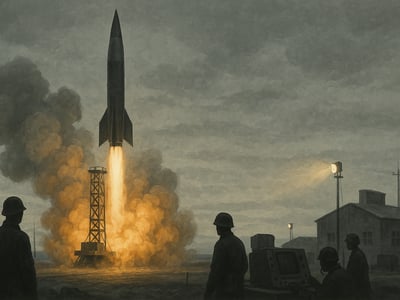
That made the early failures especially consequential. Falcon 1's first flight in 2006 failed. A second attempt in 2007 also did not reach orbit. Then came Flight 3 on August 3, 2008, which got farther but still fell short after a stage-separation recontact problem. By then, SpaceX had accumulated nearly three years of public setbacks on the same basic program. In rocketry, failure during development is not unusual. What was unusual was how little room the company appeared to have for another one.
A fourth launch was therefore more than a routine next test. It was a decision to keep backing the same vehicle concept after repeated disappointments. Engineers had to determine what had gone wrong on earlier flights, make corrections, and prepare another rocket quickly enough to preserve momentum. Leaders including Musk, Gwynne Shotwell, and propulsion specialist Tom Mueller were associated with a company trying to prove that persistence could be matched by technical competence.
Three failures and little margin
The setting underscored how far this was from a polished, high-frequency launch operation. Omelek Island, part of the Reagan Test Site in Kwajalein Atoll, was remote and logistically demanding. Everything about a launch campaign there required planning: hardware transport, range coordination, staffing, and the narrow sequence of checks that lead to ignition. For a company still learning how to become a launch operator, each attempt required not only engineering fixes but organizational discipline.
Flight 4 also carried a revealing kind of payload. Instead of risking a customer's working satellite, SpaceX flew RatSat, a mass simulator. In practical terms, that meant the mission's main purpose was to prove the rocket itself. The company needed a clean demonstration that the vehicle could complete first-stage ascent, separate properly, ignite the second stage, and continue to orbital velocity. A successful test with a non-operational payload could restore confidence without placing a client's spacecraft at immediate risk.
RatSat from a remote island
When Falcon 1 lifted off on September 28, the basic mission profile was straightforward, but the pressure behind it was not. The rocket had to do many ordinary things correctly in exact sequence, because orbital launch does not allow partial credit. A small error in propulsion, guidance, timing, or staging can end a mission. The previous launch had already shown how one event at stage separation could undo an otherwise promising flight. Flight 4 had to turn lessons from failure into a stable performance.
This time, it did. Falcon 1 completed its stage performance successfully and reached Earth orbit. The result marked the first orbital success for the Falcon 1 program and a defining moment for SpaceX as a company. Contemporary and later accounts often describe the mission as a landmark in private orbital launch, though the exact superlative wording varies depending on the source. What is not in dispute is that the flight became an important reference point in the history of commercial spaceflight.
Orbit, and what it unlocked
Its significance was not only symbolic. Reaching orbit demonstrated that SpaceX could analyze failure, revise hardware and procedures, and return with a working launch system. That mattered to customers, partners, and internal backers alike. A company can promise lower-cost access to space, but until it places a vehicle in orbit, that promise remains theoretical. Falcon 1 Flight 4 turned the idea into an operational fact.
The success did not mean Falcon 1 would become the company's long-term workhorse. In retrospect, the rocket looks more like a bridge than a destination. Falcon 1 had shown that SpaceX could build and fly an orbital launcher, but the firm's larger ambitions pointed toward bigger vehicles and broader contracts. A fifth Falcon 1 flight would follow in 2009, yet the deeper importance of Flight 4 lay in what it enabled next: confidence, credibility, and a practical foundation for later Falcon-family development.
Why it still matters
Falcon 1's fourth flight still matters because it showed that a new launch company could survive repeated technical failures and still produce an orbital rocket. That was not merely a story of persistence in the abstract. It was evidence that iterative engineering, test data, and corrective action could carry a private firm through the hardest phase of launch-vehicle development.
The mission also occupies a clear place in SpaceX's internal timeline. Before Falcon 9, cargo missions, and later high-profile launches, there was the narrower problem of proving that the company could reach orbit at all. Falcon 1 Flight 4 provided that proof. It linked SpaceX's founding ambitions in 2002 with its later role in commercial launch services and public-private space transportation.
More broadly, historians of spaceflight often point to the late 2000s as a period when commercial launch providers were gaining a larger role in orbital access. Falcon 1's success did not create that shift by itself, but it became one of the missions used to illustrate it. The flight from Omelek Island was small in scale, yet it marked a transition: private launch companies were no longer only proposing orbital capability. Some were beginning to demonstrate it.
Timeline
- SpaceX is founded
- Falcon 1 Flight 1 fails
- Falcon 1 Flight 2 fails
- Falcon 1 Flight 3 fails after stage separation
- Falcon 1 Flight 4 reaches orbit
What you uncovered
How Orbital Credibility Is Built
You didn't just complete a puzzle; you retraced the moment Falcon 1 turned repeated setbacks into a credible orbital success.
This launch matters not only because it reached orbit, but because it showed that survival in rocketry depends on disciplined iteration as much as vision. After three failures, a fourth attempt on the same basic vehicle design suggested that early commercial launch programs were shaped by testing, diagnosis, and revision rather than a single breakthrough moment. In that sense, Falcon 1's success helped establish a model for how private launch companies could earn technical trust over time.
Falcon 1 Flight 4 carried a mass simulator named RatSat rather than an operational satellite.
FAQ
What happened on 28 September 2008 with Falcon 1?
On 28 September 2008, SpaceX launched Falcon 1 Flight 4 from Omelek Island in Kwajalein Atoll, and the rocket reached orbit. The mission carried a mass simulator payload called RatSat.
Where did the Falcon 1 launch take place?
The launch took place from Omelek Island at the Reagan Test Site in Kwajalein Atoll, Republic of the Marshall Islands. That was the launch site for Falcon 1 Flight 4.
Why was this Falcon 1 flight important?
It was SpaceX’s first successful orbital flight after three earlier Falcon 1 failures. The success showed that the company could reach orbit with its own rocket design.
What was RatSat on the Falcon 1 mission?
RatSat was a mass simulator payload, not an operational satellite. SpaceX used it on Falcon 1 Flight 4, the mission that reached orbit on 28 September 2008.