

About this story
On 28 October 1886, the Statue of Liberty was dedicated on Bedloe's Island in New York Harbor. France had designed and built the figure, with Frédéric Auguste Bartholdi as sculptor and Gustave Eiffel behind the iron frame, and presented it in Paris on 4 July 1884. It reached the harbor in June 1885. President Grover Cleveland presided at the dedication.
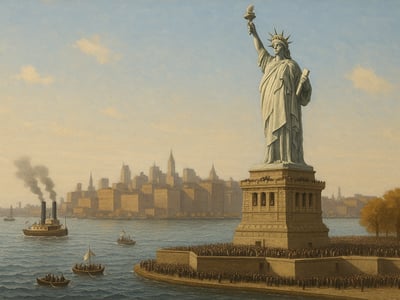
Statue of Liberty on Bedloe's Island at its 1886 dedication in New York Harbor
On October 28, 1886, the Statue of Liberty was formally dedicated on Bedloe's Island in New York Harbor, where it stood at the harbor entrance facing New York City. President Grover Cleveland led the public ceremony, marking the completion of a project that had taken shape over more than a decade in both France and the United States. By the day of the dedication, the monument had already crossed the Atlantic in pieces, been reassembled on its site, and been raised onto a completed pedestal. What appeared to spectators as a finished landmark was the result of fundraising, engineering, transport, and careful public ceremony.
A monument designed between two countries
The statue was not conceived as an isolated work of art. Its origins lay in a Franco-American effort organized in the 1870s, associated with Édouard de Laboulaye and Frédéric Auguste Bartholdi. On August 5, 1875, the Franco-American Union was created in France to organize support for the monument project. The idea linked the two republics through a visible civic symbol, and it also depended on a practical division of labor. France would support and build the statue itself, while the United States would provide the pedestal on which it would stand.
That arrangement gave the project a clear structure, but it also created an obvious problem. A monumental figure designed and constructed in France could not simply be delivered whole to a small island in New York Harbor. It had to be made, financed, shipped, and rebuilt under conditions that involved separate campaigns on each side of the Atlantic. If one part lagged behind, the entire schedule could stall. The symbolic meaning of the monument therefore rested on a series of very ordinary obstacles: raising money, making parts fit, moving heavy materials, and preparing a site suitable for public dedication.
Bartholdi designed the statue, while Gustave Eiffel provided the iron framework that helped make the monumental structure feasible. Their work brought together sculpture and engineering in a way that was essential to the statue's success. A monument intended for an exposed harbor site needed more than an impressive exterior. It also needed an internal structure capable of supporting the form once it was assembled at full scale.
From a Paris ceremony to Bedloe's Island
On July 4, 1884, France formally presented the completed statue in Paris. Bartholdi oversaw the handover ceremony there, but the project was still far from finished. Presentation in Paris was one thing; installation in New York Harbor was another. The completed work then had to be prepared for transatlantic shipment. Rather than moving a single finished object, organizers shipped the statue in crates so that it could be reassembled in the United States.
That voyage was itself a defining stage in the monument's history. In June 1885, the statue arrived in New York Harbor aboard the French frigate *Isère*. Arrival did not mean immediate completion. The harbor had received the monument, but workers still had to reconstruct it on Bedloe's Island. This stage required coordination between the delivered components and the pedestal that had been prepared in the United States. A delay in either part could have left the project visibly unfinished.
By August 5, 1886, the completed statue had been placed on its pedestal on Bedloe's Island. Only then did the final public form of the monument become fully visible in its intended setting. Location mattered. The statue was not set deep within an inland square or placed at the center of a government district. It stood in the harbor, where shipping routes, the skyline, and the approaches to the city gave it a distinct civic presence. Its setting helped define how it would be seen: not simply as an object to visit, but as a marker positioned at a major urban gateway.
Dedication, and meanings that came later
The dedication ceremony on October 28 turned construction into public meaning. Cleveland, who had previously served as governor of New York before becoming president, presided over the event as the representative of the United States. The ceremony signaled that the statue had moved from international project to national monument. It was no longer merely a French-made work awaiting placement. It had become part of the civic landscape of New York Harbor and, by extension, part of the public imagery of the United States.
Ceremonies of this kind do more than mark a date. They frame how a monument is meant to be understood. In this case, the dedication linked the statue to official state ritual, to the centennial-era memory of American independence, and to the visible cooperation of France and the United States. The event gave political and ceremonial shape to a structure whose creation had depended on years of practical work.
It is also important to separate the 1886 dedication from some of the meanings that became more prominent later. The statue's position in New York Harbor would eventually connect it strongly with migration narratives, especially because of later associations with arrivals near Ellis Island. But those associations developed over time. In 1886, the central public framing was the formal dedication of a major binational monument at the harbor entrance, not yet the full immigration symbolism that many people now treat as inseparable from it.
Why it still matters
The dedication of the Statue of Liberty still matters because it shows how monuments become meaningful through more than design alone. The statue is often remembered as an instantly recognizable symbol, yet its significance was built step by step through organization, fundraising, engineering, shipping, assembly, and state ceremony. Looking at the dedication reveals how a civic monument is made not just by an artist, but by institutions, workers, donors, and public events.
Its location also remains important. By standing in New York Harbor, the monument connected symbolism to infrastructure: ships, ports, approaches to the city, and the movement of people and goods. That placement helped later generations attach new layers of meaning to it, especially in relation to migration. The harbor setting did not automatically determine those meanings, but it made them possible.
The ceremony of October 28, 1886, therefore remains a useful historical reference point. It helps explain how transatlantic diplomacy, public fundraising, engineering expertise, and ceremonial politics combined in one highly visible project. The statue endures as an image, but the dedication reminds us that famous symbols do not arrive fully formed in public life. They are built, placed, and interpreted in specific historical circumstances.
Timeline
- Franco-American Union is formed
- France presents the finished statue in Paris
- The statue arrives in New York Harbor
- The statue is set on its pedestal
- Dedication on Bedloe's Island
What you uncovered
How a Monument Became Meaning
You didn't just… complete a picture; you traced the moment when an engineered monument was formally turned into a public symbol with civic meaning.
The Statue of Liberty did not become central to U.S. civic identity through design alone. Its meaning was built through fundraising on both sides of the Atlantic, its placement at the harbor entrance, and a dedication ceremony that framed it for the public. That combination of engineering, location, and official ritual helped transform an object into a national reference point. It also shows how monuments gain power through the systems and stories around them, not only through their physical form.
In June 1885, the statue arrived in New York Harbor aboard the French frigate Isère after being shipped from France in crates for reassembly.
FAQ
What happened on 28 October 1886?
On 28 October 1886, the Statue of Liberty was formally dedicated on Bedloe's Island in New York Harbor. President Grover Cleveland led the public ceremony.
Who dedicated the Statue of Liberty?
President Grover Cleveland dedicated the Statue of Liberty. The ceremony took place on Bedloe's Island in New York Harbor.
Where was the Statue of Liberty dedicated?
The Statue of Liberty was dedicated on Bedloe's Island in New York Harbor, facing New York City. The island was later renamed Liberty Island.
How did the statue reach New York Harbor?
The statue was shipped from France in crates and arrived in New York Harbor aboard the French frigate Isère in June 1885. It was then reassembled in the United States.
Why was the Statue of Liberty a French gift?
France formally presented the completed statue in Paris on 4 July 1884 as part of a binational project organized by supporters in France and the United States. The monument was associated with Édouard de Laboulaye and Frédéric Auguste Bartholdi.