
About this story
On 26 October 1825, New York opened the Erie Canal, a state-built waterway of about 363 miles from Buffalo on Lake Erie to Albany on the Hudson. Boats could then continue toward New York City and Atlantic trade. DeWitt Clinton and engineer Benjamin Wright were central to a project the legislature had authorized in 1817.
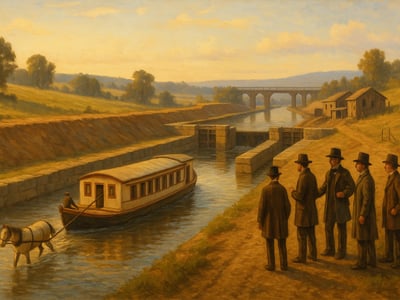
Erie Canal route in New York after its opening on 26 October 1825.
On October 26, 1825, the Erie Canal officially opened in New York, completing a continuous navigable route from Buffalo on Lake Erie to Albany on the Hudson River, with onward access to New York City and the Atlantic. The new waterway stretched about 363 miles between Buffalo and Albany. Its opening marked the end of years of planning, excavation, lock building, and political argument over whether a state-built canal on this scale could actually work.
A route that was not inevitable
To later generations, the canal could seem almost inevitable, because its economic effects became so well known. At the time, however, it was a bold and uncertain public project. Before the canal, moving goods between the interior and the Atlantic coast was slower and more expensive. Roads were often difficult, especially for heavy freight, and the barrier of distance limited how easily agricultural produce, raw materials, and manufactured goods could move in large volumes. A water link across upstate New York promised a cheaper route, but promising a route and building one were very different things.
The legal commitment came first. On April 15, 1817, the New York State Legislature authorized construction of the Erie Canal. That decision tied the reputation of state leaders to a project that skeptics had doubted for years. The canal would have to cross a varied landscape of rivers, marshy ground, escarpments, and major changes in elevation. Financing it with public backing also meant that failure would not be private and contained. If the canal proved incomplete, impractical, or too fragile for regular traffic, it would stand as a highly visible example of overreach.
Locks, aqueducts, and a route that had to work
Construction began on July 4, 1817, at Rome, New York. Engineers and laborers then faced the practical question that underlies every major infrastructure project: how to turn an ambitious line on a map into a working corridor. Benjamin Wright, one of the leading engineers associated with the canal, helped oversee the route and its technical execution. The canal was not simply a ditch cut across the state. It required locks to manage elevation changes, embankments and aqueducts in some sections, and careful control of water supply so that boats could move reliably along the route.
The physical challenge mattered because the canal’s value depended on uninterrupted use. A route could not be merely impressive in isolated stretches; it had to function as a system. Boats needed to pass through lock after lock, move through excavated channel sections, and connect the inland waters to the Hudson corridor without a break that would force cargo back onto wagons. By opening day in 1825, that system had been made navigable across hundreds of miles. The canal linked Buffalo and Albany directly, while the Hudson connection carried traffic farther south to New York City.
Clinton and a cheaper path for freight
That achievement was also political. DeWitt Clinton, governor of New York when the canal opened, had become closely associated with the project. Supporters saw the canal as a way to strengthen the state’s commercial future. Critics had long viewed it as risky, expensive, and uncertain in its returns. The opening therefore represented more than the completion of construction. It was proof that the state had succeeded in building a functioning trade artery where there had previously been no comparable route.
Opening day did not mean the canal instantly transformed every aspect of commerce overnight, but it did create a lower-cost freight option between the Great Lakes region and Atlantic trade networks. That mattered in practical terms. Water transport could carry bulky cargo more efficiently than overland routes available at the time. Farmers, merchants, shippers, and urban wholesalers all had reason to watch closely. The canal connected inland production more directly to export channels and brought imported goods more easily into the interior.
Celebration, labor, and a redirected trade
Public celebration followed the opening. After October 26, Governor Clinton traveled by packet boat toward New York Harbor, where a separate ceremonial event took place on November 4, 1825. This celebration became known as the “Wedding of the Waters,” symbolizing the union of waters from the Great Lakes and the Atlantic world through New York’s canal and river system. The symbolism was powerful because it expressed exactly what the canal had been built to do: bind distant regions into one connected commercial route.
Even so, the canal should not be remembered only as a triumphant symbol. Its construction required sustained labor over many years, and the project took shape amid regional competition and political debate. Large public works always redistribute opportunities and advantages, and the Erie Canal was no exception. It redirected traffic through a particular corridor and reinforced New York’s role within that system. Those consequences were part of the canal’s significance from the start.
Why it still matters
The Erie Canal remains important because it demonstrates how infrastructure can reorganize trade, not just support it. By creating a reliable state-backed water route between the Great Lakes corridor and the Hudson, New York positioned its own port network to capture more traffic. The canal is therefore a useful case study in how transport decisions can favor certain cities, routes, and commercial institutions over others.
It also helps explain a larger historical pattern: inland production zones become more economically integrated when transport costs fall and connections become more dependable. The canal did not invent commerce in the region, but it changed the terms under which commerce could expand. For historians of the United States, it remains a reference point in the history of public works, internal improvements, and applied canal engineering.
The opening on October 26, 1825, stands out because it joined political ambition, engineering execution, and commercial strategy in one project. The canal was a built answer to a geographic problem. Once opened, it showed that a state could use infrastructure not only to overcome distance, but also to reshape the direction of movement itself.
Timeline
- New York authorizes the Erie Canal
- Construction begins at Rome, New York
- Erie Canal opens
- Wedding of the Waters
What you uncovered
A Route That Reordered Trade
You didn't just…complete a picture—you traced the opening of a state-built route that tied inland waterways to Atlantic commerce.
The Erie Canal mattered not only because boats could pass through it, but because it gave trade a new path shaped by public policy. It showed that a state-backed transport link could pull goods, traffic, and investment toward a particular corridor and port system. That larger significance became clearer over time, but the opening already marked a shift in how people understood infrastructure as a tool for organizing economic space.
After the canal opened, Governor DeWitt Clinton traveled by packet boat to New York Harbor for the ceremonial "Wedding of the Waters" on 1825-11-04.
FAQ
When did the Erie Canal officially open?
The Erie Canal officially opened on 26 October 1825. It was opened as a completed waterway in New York.
What route did the Erie Canal connect in 1825?
It linked Buffalo and Albany as a 363-mile waterway. Through the Hudson River connection, it also extended access toward New York Harbor and the Atlantic Ocean.
Why was the Erie Canal important for trade?
It created a lower-cost freight route between the Great Lakes region and Atlantic trade networks. That made it easier to move goods between inland New York and seaboard markets.
What was the 'Wedding of the Waters'?
The 'Wedding of the Waters' was a separate ceremonial event after the canal opened. Governor DeWitt Clinton traveled by packet boat to New York Harbor for it on 4 November 1825.