
About this story
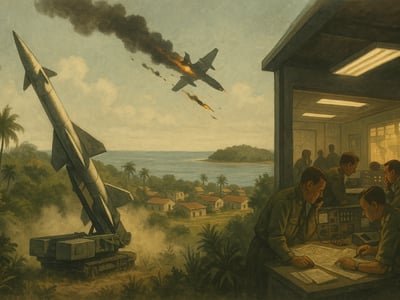
On 27 October 1962, during the Cuban Missile Crisis, a Soviet missile shot down a U.S. Air Force U-2 over Cuba and killed Major Rudolf Anderson Jr. The day, often called Black Saturday, forced Kennedy and his advisers to weigh retaliation while messages from Nikita Khrushchev were still arriving. Washington did not strike at once. A withdrawal deal followed on 28 October.
U-2 pilot Rudolf Anderson Jr. was shot down near Banes, Cuba, on 27 October 1962.
On October 27, 1962, at the most dangerous point of the Cuban Missile Crisis, a United States Air Force U-2 reconnaissance aircraft was shot down over Cuba. The pilot, Major Rudolf Anderson Jr., was killed when the high-altitude plane was destroyed near Banes in Oriente Province by an SA-2 surface-to-air missile system operating during the crisis. The loss came in the middle of a tense 13-day confrontation among the United States, the Soviet Union, and Cuba, when governments were trying to measure each other’s intentions while avoiding a wider war.
Reconnaissance at the peak of the crisis
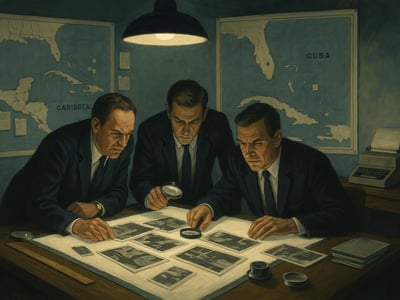
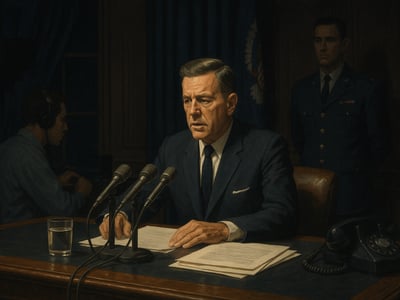
The U-2 was not an ordinary military flight. By late October 1962, Washington depended heavily on aerial reconnaissance to track Soviet missile sites in Cuba and to judge whether construction and deployment were continuing. President John F. Kennedy had publicly announced on October 22 that the United States had identified Soviet missile installations on the island. That announcement transformed a secret intelligence discovery into an open international crisis. From that point onward, photographs and flight reports were central to decision-making in Washington.
The United States had already imposed a naval quarantine around Cuba, and the administration was weighing difficult options. Officials discussed diplomacy, continued surveillance, and possible military action. Yet every reconnaissance flight carried risk. The aircraft had to pass over defended territory during an active standoff. If Soviet or Cuban forces fired on one of them, the United States would have to decide whether to treat the attack as an isolated military act or as the beginning of a broader escalation.
That danger became real on October 27, a day often remembered as "Black Saturday." Anderson took off on a mission intended to gather information over Cuba at a time when military and political leaders urgently wanted updated intelligence. His aircraft, a U-2 designed for very high-altitude reconnaissance, flew into airspace covered by Soviet-supplied missile defenses. Near Banes, the plane was struck and destroyed. Anderson did not survive.
What one missile forced Washington to decide
The shootdown was immediately important not only because an American pilot had been killed, but because of what the incident might force leaders to do next. In a crisis shaped by nuclear weapons, even a single military loss could alter the balance between caution and retaliation. News of the U-2’s destruction reached Washington, where the Executive Committee of the National Security Council, known as ExComm, was already meeting and reassessing events as they unfolded.
Inside those discussions, the central question was not only what had happened, but what it meant. U.S. officials had to consider whether the missile launch had been ordered at a high political level, initiated by commanders on the ground, or carried out under standing rules in a rapidly changing military environment. That uncertainty mattered. If the shootdown represented a deliberate decision from Moscow, the political implications were grave. If it reflected a more local or fragmented command situation, that posed a different but equally serious problem: control over dangerous weapons might be less certain than national leaders hoped.
Kennedy and his advisers were simultaneously dealing with messages from Soviet leader Nikita Khrushchev, ongoing military pressure around Cuba, and proposals for resolving the standoff. The crisis was not frozen into a single line of confrontation. It moved hour by hour through intelligence reports, military alerts, diplomatic messages, and internal debate. In that setting, Anderson’s death became one of the clearest signs that the confrontation had crossed from threat into lethal action.
Restraint, a settlement, and Anderson's name
Even so, the United States did not immediately launch the sort of retaliatory strike that some military plans had contemplated against air defense sites in Cuba. That restraint is one of the most significant features of the day. It showed how carefully political leaders were trying to avoid a chain reaction. A response to the missile launch might have led to counterstrikes, then to direct combat involving U.S. and Soviet personnel, with no reliable way to contain the consequences.
The broader crisis continued through exchanges with Khrushchev and further internal deliberations in Washington. Within a day, the confrontation began moving toward settlement terms that would lead to the removal of Soviet missiles from Cuba and a reduction in immediate danger. But the U-2 shootdown remained one of the starkest reminders of how narrow the margin had become.
Rudolf Anderson Jr. later received the Air Force Cross posthumously on November 6, 1962, the first time that decoration was awarded. The honor recognized the mission he flew under extraordinary circumstances. His name has remained closely tied to the history of the Cuban Missile Crisis, not because he shaped its diplomacy personally, but because his final flight revealed how exposed the crisis was to sudden escalation.
Why it still matters
The destruction of Anderson’s U-2 is still studied because it captures a central problem of modern crises: leaders need information most urgently when gathering it is most dangerous. Reconnaissance flights over Cuba were essential to U.S. decision-making, yet they also created occasions for confrontation. Intelligence systems, in other words, can help prevent miscalculation while also becoming targets that deepen it.
The episode also remains important as a case study in command and control. Historians and policymakers continue to examine who had authority to fire, how decisions moved through military chains of command, and how much uncertainty civilian leaders faced while trying to keep events from outrunning diplomacy. In nuclear crises, uncertainty itself becomes a strategic factor.
Finally, the shootdown illustrates how local military action can affect high-level negotiations between great powers. A missile launch near Banes was not separate from diplomacy in Washington and Moscow; it immediately became part of it. That link between battlefield events and political decision-making is one reason October 27, 1962, continues to be remembered as one of the most precarious days of the Cold War.
The story of the U-2 shot down over Cuba is therefore not only about a single aircraft loss. It is about the fragility of crisis management when governments are armed, suspicious, and operating under severe time pressure. Anderson’s final mission remains a concise example of how close the world could come to a much larger disaster through one act in one stretch of sky.
Timeline
- Kennedy addresses the nation on Cuba
- Naval quarantine of Cuba begins
- U-2 shot down; Rudolf Anderson Jr. killed
- Washington and Moscow announce a withdrawal deal
- Anderson receives the Air Force Cross
What you uncovered
A Trigger at the Edge
You didn't just…piece together a Cold War incident; you traced how one loss in Cuban airspace entered a moment when leaders were weighing choices with global consequences.
The significance of the shootdown lies not only in the aircraft's loss, but in where it landed within the crisis timeline: at the point where reconnaissance, military autonomy, and political restraint were all under strain. Intelligence flights were meant to reduce uncertainty, yet they also created opportunities for a local engagement to force a larger response. That tension is one reason the episode remains useful in studying escalation, because it shows how systems built to manage danger can also intensify it.
Rudolf Anderson Jr. was posthumously awarded the first Air Force Cross on 1962-11-06.
FAQ
What happened on 27 October 1962 over Cuba?
On 27 October 1962, a United States Air Force U-2 reconnaissance aircraft piloted by Major Rudolf Anderson Jr. was shot down over Cuba during the Cuban Missile Crisis. The aircraft was destroyed near Banes in Oriente Province, Cuba.
Who was Rudolf Anderson Jr.?
Rudolf Anderson Jr. was a Major in the United States Air Force who was flying the U-2 mission over Cuba when his aircraft was destroyed. He was killed in the incident.
Why was the U-2 flying over Cuba that day?
The U-2 was on a reconnaissance mission over Cuba during the Cuban Missile Crisis. U.S. leaders were using such flights to gather intelligence on defended missile sites during the standoff.
How did the shootdown affect the crisis in Washington?
After reports of the U-2 loss, the Executive Committee of the National Security Council met in Washington on 27 October 1962. The incident came during the most acute phase of the crisis and added to concerns about escalation.