
About this story
On 18 September 1851 Henry Jarvis Raymond and George Jones published the first issue of the New-York Daily Times in New York City, entering a crowded daily press market. The paper later shortened its name to The New York Times in 1857. The launch was a business and editorial wager, not a guaranteed institution.
The New-York Daily Times begins publication in New York City on September 18, 1851.
On September 18, 1851, the first issue of the *New-York Daily Times* was published in New York City. At that moment it was simply one more new daily paper entering a crowded and competitive urban press market. Its founders, Henry Jarvis Raymond and George Jones, were not launching a guaranteed institution. They were committing money, labor, and reputation to a newspaper that still had to find readers, advertisers, and a stable place in the city’s fast-moving world of print.
A new daily in a crowded city
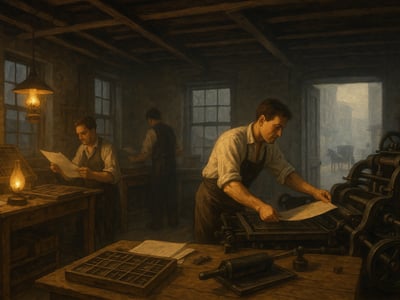
That uncertainty is central to understanding the paper’s beginning. In the middle of the 19th century, New York was already a major newspaper city. Daily papers competed for attention in a market shaped by political argument, commercial information, local reporting, and the growing demand for regular news in an expanding metropolis. A new publication needed more than a name. It needed presses, staff, distribution, and a business model strong enough to survive beyond its first days.
Raymond and Jones established the paper in 1851 under the title *New-York Daily Times*. The name itself reflected common newspaper naming conventions of the period. It identified the city, the daily rhythm of publication, and the paper’s place in a market where frequency and location mattered. In a time before digital communication and broadcast media, a daily newspaper was both a physical product and a timetable. To publish every day meant organizing writing, editing, printing, and delivery on a strict schedule.
Raymond, Jones, and the newspaper trade
Launching such a paper required practical decisions as much as editorial ones. A newspaper had to be printed in sufficient numbers, circulated efficiently, and financed steadily. Readers might buy individual copies, but circulation alone was rarely enough. Advertising was a crucial part of the business of urban newspapers, and advertisers generally favored publications that could demonstrate reach and continuity. That meant a new paper had to persuade two audiences at once: the public, which might read it, and businesses, which might pay to appear in it.
This double challenge helps explain the risk behind the first issue. The paper could have failed quickly, as many newspapers did. A crowded market could absorb new titles without rewarding them. Readers already had choices. Established competitors had routines, recognition, and existing revenue. For Raymond and Jones, publishing the first issue was not the end of the effort but the start of a test: whether the paper could sustain daily production long enough to become familiar, useful, and financially viable.
From first issue to a lasting title
The first issue’s appearance also belongs to a wider story about the growth of newspapers in 19th-century American cities. Urban expansion created larger reading publics. Commercial life generated demand for notices, prices, and advertisements. Improvements in printing and distribution gradually supported broader circulation. Newspapers were becoming more than occasional political organs; they were developing into durable businesses that depended on repetition, reliability, and recognizable identity. The *New-York Daily Times* entered that world at a moment when the modern newspaper form was still taking shape.
Its later name can make the launch seem more inevitable than it was. In 1857, the paper shortened its name from *New-York Daily Times* to *The New York Times*. Looking backward, the later title carries the weight of familiarity and institutional survival. But in 1851 that future had not yet been secured. The publication was still proving that it could continue from one issue to the next. The gap between a first issue and a lasting institution was filled by repeated acts of production: reporting, printing, selling, and paying the bills.
A print wager that survived
That continuity is easy to overlook because the first issue can seem like a symbolic milestone rather than a business event. In reality, it was both. The first publication announced an editorial and commercial venture to the city. It said, in effect, that this paper intended to enter public life and remain there. Whether it would succeed depended not only on its content but on the ordinary mechanics of the newspaper trade.
The survival of the paper beyond its launch gives historians a useful point of reference. It allows the first issue to be read not merely as a curiosity but as the beginning of an institution that would persist through major changes in media, technology, and scale. Yet the important fact about September 18, 1851, is still basic and concrete: a new daily newspaper appeared in New York City, founded by Henry Jarvis Raymond and George Jones, under a title that would later become one of the most recognized names in journalism.
Why it still matters
The first issue matters because it shows how major media institutions often begin in ordinary, uncertain conditions. Before a newspaper becomes a national or international brand, it has to solve local and practical problems: funding, printing, distribution, staffing, and reader attention. The launch of the *New-York Daily Times* is a clear example of that process.
It also helps explain how the structures of modern news developed. Nineteenth-century urban newspapers depended on a combination of circulation and advertising, regular schedules, and recognizable branding. Those elements became foundational to mass media systems long before later technologies expanded the speed and scale of news distribution. Looking at the paper’s early history makes those structures more visible.
Finally, the publication’s continuity links a print enterprise of 1851 to the later growth of national and international news networks. The significance of the first issue does not come from knowing what the paper would become in advance. It comes from seeing how a single launch in a crowded city market could, through sustained publication, become part of a much larger history of public information.
The first issue of the *New-York Daily Times* was therefore not simply the debut of a familiar name in earlier form. It was a practical wager on the future of daily news in a city where attention was hard to win and easy to lose. That wager succeeded, but only because the publication survived the uncertain conditions that surrounded its beginning.
Timeline
- First issue of the New-York Daily Times appears
- Paper shortens its title to The New York Times
- The New York Times begins publishing the Pentagon Papers
What you uncovered
A Paper Enters the Market
You didn't just… complete a puzzle; you retraced the uncertain first step of a new daily paper trying to survive in New York's competitive press market.
A first issue is not only an editorial debut but also a business wager. In 1851, starting a daily paper meant betting that enough readers, advertisers, and distributors would return the next day and the day after that. That helps explain why the launch matters beyond one publication: it shows how modern media institutions were built through repeated commercial and logistical success, not simply through a memorable founding moment.
The paper launched as the New-York Daily Times and shortened its name to The New York Times in 1857.
FAQ
When was the first issue of The New York Times published?
The first issue of the newspaper was published on 18 September 1851 in New York City. At that time, it appeared under the title New-York Daily Times.
Who founded the newspaper in 1851?
Henry Jarvis Raymond and George Jones founded the paper in 1851. They established it as a daily newspaper in New York City.
Why was it originally called the New-York Daily Times?
That was the title used when the paper launched on 18 September 1851. The name later changed, but the first issue used the original New-York Daily Times title.
When did the paper become The New York Times?
In 1857, the newspaper shortened its name from New-York Daily Times to The New York Times. That is the name it has used since then.