
About this story
On 29 October 1969, at about 10:30 p.m. in Boelter Hall at UCLA, Charley Kline tried to log in to a computer at SRI. The link died after the letters L and O. That broken login was the first host-to-host message on ARPANET. UCLA had received the first node early that September. By the end of 1969 the network had four nodes. Leonard Kleinrock's lab measured the traffic.
UCLA-to-SRI ARPANET test on 29 October 1969, remembered for the transmitted "LO"
On October 29, 1969, at about 10:30 p.m., a small group of researchers in Boelter Hall at the University of California, Los Angeles, tried something that had never been done before: they attempted to log in from one computer to another over ARPANET, the U.S. Defense Department-funded packet-switching network project that would later be recognized as a foundation of the modern internet. The most familiar version of the story is also the simplest. The intended word was "LOGIN." What arrived first was only "LO" before the receiving system crashed.
Scarce computers and a new way to connect them
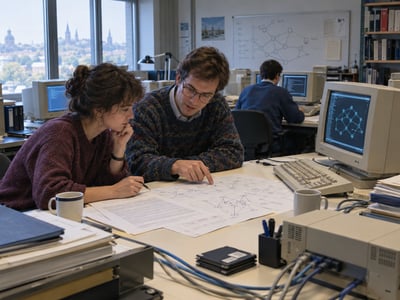
That fragment has become one of the best-known moments in network history, not because it was polished or dramatic, but because it showed that a new kind of connection between distant computers could work at all. The event joined two early ARPANET sites: UCLA and the Stanford Research Institute in Menlo Park, California. At UCLA, student programmer Charley Kline initiated the remote login. At SRI, programmer Bill Duvall monitored the receiving SDS 940 computer. Around them stood months of planning, installation, and testing, and behind those efforts was a larger research program directed in 1969 by Lawrence Roberts.
To understand why this brief exchange mattered, it helps to recall what ARPANET was meant to do. Computers in the late 1960s were expensive, scarce, and often isolated. Different institutions had powerful machines, but they were not designed to share resources easily across distance. ARPANET was created to explore whether packet switching could link separate computers into a working network, allowing researchers in one place to use or communicate with systems in another.
Packet switching was a significant break from traditional communications models. Instead of reserving a single dedicated path for an entire exchange, information could be broken into smaller units and routed through a network. This approach promised efficiency and flexibility, but in 1969 it was still a working research problem rather than an established everyday technology. The equipment, software, and procedures all had to be tested under real conditions.
The login that stopped at LO
One of the central pieces of that system was the Interface Message Processor, or IMP, a specialized machine used to connect host computers to the network. UCLA became the first ARPANET node in early September 1969 when its IMP was installed in Boelter Hall. SRI became the second node before the October 29 transmission attempt. By then, the network existed not as a broad public system but as a fragile, experimental link between a very small number of research sites.
That fragility is what gave the evening's test its tension. This was not just a theoretical demonstration on paper. A remote login had to pass from one host computer to another through newly installed networking equipment, while both hardware and software were still being validated. If no readable characters got through, confidence in the basic practicality of the network would have suffered. The promise of linking distant computers depended on more than diagrams and funding memoranda; it depended on whether people at two sites could actually make the machines communicate.
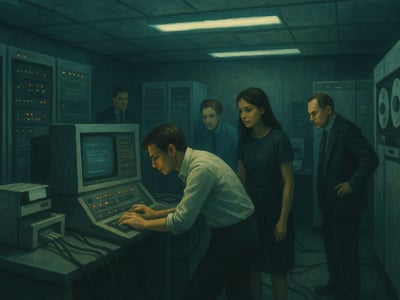
Kline began the login from UCLA. Duvall, at SRI, watched the receiving side. The planned sequence was straightforward: type L, then O, then G, then I, then N. According to the commonly cited account, the first two letters were transmitted successfully. After that, the system crashed. Instead of the full command, the record of the attempt became "LO."
Two hosts, then a wider network
In retrospect, the partial message can sound symbolic, almost too neat to be true: the network's first famous utterance as a short, unfinished opening. But historians and archivists usually treat its importance more concretely. The key fact is not that "LO" formed a suggestive syllable in English. It is that a host-to-host transmission occurred over ARPANET between UCLA and SRI during a real login attempt. Even with the crash, the test demonstrated that the basic network link was functioning.
The event also reminds us how collaborative early networking was. Leonard Kleinrock's laboratory at UCLA played a major role in measuring and studying network behavior. Federal funding through ARPA made the larger project possible. Contractors and institutional teams handled equipment, installation, and software. The result was not the product of a single inventor working alone, but of coordinated work across universities, government, and industry.
By the end of 1969, ARPANET would expand to four nodes. In the years that followed, researchers developed additional protocols and methods for moving data between machines and, later, between networks. Those steps were essential in the long transition from ARPANET to TCP/IP-based internetworking. The October 29 test did not create the internet in its later global form, but it marked an early operational milestone in the effort to make networked computing practical.
Why it still matters
The UCLA-to-SRI transmission still matters because it captures the internet's origins at a very early stage, before scale made the underlying systems invisible to most users. Today, networked communication often feels immediate and ordinary. In 1969, even sending a few characters from one research institution to another required new theory, custom hardware, federal support, and close coordination between specialists.
It also shows how much of modern digital infrastructure grew out of joint public and academic research. ARPANET emerged from Cold War-era funding priorities, but its technical legacy extended far beyond military planning. The methods explored in these early experiments helped shape later civilian communication networks and standards. That history is useful when considering how deeply public institutions, universities, and contractors have influenced technologies that now seem universal.
Finally, the story offers perspective. The systems on which daily life now depends did not begin as seamless consumer tools. They began as uncertain experiments, with crashes, incomplete transmissions, and teams trying to learn what would happen when separate machines were connected in new ways. Remembering that helps place current concerns about resilience, scale, and dependence on digital networks in a longer historical frame.
The first famous ARPANET message was not a triumphant sentence. It was two letters sent across a fragile new link. Yet those letters marked the moment when distant computers began to exchange information in a way that would eventually reshape research, communication, and everyday life.
Timeline
- First ARPANET node installed at UCLA
- First host-to-host message, UCLA to SRI
- ARPANET reaches four nodes
- ARPANET switches to TCP/IP
What you uncovered
When a Network Begins Small
You didn't just… finish a puzzle; you retraced a moment when a fragile test between two distant computers showed that networked communication could begin to work in practice.
The remembered detail is not a polished first message but an interrupted one: "LO" instead of the intended "LOGIN." That makes the moment useful as more than a milestone, because it shows how major infrastructure often begins as a limited and failure-prone demonstration rather than a seamless debut. The later internet grew from systems built across universities, federal funding, and private contractors, and its earliest success was inseparable from uncertainty.
UCLA became the first ARPANET node in early September 1969 when its Interface Message Processor was installed in Boelter Hall.
FAQ
What happened on 29 October 1969 at UCLA and SRI?
On 1969-10-29, UCLA student programmer Charley Kline initiated a remote login from UCLA to the SDS 940 computer at the Stanford Research Institute. The attempt is commonly associated with the first ARPANET host-to-host transmission.
Who was Charley Kline in the ARPANET test?
Charley Kline was a UCLA student programmer who initiated the remote login on 1969-10-29. Bill Duvall oversaw the receiving system at the Stanford Research Institute during the attempt.
Why did the first login attempt stop at "LO"?
In the commonly cited account, the intended login string was "LOGIN," but the receiving system crashed after the first two letters were transmitted. That is why the recorded message became "LO."
How were UCLA and Stanford Research Institute connected?
They were linked through ARPANET, a U.S. Department of Defense-funded packet-switching network project. UCLA became the first ARPANET node in early September 1969, and Stanford Research Institute was the second node.