
About this story
On 15 November 1971, Intel’s first advertisement for the 4004 microprocessor appeared in Electronic News. The 4-bit chip, with about 2,300 transistors, grew from a 1969 calculator project for the Japanese firm Busicom. Ted Hoff and Stan Mazor shaped the programmable architecture; Federico Faggin, who joined Intel in April 1970, led the chip design with Masatoshi Shima. A 1971 renegotiation let Intel sell the MCS-4 family beyond that customer. The advertisement dates a public offer, not the invention.
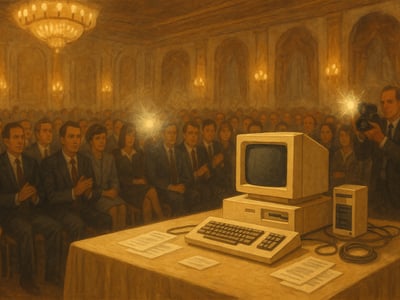
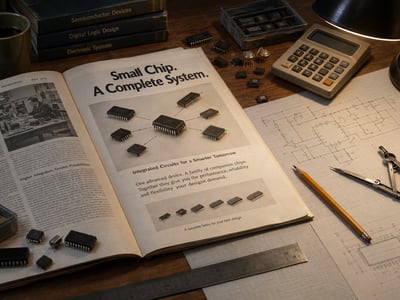
Intel’s November 1971 advertisement presented the 4004 alongside the other MCS-4 chips.
On November 15, 1971, Intel’s first advertisement for the 4004 microprocessor appeared in Electronic News, a United States electronics trade publication. The advertisement presented a small processor alongside the memory and supporting components it needed to operate. Behind that public announcement lay a calculator project, several distinct kinds of engineering work, and a commercial agreement that had changed what Intel could sell.
A calculator problem becomes a processor
The 4004 was a 4-bit processor containing approximately 2,300 transistors. Those specifications described a compact electronic device, but they did not explain how it had come into being. Its development connected Busicom, a Japanese calculator company based in Tokyo, with Intel’s chip-development operations in Santa Clara, California. A customer’s requirements provided the starting point for a programmable processor system.
In 1969, Busicom’s calculator project brought Masatoshi Shima into collaboration with Intel’s Ted Hoff and Stan Mazor. The engineering problem was not simply to fit a calculation onto a chip. Processor logic, memory, and input and output functions had to work together in a system that could be manufactured and could execute the calculator’s programs correctly.
Hoff and Mazor worked on the programmable processor architecture. This approach placed an important distinction at the center of the project: hardware would execute instructions, while programs would specify the operations needed for the calculator. The architecture defined how the processor would work, but a workable plan was not yet a finished semiconductor device.
Architecture, then the silicon
That distinction matters when assigning credit. Architectural planning establishes the organization of a processor and the operations it supports. Chip implementation turns that organization into circuits that must function within the constraints of semiconductor manufacturing. Application engineering connects the resulting hardware with the work the customer needs it to perform. These activities depend on one another, but they are not interchangeable.
Federico Faggin joined Intel in April 1970 and took responsibility for the project’s chip design and implementation, working with Shima. The task required turning the proposed processor into working silicon. A design that appeared coherent at the architectural level still had to operate correctly as a physical device and as part of the calculator system.
The right to sell beyond Busicom
The development record therefore involves all four contributors: Hoff, Mazor, Faggin, and Shima. Hoff and Mazor contributed to the programmable architecture; Faggin led the chip design and implementation; Shima brought Busicom’s calculator requirements into the collaboration and worked with Faggin during implementation. Describing the result as the work of a single inventor would obscure the different responsibilities that made the system possible.
Engineering success was only one condition for a wider market. Intel also needed the commercial right to offer the technology beyond the original customer. In 1971, Intel and Busicom renegotiated their agreement. Busicom received reduced component prices, while Intel obtained rights to market the chipset beyond Busicom. The arrangement connected the interests of a calculator manufacturer with those of a component supplier.
What the advertisement does and does not date
When the November advertisement appeared, it presented not just the 4004 but the MCS-4 family. The other devices were the 4001 read-only memory, or ROM; the 4002 random-access memory, or RAM; and the 4003 shift register. Together, these components showed the supporting hardware around the processor. The 4004 was central, but it was not a complete computer by itself.
The publication date is consequently a precise kind of milestone. It records Intel’s first advertisement for the 4004 in Electronic News. It should not be treated as the date on which the architecture was conceived, the chip was first fabricated, or a customer first received working hardware. Those are different stages in a product’s history, even when a later account compresses them into a single introduction date.
Why it still matters
The 4004 project offers a clear example of how a specific customer’s engineering problem can lead to components suitable for a wider range of applications. Programmability made it possible to describe operations through instructions rather than define every task solely through dedicated circuitry. Commercial rights determined whether Intel could offer the resulting chipset beyond the original contract. Technical capability and permission to market were separate requirements.
The MCS-4 family also makes a basic computing principle visible. A processor needs access to instructions and data, as well as ways to exchange information with other parts of a system. Focusing only on the processor’s transistor count can hide those relationships. The advertisement’s collection of devices provides a more useful picture: computation depended on coordinated components, not an isolated chip.
Finally, the record encourages careful language about technological milestones. Claims about the “first microprocessor” depend on definitions and competing development histories. The November advertisement supplies a narrower, firmly documented event. Its significance does not require an unqualified invention claim: it marks the public marketing of a processor family whose development joined architectural work, silicon implementation, calculator engineering, and a negotiated commercial agreement.
Timeline
- Busicom calculator project
- Federico Faggin joins Intel
- Intel and Busicom renegotiate marketing rights
- Intel first 4004 advertisement
What you uncovered
Beyond the Original Contract
You didn't just… finish a puzzle; you revisited the public debut of a processor developed for a calculator project.
A programmable design could serve applications beyond the original calculator, but technical flexibility alone did not give Intel permission to sell it more widely. Renegotiated marketing rights helped turn customer-specific engineering into a broader component business. The advertisement marked a public commercial milestone, not a single moment of invention.
Intel's November 1971 advertisement presented the MCS-4 family: the 4004 processor, 4001 ROM, 4002 RAM, and 4003 shift register.
FAQ
What happened on 15 November 1971?
On 15 November 1971, the first Intel advertisement for the 4004 appeared in Electronic News. It introduced the MCS-4 family, including the 4004 processor, 4001 ROM, 4002 RAM, and 4003 shift register.
Who was involved in developing the Intel 4004?
The development involved Federico Faggin, Marcian Edward "Ted" Hoff Jr., Stanley "Stan" Mazor, and Masatoshi Shima. Hoff and Mazor worked on the programmable processor architecture, while Faggin handled the chip design and implementation with Shima.
Why did the 4004 need the other MCS-4 chips?
The Busicom calculator project required processor logic, memory, and input/output functions to work together in one manufacturable system. The MCS-4 family was built to provide those functions alongside the 4004 processor.
Why is the 4004 advertising date important?
The advertisement marks the public introduction of the 4004, but it is not the same as fabrication or delivery. Intel and Busicom had renegotiated their agreement in 1971, which allowed Intel to market the chipset beyond Busicom.