About this story
On 7 November 1991, Magic Johnson told reporters at the Great Western Forum that he had tested positive for HIV and would retire at once from the Los Angeles Lakers. Owner Jerry Buss stood with him. In a year of fear and rumor about AIDS, a star athlete put the diagnosis in his own words.
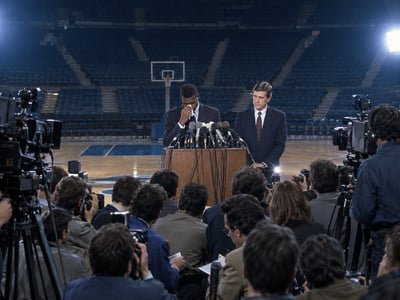
Magic Johnson announces his HIV diagnosis and Lakers retirement in Inglewood in 1991.
On November 7, 1991, Earvin "Magic" Johnson stood before reporters at the Great Western Forum in Inglewood, California, and made an announcement that reached far beyond basketball. He said that he had tested positive for HIV and that he would retire immediately from the Los Angeles Lakers. Because Johnson was one of the NBA's most recognizable players and one of the central figures of the Lakers franchise, the news moved instantly from sports pages to front pages and television broadcasts around the world.
A statement at the Forum
By that point, Johnson was not simply a successful athlete. He was closely identified with the Lakers' rise as a dominant and highly visible NBA team during the 1980s. His style of play, public image, and long association with Los Angeles had made him one of the best-known figures in American sports. The fact that the announcement came from an active player, still young and still strongly associated with top-level competition, gave it unusual force.
The press conference was formal and carefully staged. The Lakers held it at their arena, and team owner Jerry Buss appeared with Johnson. That setting mattered. It framed the moment not as rumor or tabloid speculation, but as an official statement by a player and the organization with which he had long been linked. Johnson had signed a 25-year personal services contract with the Lakers in 1981, and his relationship with the franchise extended beyond his role on the court. His retirement announcement therefore marked a public turning point in a partnership that had already become part of NBA history.
What made the moment especially significant was the wider climate of public understanding in 1991. In the United States, HIV/AIDS was still surrounded by fear, misinformation, and stigma. Many people did not clearly understand how HIV was transmitted, and public discussions often mixed medical facts with anxiety, prejudice, and rumor. For years, much coverage of the epidemic had been shaped by distance: it was often discussed through public health statistics, policy debates, or communities that many mainstream audiences treated as socially separate from themselves.
Fear, rumor, and a public diagnosis
Johnson's disclosure disrupted that distance. Here was a globally famous athlete, associated with elite fitness and with one of the most visible leagues in the world, stating plainly that he was HIV-positive. His announcement did not end misunderstanding, and it did not instantly create a well-informed public conversation. But it did make it harder to keep the subject confined to older stereotypes about who could be affected.
There was also a personal risk in speaking publicly. A private diagnosis can always remain private, but Johnson chose disclosure at a moment when the medical and social implications of HIV were widely feared. By retiring immediately, he made clear that the diagnosis had direct consequences for his professional life. At the same time, he took control of the information before it could be shaped by leaks, rumor, or secondhand reporting. That decision gave the public a verified account from Johnson himself.
The league's next procedural step
The reaction was immediate and intense. News organizations covered the announcement not only as sports news but as national news. The story raised practical questions about professional athletics, player health, and what the diagnosis meant for Johnson's future. It also raised broader questions that many viewers and readers had not previously connected to sports: how much the public actually understood about HIV, what assumptions people carried about risk, and how institutions responded when a major public figure disclosed a serious medical condition.
In the days that followed, the NBA had to address the issue in procedural terms as well as public terms. Later in November 1991, Commissioner David Stern said that Johnson could return to league play if team physicians and his own doctor cleared him under league procedures. That statement reflected an effort to place the matter within medical review rather than rumor. Even so, the larger public conversation extended well beyond league rules. The announcement had already become a major cultural event.
A sports story that would not stay in sports
Johnson's case also changed the scale of media attention around HIV/AIDS. Coverage that might otherwise have remained within health reporting or policy reporting now appeared across sports broadcasts, newspapers, and general-interest programs. For many people, the story became one of the first times they encountered extended public discussion of HIV in a setting tied to a familiar sports hero rather than an abstract crisis.
The moment did not erase the difficulties of the period. Reactions in 1991 often reflected the limited and sometimes inaccurate understanding common at the time. That context matters when looking back. Johnson's announcement became important not because it solved the public conversation, but because it forced that conversation into spaces that had often avoided it.
Why it still matters
Johnson's announcement remains a reference point for how public figures disclose major health diagnoses. It showed the power of a direct, formal statement in a moment when speculation could easily have overwhelmed facts. In that sense, it became part of a broader history of how athletes, entertainers, and political figures manage medical privacy while speaking to a public that often expects immediate explanation.
It also widened the media treatment of HIV/AIDS. Once the story entered the center of sports culture, it reached audiences that might not have followed health policy or medical reporting closely. The significance was not only that a famous player was affected, but that his status made many institutions—newsrooms, leagues, teams, and viewers—confront what they did and did not understand.
The event is still relevant in discussions of stigma and workplace visibility. Questions about when a person reveals a diagnosis, what an employer or institution does with that information, and how public reaction shapes private life remain current well beyond HIV. Johnson's announcement is often remembered because it joined those questions to one of the most public workplaces of all: professional sports.
In the years after November 1991, Johnson remained a public figure, and the announcement stayed part of his legacy. But the press conference itself remains the central historical moment: a star athlete, speaking in his own name, at the height of his fame, about a diagnosis that much of the public still misunderstood. That is why the event is remembered not only as a sports retirement, but as a turning point in public conversation.
Timeline
- Magic Johnson signs a long-term Lakers services contract
- Magic Johnson announces his HIV diagnosis and retires
- Magic Johnson appears in the 1992 NBA All-Star Game
What you uncovered
When Sports Changed the Conversation
You didn't just…complete a puzzle; you revisited a moment when a sports press conference became part of a much larger public conversation about illness, visibility, and stigma.
What made this announcement significant was not only who delivered it, but where the message landed. HIV/AIDS had often been discussed at a social distance, through public health reporting or stereotypes, but this brought it into a familiar arena of television, fandom, and workplace identity. That shift changed how many people understood the issue: not as an abstract crisis affecting someone else, but as something present within mainstream public life.
The announcement was held as a formal Los Angeles Lakers press conference at the Great Western Forum in Inglewood, with owner Jerry Buss present.
FAQ
What did Magic Johnson announce on November 7, 1991?
On 1991-11-07, Earvin "Magic" Johnson announced that he had tested positive for HIV. He also said he would retire from the Los Angeles Lakers.
Where did Magic Johnson make his HIV announcement?
He made the announcement at the Great Western Forum in Inglewood, California, during a formal press conference. The Los Angeles Lakers held the event, and team owner Jerry Buss was present.
Why did Magic Johnson retire from the Lakers in 1991?
Johnson said he would retire after learning that he had tested positive for HIV. His announcement linked his diagnosis directly to stepping away from professional basketball.
How did the NBA respond after Magic Johnson's announcement?
Later in November 1991, NBA Commissioner David Stern said Johnson could return to league play if team physicians and his own physician cleared him under league procedures.