
About this story
On 6 September 1901 President William McKinley was shot by Leon Czolgosz while greeting the public at the Temple of Music during the Pan-American Exposition in Buffalo. After an operation at the fairgrounds hospital he appeared to improve, then died on 14 September. That same day Vice President Theodore Roosevelt took the oath at the Ansley Wilcox House, an orderly succession after public political violence.
William McKinley at the Pan-American Exposition in Buffalo on September 6, 1901.
On September 6, 1901, President William McKinley was shot while greeting members of the public at the Temple of Music on the grounds of the Pan-American Exposition in Buffalo, New York. The setting was meant to display progress, industry, and international exchange. Instead, it became the site of one of the most consequential attacks in American political history, an event that led within days to the death of a sitting president and the accession of Theodore Roosevelt.
A handshake line at a world’s fair
McKinley had traveled to Buffalo to appear at the exposition, a major fair that drew large crowds and reflected the confidence of the United States at the turn of the century. Public receptions were part of the political culture of the time. Presidents were expected to appear before citizens, shake hands, and embody a style of office that still allowed direct access. Security existed, but it was limited by modern standards, and visitors were not screened in the way later generations would come to expect.
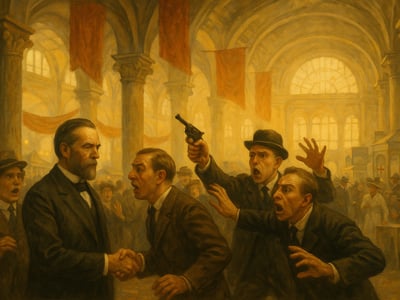
At the Temple of Music, McKinley stood in a reception line, meeting people one by one. Leon Czolgosz entered that line and approached the president at close range. He fired two shots. The attack took place quickly, in the middle of what had been arranged as a ceremonial and public encounter. In an instant, the ordinary ritual of political contact turned into confusion, fear, and an urgent struggle to respond.
McKinley was rushed from the scene to the exposition hospital, where doctors operated on him. The immediate challenge was medical as much as political. He had been wounded at close range, and treatment had to be improvised within the facilities available on the fairgrounds. The operation was carried out under pressure, with the expectation that stabilizing the president was the first priority. In the first reports after the shooting, there appeared to be some reason for cautious hope. His condition seemed, at least temporarily, to improve.
Czolgosz, two shots, and a rushed operation
That early optimism mattered. It shaped public expectations and the atmosphere in Buffalo during the days that followed. News traveled quickly through newspapers and telegraph dispatches, and the country watched for updates. The president remained in Buffalo rather than being moved elsewhere, and attention centered on each report from his physicians. Yet the apparent stabilization did not last. His condition worsened in the days after the operation.
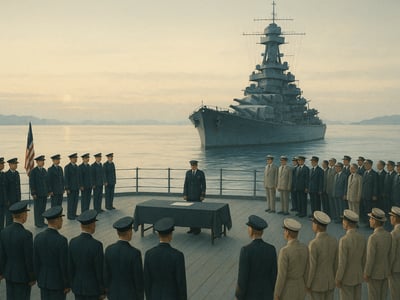
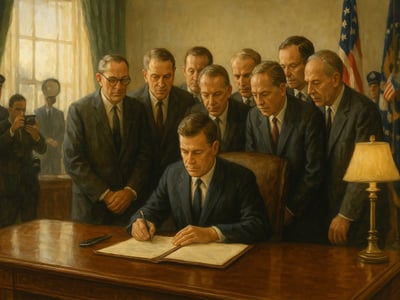
McKinley died in Buffalo on September 14, 1901, eight days after the shooting. His death ended the presidency of a leader who had overseen the nation during a period of expansion, war, and economic change. It also triggered a constitutional transfer of power that had to happen without delay. Vice President Theodore Roosevelt, who had been away from Buffalo, was summoned back and took the presidential oath of office on September 14 at the Ansley Wilcox House in Buffalo.
Eight days of waiting and a death in Buffalo
The transition was orderly, which was crucial. A president had been attacked in public, the country had endured days of uncertainty, and then the executive office changed hands. Yet the succession itself followed constitutional procedure. That continuity mattered not only in legal terms but also as a public signal that government would continue despite violence against its head.
The attack also belonged to a broader political climate of the era. In the late 19th and early 20th centuries, anarchist violence was a subject of deep concern in several countries, and the shooting of McKinley was quickly understood in that wider context. Even so, the central facts of the event remain grounded in the scene at Buffalo: a president in a public receiving line, an assailant able to come within arm’s reach, a rushed medical response, and a nation waiting for news over the course of eight days.
Roosevelt’s oath and a change in public access
The fair itself gave the episode a particular historical irony. World’s fairs and expositions were designed to present modern civilization as orderly, forward-looking, and increasingly interconnected. The Pan-American Exposition promoted those themes. Yet the shooting exposed a different side of modern public life: mass gatherings could create symbolic visibility, but they also created vulnerability. The very openness that made a president seem accessible also made protection more difficult.
In that sense, the event was not only a tragedy for one administration. It marked the end of an older style of presidential contact with the public. McKinley had not entered an obviously private or hidden space; he had been participating in a public ritual that many people would have considered normal. What changed after Buffalo was the understanding that such rituals carried risks that could not be managed casually.
Why it still matters
The shooting of McKinley remains important partly because it is a reference point in the history of presidential security. Later generations would come to see close, unscreened access to a president as a serious danger, but in 1901 that understanding was still incomplete. The attack helped demonstrate that symbolic openness and physical safety could come into direct conflict.
It also continues to matter as an example of how constitutional systems respond to sudden violence. McKinley’s death did not leave a vacuum at the top of government for long. Theodore Roosevelt’s oath in Buffalo showed the practical importance of succession rules when events move faster than public expectations.
Finally, the event is still studied as part of the history of anarchist violence in the late 19th and early 20th centuries. Historians use it not only to examine motive and ideology, but also to understand how states, the press, and the public interpreted political violence in an age of expanding mass communication.
What happened in Buffalo on September 6, 1901, therefore endures on several levels at once: as the shooting of a president, as a test of medical and governmental response, and as a turning point in how modern political leaders are protected in public. The scene at the Temple of Music was brief, but its consequences reached far beyond the exposition grounds.
Timeline
- McKinley is shot at the Temple of Music in Buffalo
- McKinley dies in Buffalo
- Theodore Roosevelt takes the oath at the Ansley Wilcox House
What you uncovered
Public Ritual, New Risk
You didn't just…reassemble a historical scene; you traced the moment when a routine public appearance exposed how vulnerable the presidency could be.
In 1901, close public access to a president was still treated as part of ordinary political life, not as an exceptional security problem. The shooting showed that older expectations of openness no longer fit the risks facing national leaders. It also revealed how constitutional systems must be prepared to absorb sudden violence without collapsing, from emergency response to succession. That tension between public access and protective distance still shapes modern political life.
Theodore Roosevelt took the presidential oath of office on September 14, 1901, at the Ansley Wilcox House in Buffalo.
FAQ
What happened to William McKinley on September 6, 1901?
On 1901-09-06, U.S. President William McKinley was shot inside the Temple of Music at the Pan-American Exposition in Buffalo, New York. The attack happened during a public reception line.
Where was McKinley when Leon Czolgosz shot him?
McKinley was at the Temple of Music on the grounds of the Pan-American Exposition in Buffalo, New York. He was receiving members of the public there when the shooting took place.
Who shot President McKinley?
Leon Czolgosz shot McKinley on 1901-09-06. He approached McKinley in the public reception line and fired two shots at close range.
How long did McKinley live after the shooting?
William McKinley died on 1901-09-14 in Buffalo, eight days after he was shot. He had been operated on at the Pan-American Exposition hospital after the attack.
What happened after McKinley died in Buffalo?
Theodore Roosevelt took the presidential oath of office on 1901-09-14 at the Ansley Wilcox House in Buffalo. That same day, presidential power transferred after McKinley's death.