

About this story
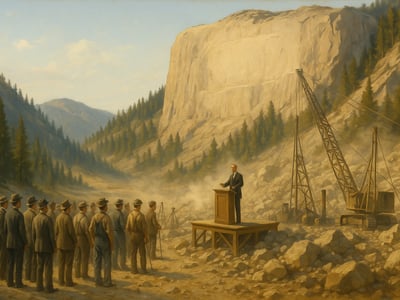
On 4 October 1927 ceremonies in South Dakota began the carving of Mount Rushmore, with President Calvin Coolidge present. Sculptor Gutzon Borglum led a project, promoted by Doane Robinson, to cut George Washington, Thomas Jefferson, Abraham Lincoln, and Theodore Roosevelt into a Black Hills granite face. The site stands on land bound up with Lakota history and claims.
Start of carving work at Mount Rushmore, South Dakota, in 1927.
On October 4, 1927, formal ceremonies in South Dakota marked the beginning of carving at Mount Rushmore, where a granite mountainside in the Black Hills was to be transformed into one of the most recognizable monuments in the United States. President Calvin Coolidge took part in the dedication, giving national visibility to a project that had started as a regional idea and was becoming a major public work. From the outset, the undertaking combined art, engineering, tourism promotion, and politics, all on a site with a far longer and more contested history than the monument itself.
From a regional idea to a national ceremony
The path to that October opening began with historian Doane Robinson, who had promoted the idea of a large monument in the Black Hills as a way to draw visitors to South Dakota. His original concept was not yet the familiar lineup of four presidents. Like many monument plans, the project changed as it moved from local promotion to national ambition. When sculptor Gutzon Borglum took charge of the design, the scale increased and the subject shifted toward figures from the presidential past.
Borglum was already known for monumental sculpture, and Mount Rushmore offered him a vast surface on which to attempt something few artists had ever tried: carving colossal likenesses directly into a mountain. The chosen figures were George Washington, Thomas Jefferson, Abraham Lincoln, and Theodore Roosevelt. Together, they were intended to represent different phases in the story of the United States as the planners understood it. Washington stood for the founding, Jefferson for expansion and political thought, Lincoln for preservation of the Union, and Roosevelt for a period of national development and international presence.
Four presidents in granite
Even with a clear symbolic program, turning the mountain into sculpture posed immediate practical problems. Workers were not shaping clay in a studio or assembling cut stone at ground level. They were operating on a steep granite face, suspended by cables and dependent on careful drilling, blasting, and finishing techniques. Large amounts of rock had to be removed with precision. The challenge was to cut deeply enough to create recognizable forms while working with the mountain’s natural contours, cracks, and limits.
That technical difficulty was part of what made the October 1927 start so important. A dedication ceremony could announce a plan, but the real test would be whether labor, money, and engineering could sustain it over time. Monument projects often depend on continued public support, and Mount Rushmore was no exception. Because the work was fixed to a single site and impossible to relocate or easily redesign, early decisions carried long consequences. If funding stalled, if the stone proved uncooperative, or if the methods failed, the result might have been an unfinished scar on the mountainside rather than a completed national memorial.
Work on a mountain face
Federal attention helped give the project momentum. Coolidge’s involvement signaled that this was more than a state attraction. It was becoming part of a broader national culture of commemoration in which governments and public institutions helped define which people and events should be monumentalized in durable form. At Mount Rushmore, that process was visible in literal terms: the nation’s story was being cut into rock.
As work continued, the design itself evolved. Jefferson’s likeness, for example, had to be reconsidered during the carving process, showing how even monumental plans remained subject to geological and technical realities. The original vision also extended beyond the heads that visitors know today. Borglum had proposed larger upper-body figures, but the final outcome was more limited. Carving continued for years, through changing conditions and ongoing financial demands, until the project ended in 1941. By that point Borglum had died, and the memorial was left without the full upper-body design that had once been imagined.
A monument and the Black Hills
The gap between plan and completion is central to understanding Mount Rushmore. The monument is often seen as fixed and inevitable, but it was neither. It depended on persuasion, state and federal backing, specialized labor, and years of physical risk on the mountain. Workers had to execute an artistic program at enormous scale under difficult conditions, making countless adjustments that ordinary visitors never see. What appears from a distance as a seamless image was the product of repeated problem-solving.
The site also cannot be understood only as a story of engineering ambition. Mount Rushmore stands in the Black Hills, a region deeply connected to Lakota history and to longstanding land claims. The monument’s rise as a national symbol took place on land whose meaning long predated the 20th-century memorial project. Any account of its beginnings is incomplete if it treats the mountain simply as an empty canvas waiting for a patriotic design.
Why it still matters
Mount Rushmore remains important in part because it shows how public memory is built through institutions, money, and spectacle. The memorial did not appear simply because four presidents were widely admired. It emerged from campaigns for tourism, decisions by planners and artists, and visible support from government. That makes it a useful example of how large civic monuments are shaped by both cultural meaning and political choice.
It also continues to matter as an intersection of art and engineering. The carving demonstrated how modern drilling and blasting methods could be used in service of monumental sculpture, turning a natural granite outcrop into a work intended for mass public recognition. In that sense, the project belongs not only to art history but also to the history of infrastructure, labor, and national image-making.
At the same time, the site remains part of ongoing discussion about commemoration and dispossession in the Black Hills. For many people, Mount Rushmore is a familiar national landmark; for others, it is inseparable from the history of Indigenous land loss and the selective ways nations tell their stories. Those different meanings are not a later addition to the monument’s history. They are part of what the site has come to represent.
The start of carving in 1927 marked the beginning of a famous public work, but it also set in motion a longer debate about what monuments do, whom they honor, and what histories they leave in the background. That is one reason the first cuts into the granite still matter nearly a century later.
Timeline
- Carving ceremonies begin at Mount Rushmore
- Washington’s likeness is dedicated
- Work on the monument ends
What you uncovered
Monument, Memory, and Land
You didn't just… complete a puzzle; you traced the beginning of a monument project that joined engineering, politics, and public memory on a contested landscape.
The start of carving at Mount Rushmore was not only a technical milestone but also a decision about what the nation would place into stone and what histories it would leave in the background. Large monuments often look permanent, yet they are shaped by selective choices about leadership, identity, and public funding. In the Black Hills, that process remains especially visible because the site is tied both to national commemoration and to unresolved questions about land and dispossession.
The carving continued until 1941, and the larger original plan for full upper bodies was never completed.
FAQ
What happened at Mount Rushmore on October 4, 1927?
On 1927-10-04, the formal dedication marking the start of work took place at Mount Rushmore in South Dakota. Carving of the granite mountain face then began.
Who led the Mount Rushmore project?
Sculptor Gutzon Borglum directed the Mount Rushmore project. He oversaw the carving of presidential figures into the granite mountain.
Which presidents were chosen for Mount Rushmore?
The four figures selected were George Washington, Thomas Jefferson, Abraham Lincoln, and Theodore Roosevelt. They were the presidents intended to appear on the monument.
Why was Mount Rushmore proposed in the first place?
Historian Doane Robinson had earlier promoted the idea of a large monument in the Black Hills. One goal was to attract tourism to South Dakota.
Why is Mount Rushmore historically sensitive?
Mount Rushmore stands in the Black Hills, a region central to Lakota history and land claims. It is often discussed in relation to Indigenous dispossession and commemorative politics.