
About this story
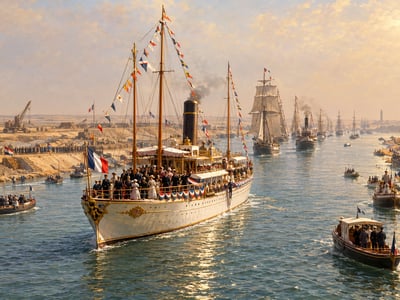
On 17 November 1869, the yacht Aigle, with Empress Eugénie aboard, led ships from Port Said into the Suez Canal. A decade of work, under a concession Ferdinand de Lesseps received in 1854, had linked the Mediterranean and the Red Sea across Egypt. Egyptian workers, at first under corvée, carried much of the digging. The procession showed a navigable passage, not the end of maintenance.
The Suez Canal opened with a ship procession from Port Said on 17 November 1869.
On 17 November 1869, the French imperial yacht Aigle, carrying Empress Eugénie, led an inaugural procession of ships into the Suez Canal from Port Said. After a decade of construction, a navigable waterway now linked the Mediterranean Sea with the Red Sea across Egyptian territory. Approximately 164 kilometres long, the canal offered shipping a route between the two seas without sailing around Africa.
A procession out of Port Said
The procession followed inauguration ceremonies held at Port Said on 16 November, attended by Egypt’s ruler, Khedive Ismail Pasha, and Empress Eugénie among other guests. The two dates mark distinct parts of the opening: ceremonies on one day, followed by the departure of the inaugural ships on the next. Together, they publicly introduced a project whose significance extended far beyond its desert banks.
The undertaking had begun with a concession rather than an excavation. On 30 November 1854, Sa'id Pasha, then ruler of Egypt, granted Ferdinand de Lesseps an initial concession to establish a company to construct a canal across the Isthmus of Suez. De Lesseps became the project’s leading promoter, but turning an agreement into a working passage required finance, political support, labour and years of engineering work.
A concession before the digging
The canal’s geography made its purpose clear. At its northern end lay the Mediterranean, with access to European ports. At its southern end, the Red Sea opened towards the Indian Ocean and routes to Asia. The isthmus separated those waters by a comparatively narrow stretch of land, yet crossing it with ocean-going ships required much more than drawing a line on a map. A continuous channel had to be excavated and kept deep enough for navigation.
Excavation formally began on 25 April 1859 at the Mediterranean end of the route, at the site of Port Said. From there, the works extended south through the isthmus, incorporating Lake Timsah and the Bitter Lakes before reaching Suez. These lakes formed parts of the route, but they did not remove the need to cut through intervening ground or prepare channels of adequate depth.
Labour across a desert isthmus
Freshwater supply was another essential part of construction. Workers and settlements along the route needed water in desert conditions, making supporting infrastructure necessary alongside the shipping channel itself. The project was therefore not simply a long excavation. It depended on the organization of supplies, transport and labour across a large worksite over many years.
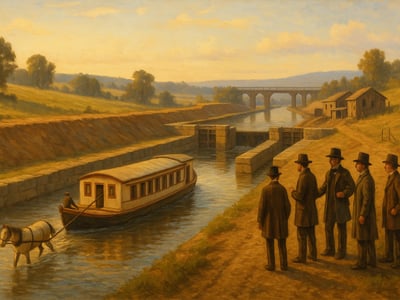
Egyptian workers carried out much of the demanding construction, and the early works relied heavily on corvée, a system of compulsory labour. Their contribution cannot be separated from the hardships and coercion under which many worked. Over the construction period, the project shifted towards greater use of mechanical excavation and dredging. Machinery changed how material could be removed, but the finished waterway remained the product of extensive human labour as well as engineering equipment.
A shorter route that still needs upkeep
Responsibility and benefit were not distributed equally. Egypt’s rulers committed resources and supported the undertaking, while the canal company brought together commercial interests and international finance. European governments and shipping interests watched its progress because it promised to change established routes. Describing the canal only as the achievement of its best-known European promoter would leave out both Egyptian decision-making and the workers who made construction possible.
By November 1869, the central question was whether the completed works could serve ships reliably. Captains entering the new channel depended on sufficient depth, manageable banks and a clear navigable course. Grounding or other difficulties could endanger vessels and weaken confidence in the route. The inaugural procession was thus both a ceremonial occasion and an early demonstration of the canal as a working passage.
Why it still matters
The Suez Canal shows how a single transport corridor can reorganize much wider networks. For many voyages between Europe and Asia, the new route reduced the distance compared with passage around the Cape of Good Hope. Its usefulness nevertheless depended on a ship’s origin, destination and operating requirements. A shorter line on the map created opportunities, not identical advantages for every vessel or every economy.
Its construction also connects engineering history with questions of authority, finance and labour. The concession that authorized the project, the resources committed to it and the conditions faced by its workers were not peripheral details. They helped determine how the canal was built and who carried its costs. The opening belongs to Egyptian history as well as to the history of international shipping.
Finally, an opening is not the end of an infrastructure project. Sediment must be removed, channels maintained and navigation organized if a waterway is to remain useful. The ships departing Port Said in November 1869 marked the beginning of commercial operation, not the completion of every challenge. The lasting significance of their passage rests in both the connection they demonstrated and the continuing work required to sustain it.
Timeline
- Suez Canal concession granted
- Excavation begins at Port Said
- Inauguration ceremonies at Port Said
- Suez Canal opens to ships
- Britain buys canal shares
What you uncovered
The Work Behind a Level Passage
You didn't just complete a puzzle; you traced a passage that changed how ships could travel between two seas.
The Mediterranean and Red Seas have sufficiently similar surface elevations for the Suez Canal to operate without locks to raise or lower ships. That advantage did not remove the work of creating and sustaining a navigable channel: excavation and continuing dredging were still essential. The canal illustrates how a trade route depends not only on an opening breakthrough, but also on maintenance and navigation rules.
The French imperial yacht Aigle carried Empress Eugénie at the head of the inaugural ship procession from Port Said on 17 November 1869.
FAQ
When did the Suez Canal open in 1869?
The Suez Canal officially opened on 17 November 1869. Inauguration ceremonies also took place at Port Said on 16 November 1869.
Where did the opening ceremonies take place?
The ceremonies took place at Port Said, Egypt, at the Mediterranean end of the canal. The inaugural ship procession then entered the canal from Port Said.
Who was present at the canal's opening?
Khedive Ismail Pasha and Empress Eugénie were among those attending the ceremonies on 16 November 1869. On 17 November, the French imperial yacht Aigle, carrying Empress Eugénie, led the ship procession.
How long did it take to build the Suez Canal?
Construction began on 25 April 1859 and the canal opened on 17 November 1869, so it took a little over ten years. The route was about 164 kilometres long across the Isthmus of Suez.