
About this story
On 8 November 1895, Wilhelm Röntgen noticed a screen glowing beside a covered cathode-ray tube in his Würzburg laboratory. He treated the unknown effect as real and later called the rays X-rays. A radiograph of his wife’s hand, a paper to the local society, and rapid use in hospitals followed within months.
Röntgen's 1895 laboratory work in Würzburg led to the identification of X-rays.
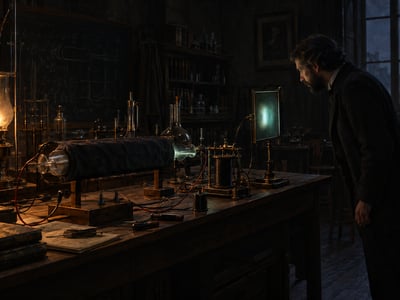
On November 8, 1895, Wilhelm Conrad Röntgen was working in his laboratory at the University of Würzburg when he noticed an effect that did not fit the experiment he thought he was running. He had been studying cathode rays with a covered discharge tube, a familiar kind of apparatus in late-19th-century physics. Even though the tube was shielded, a nearby screen coated with barium platinocyanide began to fluoresce. Something from the apparatus was reaching beyond the covered tube and causing light to appear where it should not have.
A glow that did not belong
That moment did not instantly produce a finished theory, but it did set a discovery in motion. Röntgen recognized that the effect was not easily explained as a simple error or stray visible light. The radiation seemed able to pass through materials that would normally block ordinary light, and it left a detectable trace outside the apparatus. Instead of dismissing the result as an artifact of the equipment, he began to investigate it as a distinct physical phenomenon.
This was a significant choice. Laboratories often produce odd results: flickers, sparks, reflections, contamination, electrical leakage. Many are eventually traced to setup problems rather than new natural phenomena. The difficulty for any experimental scientist is deciding when an anomaly is worth pursuing. In Röntgen's case, the unusual fluorescence suggested that the experiment was revealing something not accounted for by the existing setup. He approached it systematically, testing the effect and trying to determine its properties.
The context mattered. Across Europe, physicists in the late 19th century were actively studying electrical discharge in gases, vacuum tubes, and cathode rays. These were not isolated curiosities but part of a broader effort to understand matter, electricity, and radiation. Röntgen's work emerged from that research environment. His discovery was therefore both unexpected and connected to a larger scientific culture in which strange effects from laboratory tubes were already attracting attention.
Naming the unknown X
What distinguished Röntgen's response was the care with which he documented the new phenomenon. He referred to the rays as "X" rays, using the mathematical and scientific convention of "X" for something unknown. The name reflected uncertainty rather than explanation. He did not yet claim to know what the radiation was in full, only that it behaved in ways that justified treating it as something new.
Over the following weeks, he continued his investigation in Würzburg. The rays showed an unusual ability to penetrate certain materials while being blocked more strongly by others. This made them especially striking not only as a physical effect but also as a visual one. If the radiation passed through soft tissue more readily than through bone or metal, then it could produce an image that revealed hidden internal structures. That possibility quickly moved the discovery beyond the boundaries of laboratory physics.
A hand, a ring, and a paper
A famous demonstration came on December 22, 1895, when Röntgen produced a radiograph of the hand of his wife, Anna Bertha Röntgen. The image showed the bones of her hand and the ring she wore. It was one of the earliest and most influential visual proofs of what the rays could do. The image did not simply confirm that the radiation existed. It showed that the new rays could make the inside of the body visible without surgery. For physicians and the public alike, that was a startling development.
Röntgen then moved from observation to communication. On December 28, 1895, he submitted his paper, *Über eine neue Art von Strahlen* (“On a New Kind of Rays”), to the Würzburg Physical-Medical Society. This formal step mattered because discovery in science depends not only on seeing something new but on describing it clearly enough for others to examine, repeat, and judge. On January 1, 1896, offprints of the paper were circulated to leading physicists before broader journal publication, helping the news spread rapidly.
From the bench to the hospital
The response was swift. During 1896, X-ray imaging was adopted with remarkable speed in hospitals and surgery. Within a short time, physicians were using the method to locate fractures, bullets, and other internal features that had previously been much harder to examine without invasive procedures. The transition from laboratory observation to practical medical use was unusually fast. What had begun as an unexpected glow on a screen in a physics experiment became, within weeks and months, a powerful diagnostic tool.
Recognition followed later. On December 10, 1901, Röntgen received the first Nobel Prize in Physics for the discovery of X-rays. By then, the importance of the finding was already clear. It had changed both scientific research and medical practice, and it had done so from a relatively simple but carefully interpreted observation.
Why it still matters
Röntgen's observation remains important because it is a clear example of how science often advances: not by following a straight line to a planned result, but by noticing when reality departs from expectation. The crucial event on November 8, 1895, was not only that something unusual happened in the apparatus. It was that Röntgen chose to test the anomaly seriously and to document it in a form others could use.
The discovery also marks an unusually direct path from physics to medicine. X-rays helped establish imaging as a permanent part of hospital practice, medical training, and diagnosis. Modern radiology, with all its later developments, rests in part on this first recognition that invisible radiation could produce useful internal images.
Beyond medicine, the episode shaped later research on radiation, matter, and scientific instruments. It showed how a laboratory effect could open new technical systems as well as new fields of inquiry. The unknown "X" in Röntgen's name for the rays captured a moment of uncertainty, but the consequences of that uncertainty were lasting and concrete.
Timeline
- Röntgen observes unknown radiation
- Radiograph of Anna Bertha Röntgen's hand
- Paper submitted to the Würzburg society
- Offprints circulate to physicists
- First Nobel Prize in Physics
What you uncovered
From Apparatus to Image
You didn't just… complete a puzzle; you traced the moment an odd laboratory signal began turning into a practical way to look inside the human body.
What stands out here is not only the observation itself, but the speed of translation from experiment to use. Within weeks, an effect seen around a physics apparatus was being named, documented, and turned into visual evidence that others could understand immediately. That helped make X-rays more than a curiosity: they became part of a wider system linking instruments, publication, and hospital practice.
On 1895-12-22, Röntgen made a radiograph of Anna Bertha Röntgen's hand that showed both her bones and her ring.
FAQ
What did Wilhelm Conrad Röntgen observe on 8 November 1895?
On 1895-11-08, Wilhelm Conrad Röntgen observed a new penetrating radiation during experiments in his laboratory at the University of Würzburg. It was an unknown effect produced in the apparatus, not something he had set out to study directly.
Where was Röntgen working when he made the discovery?
He was working in his laboratory at the University of Würzburg in Würzburg, Germany. The observation came from cathode-ray experiments there.
Why did Röntgen call the rays X-rays?
He labeled the rays “X” to mark their unknown nature. The name reflected that he did not yet know what the radiation was.
How was the first X-ray image of a hand made?
On 1895-12-22, Röntgen produced a radiograph of Anna Bertha Röntgen’s hand. The image showed bones and a ring.
When did Röntgen’s discovery receive major scientific recognition?
Röntgen submitted his paper on 1895-12-28, and offprints were circulated to leading physicists on 1896-01-01. He later received the first Nobel Prize in Physics on 1901-12-10.