
About this story
On 19 November 1819, the Royal Museum of Painting and Sculpture opened in Madrid in a building Juan de Villanueva had designed in 1785 for a natural-history cabinet. The first public display held 311 Spanish-school paintings from the royal collections, listed in Luis Eusebi’s catalogue. Ferdinand VII backed the museum that Queen Maria Isabel de Braganza had promoted. Opening the rooms was not the same as transferring ownership.
Madrid’s Prado opened on 19 November 1819 as the Royal Museum of Painting and Sculpture.
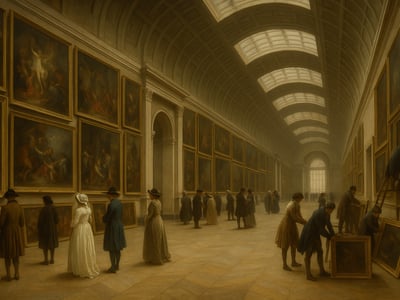
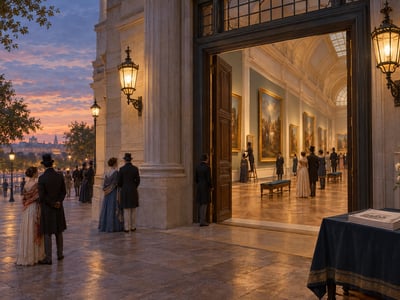
On 19 November 1819, the institution now known as the Museo del Prado opened to the public in Madrid. Its name was then the Royal Museum of Painting and Sculpture, and its opening display brought together 311 paintings from the Spanish school, selected from the royal collections. A building originally intended for natural history had become a place for encountering art.
A science building turned toward paintings
The opening joined two histories that had not begun together: the construction of a royal scientific institution and the accumulation of paintings by the Spanish monarchy. Bringing them into a museum required more than a decision to admit visitors. The building had to accommodate a different purpose, and artworks had to be selected and organized for exhibition.
The architectural story began in 1785, when Charles III commissioned Juan de Villanueva to design a building for the Natural History Cabinet. Its location beside Madrid’s Paseo del Prado placed it within the setting from which the museum would eventually take its familiar name. Yet paintings were not the reason for the original commission. The structure’s later use was an adaptation, not the fulfillment of its first intended function.
That distinction matters when looking back at a building now closely identified with the art inside it. The Prado did not begin as a purpose-built gallery for the collection visitors know today. Its history instead shows how an existing architectural project could be redirected to serve another institution. Preparing it for paintings was part of creating the museum itself.
Royal holdings become a public display
The project took shape under Ferdinand VII. Queen Maria Isabel de Braganza promoted the establishment of the museum before her death, and Ferdinand supported its creation using works held by the monarchy. Their roles belong to the same institutional story, although the queen did not live to see the opening.
Royal collecting provided the foundation, but a royal collection and a museum exhibition were not identical things. Paintings gathered under the monarchy had to become a selection that visitors could encounter in a dedicated setting. The opening therefore represented both the use of existing holdings and a new way of presenting part of them.
Three hundred and eleven Spanish pictures
The number 311 gives that first display a concrete scale. It refers to the paintings exhibited at the opening, not to the entirety of the royal holdings or to the Prado’s later collection. These works were classified as belonging to the Spanish school. The museum’s title referred to both painting and sculpture, but the documented opening selection consisted of those 311 paintings.
The Spanish-school designation also tells us something about how the display was organized. It was a historical category through which works could be grouped and understood, rather than a timeless definition of national identity. An opening exhibition was necessarily selective: it presented a particular account of the art available to the institution, not a comprehensive survey of everything the monarchy possessed.
A catalogue that fixes the opening
Luis Eusebi’s printed catalogue of 1819 recorded that selection. Alongside the preparation of the galleries, the catalogue helped give the new museum a documented form. It identified the works included and preserved evidence of what the institution presented at its beginning. For later readers, it offers a way to distinguish the opening museum from the much larger collection associated with the Prado today.
The catalogue and exhibition thus belong together. One placed paintings before visitors; the other made the selection available as a written record. Both were acts of organization, turning a group of royal artworks into a defined museum display.
Why it still matters
The Prado’s opening helps explain how collections became public cultural resources through changes in their use and presentation. Public access in 1819 should not be confused with unrestricted admission, nor did opening the galleries itself mean that royal property had immediately become nationally owned. Access, ownership, and institutional status were related questions, but they were not the same question.
Its early history also makes the work of museums more visible. Selecting 311 paintings, grouping them under a school, and recording them in a catalogue were decisions that shaped the encounter with art. A museum does not simply contain objects. Through selection and classification, it gives visitors a framework for understanding them.
The building adds another dimension. Villanueva’s design links the Prado to an earlier scientific purpose, reminding us that cultural institutions can develop by adapting architecture rather than beginning from scratch. The museum that opened in November 1819 emerged from that combination of inherited space, royal paintings, institutional support, and practical preparation. Its first display was a defined beginning—not the whole Prado, but the exhibition through which its public history began.
Timeline
- Villanueva commissioned for a natural-history building
- Opening catalogue prepared
- Prado opens to the public
What you uncovered
The Meaning of Access
You didn't just… complete a puzzle; you revisited the moment when paintings from Spain's royal collections gained a public museum setting.
Opening a royal collection to visitors changes access, but does not by itself transfer ownership to the nation. The Prado's opening display and catalogue made selected works publicly visible while also organizing how visitors encountered them. Access, ownership, and the choices behind an exhibition are separate dimensions of a museum's history.
Luis Eusebi compiled the museum's 1819 printed catalogue, which listed the opening selection of 311 paintings.
FAQ
When did the Prado open to the public, and what was it called then?
It opened on 19 November 1819 in Madrid. At that time it was called the Royal Museum of Painting and Sculpture.
What did the Prado show at its opening in 1819?
Its opening display consisted of 311 paintings from the Spanish school. They were selected from the royal collections.
Who supported the Prado’s creation before it opened?
Ferdinand VII supported the establishment of the public museum. The project had also been promoted by Queen Maria Isabel de Braganza before her death.
What was the Prado building originally designed for?
Juan de Villanueva designed the building in 1785 to house the Natural History Cabinet. It was later adapted for the museum.