

About this story
On 16 November 1974, Arecibo Observatory in Puerto Rico sent a 1,679-bit radio message toward the star cluster Messier 13. Frank Drake designed it, with Carl Sagan and others, as a picture built from the primes 23 and 73. The transmission lasted about three minutes and showed that a structured signal could be sent. It did not show that anyone received or understood it.
Arecibo’s binary message was transmitted toward Messier 13 on November 16, 1974.
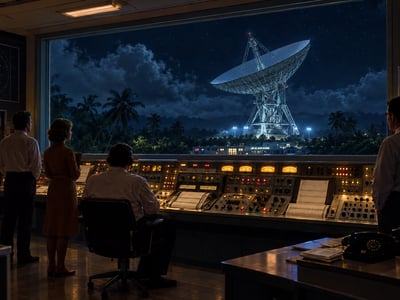
On November 16, 1974, Arecibo Observatory in Puerto Rico transmitted a brief radio message toward Messier 13, a globular star cluster in the constellation Hercules. Sent during a ceremony marking improvements to the observatory’s 305-meter radio telescope, the transmission lasted approximately three minutes. Its contents were ambitious for such a short broadcast: a compact representation of numbers, chemistry, DNA, human beings, the Solar System, and the telescope itself.
A ceremony and a three-minute signal
The event was a demonstration of communication technology, not an announcement of contact. No recipient had been identified, and no reception or understanding was established. What Arecibo could demonstrate was that its equipment could send a deliberately structured signal into space. Whether an unknown listener could recognize that structure and recover its intended meaning was a different question.
Frank Drake, the message’s principal designer, developed it with input from Carl Sagan and others. Their problem was not simply what to say about Earth. They also had to decide how to say it without a shared spoken language, familiar writing system, or accompanying explanation. A greeting in any human language would assume knowledge that an extraterrestrial recipient could not be expected to possess.
The designers instead used a sequence of 1,679 binary digits. Binary offers two possible values, conventionally written as zero and one, making it a compact way to represent information. Yet those two values do not explain themselves. A listener would still need to identify the sequence as a message and determine how its parts belonged together.
A picture built from two primes
The length supplied one possible clue. The number 1,679 is the product of two prime numbers, 23 and 73. The intended arrangement places the digits into 73 rows and 23 columns. Viewed as a rectangular pattern, with the two values represented by contrasting spaces, the sequence becomes a picture containing several groups of symbols.
That structure offered a route toward interpretation, not a guarantee. A recipient would have to consider a rectangular arrangement, choose the intended orientation, and recognize that the resulting marks represented things rather than merely forming an abstract pattern. Mathematical regularity could make the message distinctive while leaving its meaning uncertain.
Numbers, chemistry, and the telescope
The message began with representations of the numbers one through ten. It also included the atomic numbers of hydrogen, carbon, nitrogen, oxygen, and phosphorus, elements central to the chemistry of DNA. Other portions represented components of DNA and its double-helical structure. These choices placed counting and chemistry near the foundation of the account of humanity.
Elsewhere in the picture, a human figure appeared alongside information intended to describe people. A simplified Solar System identified Earth’s place among the planets. A representation of the Arecibo telescope connected the message to the instrument that had sent it. Together, these elements attempted to describe a species, its biological basis, its home, and its means of communication.
A broadcast without a confirmed listener
The selection was necessarily narrow. A short binary sequence could not provide a comprehensive account of human life, and each symbol depended on assumptions about what another intelligence might recognize. Even a familiar-looking outline would carry meaning only if a viewer understood the conventions behind it. The message therefore recorded both scientific information and the designers’ judgments about which forms of knowledge might be shareable.
Arecibo transmitted the sequence at a frequency near 2,380 megahertz and a rate of 10 bits per second. At that rate, the 1,679 digits took just under three minutes to send. The destination was a direction in the sky, not a known receiving station. The successful transmission established that the observatory could broadcast the designed signal; it did not establish that anyone was listening.
Why it still matters
The Arecibo message brings together several ideas that are often treated separately: binary representation, prime factorization, image construction, and the interpretation of symbols. It shows how a stream of simple values can carry a more elaborate description, provided that a reader knows—or discovers—the rules used to organize it.
It also makes the limits of that process unusually clear. Delivering data and communicating meaning are not identical achievements. An intended picture can remain unrecognized, and a recognized picture can still be misunderstood. The same distinction applies to unfamiliar scientific diagrams or obsolete data formats: information may survive while the conventions needed to interpret it are missing.
The transmission’s historical significance does not depend on an extraterrestrial audience having received it. It stands as a specific technical demonstration and an exercise in representing humanity under severe constraints. Its designers chose a small set of facts they hoped could travel beyond the languages and customs in which those facts were normally expressed.
For approximately three minutes, Arecibo sent that account toward the stars. The equipment supplied the signal, and the designers supplied its intended meaning. The distance between those two achievements remains the central question raised by the message.
Timeline
- Project Ozma
- Arecibo Observatory opens
- Pioneer 10 launch
- Arecibo message transmitted
- Voyager Golden Record
What you uncovered
Between Pattern and Meaning
You didn't just… complete a puzzle; you explored the challenge of finding meaning in patterns that shaped Arecibo’s message.
Factoring 1,679 suggests a rectangular layout, but finding that layout is not the same as understanding its contents. Even a recognizable picture depends on assumptions about how symbols represent objects and ideas. Arecibo’s transmission highlights the gap between sending structured data and establishing shared meaning.
The Arecibo message was transmitted at a rate of 10 bits per second on a frequency near 2,380 megahertz.
FAQ
What was sent from Arecibo on 16 November 1974?
Arecibo Observatory in Puerto Rico transmitted a radio message toward Messier 13 during a rededication ceremony for upgrades to its 305-meter telescope. The message was a 1,679-bit binary sequence designed to present information about humans and science.
Who designed the Arecibo message?
Frank Drake devised the message, with input from Carl Sagan and others. The goal was to fit a compact statement about humanity into a binary form that could be sent into space.
Why does the Arecibo message use 1,679 bits?
The message length is the product of two prime numbers, 23 and 73. That choice supports an intended arrangement of 73 rows and 23 columns, which helps form the picture embedded in the data.
What information did the Arecibo message include?
The payload included the numbers one through ten and the atomic numbers of hydrogen, carbon, nitrogen, oxygen, and phosphorus. It also encoded DNA, a human figure, the Solar System, and the telescope.
Did the Arecibo message prove contact with extraterrestrials?
No. It demonstrated a technology for sending a structured message, but reception was not established and there is no confirmed reply. The transmission showed what scientists chose to send, not that anyone received or understood it.