
About this story
On 23 November 1964, according to the Slovak Bishops’ Conference news service, Pope Paul VI granted minor basilica status to the Shrine of Our Lady of Sorrows in Šaštín, then in Czechoslovakia. The church was already a pilgrimage place. The title is an ecclesiastical rank, not a measure of size or a new building. John Paul II visited on 1 July 1995, and Francis celebrated Mass there on 15 September 2021. The reported date has not been checked against an original papal grant in this article.
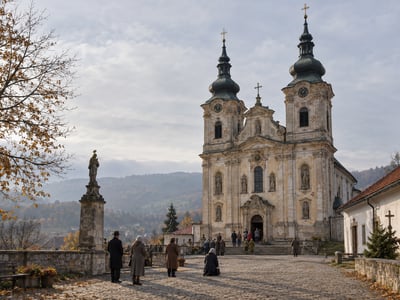
Šaštín’s Shrine of Our Lady of Sorrows, whose minor basilica designation is reported to date to 1964.
On 23 November 1964, according to the Slovak Bishops’ Conference news service, Pope Paul VI granted minor basilica status to the Shrine of Our Lady of Sorrows in Šaštín. The town was then in Czechoslovakia; today it forms part of Šaštín-Stráže in Slovakia. The reported decision concerned an existing pilgrimage church, not the founding of a shrine or the completion of a new building.
A title for a pilgrimage already underway
That distinction places the event in its proper setting. Before receiving the title, the church was already a place to which pilgrims came for religious devotion. Papal recognition added an institutional distinction to that established role. The history of the place and the history of its official titles overlapped, but they did not begin together.
Paul VI had become pope on 21 June 1963, following his election as Giovanni Battista Montini. The designation reported for Šaštín therefore belongs to the early years of his pontificate. It connected a particular pilgrimage church in Czechoslovakia with the authority of the papacy in Vatican City, giving formal expression to its place within the wider Catholic Church.
What minor basilica does not mean
In Catholic usage, “minor basilica” is an ecclesiastical title granted by the pope. It is not a measurement of a church’s physical size, nor does it identify a single architectural style. A visitor cannot establish that status simply by looking at the shape of the building. The title belongs to the church’s institutional identity, even when the building itself is the most immediately visible part of its heritage.
“Shrine” and “basilica” also describe different aspects of the same place. The first concerns its religious significance as a destination for devotion and pilgrimage; the second identifies a formal distinction within the Catholic Church. Using both terms for Šaštín is therefore not contradictory. Each draws attention to a different strand of its history.
A reported date, checked only so far
For the clergy and pilgrims associated with the church, however, an institutional title and everyday religious experience were not necessarily the same thing. The evidence available here establishes no particular reaction to the designation. It does not tell us how the news was announced locally, what worshippers said about it, or whether they noticed immediate changes in the life of the shrine. Those questions would require contemporary accounts rather than assumptions based on the title alone.
The exact date also needs a clear qualification. The Slovak Bishops’ Conference news service reports 23 November 1964, but the original papal grant or an authenticated official publication has not been independently checked in the material available for this account. The date can therefore be presented as a reported milestone, with its source identified, rather than as one independently confirmed from the original document.
Later popes, later visits
Later papal visits provide further, distinct episodes in the shrine’s history. John Paul II visited Šaštín on 1 July 1995. Francis celebrated Mass at the National Shrine on 15 September 2021, the feast of Our Lady of Sorrows. These visits took place decades after the reported designation and in the territory of present-day Slovakia. They belong to the continuing relationship between the shrine and the papacy, but they do not by themselves establish the effects of the earlier decision.
Why it still matters
Šaštín offers a useful example of how to read the history of a religious landmark. A building’s origins, its construction, its devotional role and its formal status are separate subjects. Collapsing them into a single anniversary can leave visitors with the mistaken impression that a church began when it received a title. Keeping the milestones distinct makes the history clearer without diminishing any of them.
The shrine also shows how local religious life connects with an international institution. Pilgrimage gives a place meaning through the practices of the people who visit it. A papal designation recognizes that place within a wider ecclesiastical framework. Both dimensions matter, but neither should be used as a substitute for evidence about the other.
That care extends to national identity. The shrine has Slovak religious and cultural associations, yet those associations do not describe the beliefs of every Slovak. Likewise, locating the reported designation in Czechoslovakia preserves the political geography of its time without assigning an unsupported political motive to the decision.
The most accurate account of the milestone is therefore a measured one: an established pilgrimage church received a papal distinction, on a date reported by a named church news service. Its earlier devotional life and its later papal visits remain parts of a longer history—one that no single title or anniversary can fully contain.
Timeline
- Paul VI is elected pope
- Minor basilica title reported for Šaštín
- John Paul II visits Šaštín
- Francis celebrates Mass in Šaštín
What you uncovered
A Title Within a Tradition
You didn't just… complete a puzzle; you explored a moment of formal recognition in the history of Šaštín’s pilgrimage church.
An institutional title and a community’s established religious practices belong to different layers of a shrine’s history. Understanding what recognition changed requires distinguishing formal status from everyday pilgrimage life, rather than assuming that one transformed the other. Later papal visits add further milestones, but do not by themselves establish how the designation affected clergy or pilgrims.
John Paul II visited the Shrine of Our Lady of Sorrows in Šaštín on 1 July 1995.
FAQ
When was the Šaštín shrine made a minor basilica?
According to the Slovak Bishops’ Conference news service, Pope Paul VI granted the Shrine of Our Lady of Sorrows in Šaštín minor basilica status on 23 November 1964. In the supplied material, that date is a reported secondary-source date, not independently confirmed by a primary document.
Where is the Shrine of Our Lady of Sorrows in Šaštín?
The shrine is in Šaštín, now part of Šaštín-Stráže in Slovakia. In 1964, the site was in Czechoslovakia.
What does minor basilica status mean for this church?
It is an ecclesiastical designation within the Catholic Church that gives a church formal papal recognition. In this case, it changed the status of an existing pilgrimage church; it did not mark the shrine’s founding or the building’s construction.
Who are the key popes connected with Šaštín?
Pope Paul VI is linked to the 1964 designation. Later, John Paul II visited the shrine on 1 July 1995, and Francis celebrated Mass there on 15 September 2021.