
About this story
On 2 November 1947, Howard Hughes flew the Hughes H-4 Hercules over Long Beach Harbor, the only flight of the giant flying boat. It rose about 70 feet and covered roughly a mile. Conceived in 1942 with Henry J. Kaiser as a wartime transport built largely of wood, the prototype never entered service.
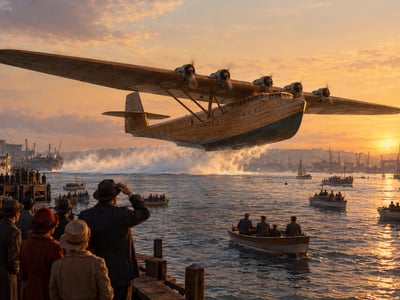
Howard Hughes and the H-4 Hercules at Long Beach Harbor in its 1947 test flight
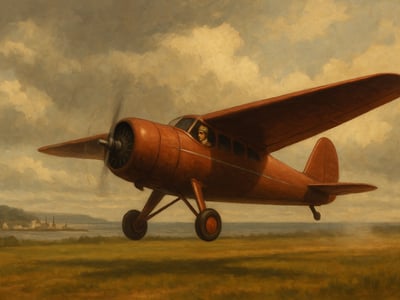
On November 2, 1947, Howard Hughes took the Hughes H-4 Hercules into the air over Long Beach Harbor in California, making the first and only flight of an aircraft that had already become famous before it had truly flown. The giant flying boat rose to about 70 feet above the water and covered roughly one mile. For a program surrounded by delay, criticism, and curiosity, that brief flight was both a technical demonstration and a public answer to doubt.
A flying boat for a wartime shortage
The H-4 Hercules had been conceived during the Second World War, when the United States and its allies were confronting a practical problem of transport. Ships crossing the Atlantic were vulnerable to attack, and military planners were interested in ways to move large numbers of troops and supplies with less exposure at sea. In that setting, the idea emerged for an enormous flying boat capable of carrying heavy loads over long distances.
The project began as the HK-1, reflecting the partnership between industrialist Henry J. Kaiser and Howard Hughes. On November 16, 1942, the U.S. War Production Board approved construction of the aircraft using non-strategic materials. That requirement mattered. Aluminum was a critical wartime material, and designers were pushed toward alternatives. As a result, the giant aircraft was built largely from wood, an unusual choice for a machine of such scale. Later popular culture would attach the nickname “Spruce Goose” to it, though the aircraft was not simply made of spruce and Hughes reportedly disliked the label.
Even at the planning stage, the aircraft stood apart from anything then in service. Its wingspan reached about 320 feet, placing it among the largest aircraft ever built. Size promised capacity, but it also magnified every engineering problem. Weight, structural strength, control, engines, and the demands of water takeoff all became more difficult at that scale. What looked impressive in concept had to function as a real aircraft under real operating conditions.
Wood, size, and a partner who left
As the war continued, development moved slowly. Building such a large prototype was difficult enough, but the project also faced scrutiny because of its cost and its uncertain timetable. In 1944, Henry J. Kaiser withdrew from the program, and the aircraft thereafter became known as the Hughes H-4 Hercules. By then, the original wartime urgency had already begun to shift. Technology, transport planning, and the wider military situation were changing, and the aircraft was moving toward completion in a different world from the one that had first called it into being.
That changing context mattered. A project launched under wartime pressure was now approaching demonstration after the war had ended. The H-4 was no longer simply being judged as a possible answer to an immediate strategic need. It was also being judged as a symbol of whether a bold and expensive idea could justify itself. Hughes, who had a public reputation as both an innovator and a controversial businessman, became closely identified with that question.
One short flight over the harbor
By 1947, expectations around the aircraft were divided. Some observers saw it as an extraordinary engineering achievement regardless of its future. Others saw it as a costly experiment that had arrived too late. In that atmosphere, taxi tests in Long Beach Harbor were not minor events. They were closely watched demonstrations of whether the immense flying boat could perform as Hughes had claimed.
During those tests on November 2, Hughes made the decision that turned a water run into a flight. With reporters, officials, and other observers present, he piloted the H-4 Hercules off the water and into the air. The aircraft remained aloft only briefly, but the fact of controlled flight was significant. It showed that the giant machine could lift itself, remain stable, and move through the air under pilot control. For an aircraft that many doubted would ever leave the surface, even a short flight carried weight.
A prototype that never became a fleet
At the same time, the demonstration had clear limits. The flight lasted only a short distance and low altitude. It did not establish the H-4 as a practical transport aircraft, nor did it lead to series production or operational service. The program never advanced beyond the prototype. In that sense, the flight was both an achievement and a boundary. It proved something important, but not everything its original backers had once hoped to prove.
The H-4’s afterlife has been almost as notable as its single flight. Because it flew only once, it came to occupy a special place in aviation history: not as a workhorse or wartime mainstay, but as a dramatic example of ambition, material constraint, and engineering scale. Its image endures because it combines contradiction so clearly. It was real, and it flew, yet it never became part of everyday aviation. It was massive, technically sophisticated, and widely remembered, yet operationally limited.
Why it still matters
The H-4 Hercules still matters because it shows how wartime procurement rules can shape the physical form of a machine. The requirement to use non-strategic materials was not a minor detail; it influenced the aircraft’s construction and helped make the project distinctive. In that way, the H-4 is a useful case study in how policy and supply constraints affect engineering decisions.
It also remains relevant in discussions about experimental aerospace projects. Large programs are often judged on a tension between bold vision and practical use. The H-4 did fly, which made it more than an unrealized concept, but its single short demonstration also illustrated how technical success in one sense does not always translate into operational viability. Questions of scale, cost, timing, and purpose that surrounded the H-4 continue to appear in later aerospace efforts.
Finally, the aircraft’s preservation has helped turn it into a historical object as well as a technical one. Preserved museum aircraft allow the public to see the manufacturing ambitions of an earlier era in physical form. The H-4 Hercules makes mid-20th-century aviation history tangible: the wartime thinking that produced it, the industrial effort required to build it, and the narrow but memorable moment when it finally lifted above the harbor.
That is why the flight of November 2, 1947, remains part of the story of aviation. It was not the beginning of a new transport system, and it did not transform military logistics. Instead, it marked the moment when one of the most unusual aircraft ever built briefly met its defining test. For about a mile over Long Beach Harbor, the H-4 Hercules became not just an audacious proposal, but a flying machine.
Timeline
- War Production Board approves HK-1 construction
- Henry J. Kaiser leaves the HK-1 program
- Howard Hughes flies the H-4 Hercules
What you uncovered
A Giant Between Eras
You didn't just… complete a puzzle; you retraced a moment when an aircraft proved it could fly, even as bigger questions remained about whether it made practical sense.
The H-4's brief flight mattered not because it settled the project's value, but because it exposed the difference between showing that something can work once and proving that it can serve a real transport role. That gap often defines experimental aerospace programs, especially when wartime urgency drives design decisions that peacetime operations may not justify. In that sense, the aircraft sits at the intersection of engineering ambition, procurement pressure, and changing military needs.
The project began as the HK-1, a Hughes-Kaiser partnership approved by the U.S. War Production Board in 1942 to use non-strategic materials.
FAQ
What happened on 2 November 1947?
On 2 November 1947, Howard Hughes piloted the Hughes H-4 Hercules during its only flight at Long Beach Harbor, California. The flight lasted about one mile and reached roughly 70 feet above the water.
Why was the H-4 Hercules built mainly from wood?
The aircraft was developed during wartime under material restrictions, so non-strategic materials were used in its construction. The project was approved by the U.S. War Production Board on 16 November 1942.
How large was the H-4 Hercules?
The H-4 Hercules had an approximately 320-foot wingspan. That made it one of the largest aircraft ever built.
Why is the H-4 Hercules called the Spruce Goose?
The aircraft became popularly known as the Spruce Goose, although Howard Hughes reportedly disliked that nickname. The name reflected public attention to its unusual wooden construction.
What happened to the H-4 program after the flight?
Henry J. Kaiser withdrew from the HK-1 program in 1944, and the aircraft became known as the Hughes H-4 Hercules. After the 1947 flight, it remained a historical example of a very large experimental flying boat.