
About this story
Maradona in the 1986 World Cup quarter-final against England in Mexico City
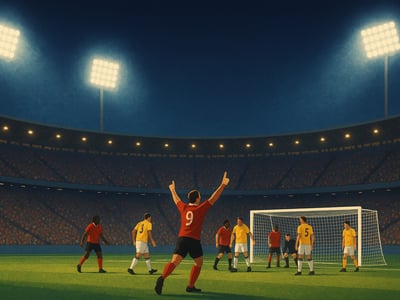
On 22 June 1986, Argentina and England met in a FIFA World Cup quarter-final at Estadio Azteca in Mexico City, and one brief passage of play became one of the most discussed moments in football history. Early in the second half, Diego Maradona scored a goal that replays showed had involved his hand. The officials allowed it, the match continued, and Argentina went on to win 2–1 before advancing in the tournament.
The match itself already carried the pressure of a World Cup knockout tie. A quarter-final offers little room for correction: one decision, one error, or one sudden piece of skill can shape the entire outcome. Argentina and England reached the game through the tournament’s earlier rounds and arrived at a stage where every attack carried unusual weight. In that setting, the incident that later became known as the “Hand of God” was not a long tactical move but a fast and confusing sequence near the goal.
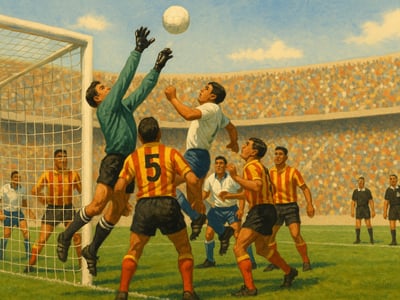
In the 51st minute, the ball rose and then dropped into a crowded area close to England’s net. Maradona moved toward it as England goalkeeper Peter Shilton came forward to claim it. For the referee, Ali Bin Nasser, and assistant referee, Bogdan Dotchev, the action had to be judged instantly. There was no video review system, no pause for consultation with screens, and no mechanism for re-running the play from several angles. The decision depended entirely on what the officials believed they had seen in real time.
The ball went into the net after contact from Maradona, and the goal was awarded. England’s players protested, believing handball had occurred. But the ruling stood. In official terms, that was decisive: the score changed, the restart followed, and the event entered the record as a goal.
What gave the episode such lasting force was not only the infringement itself, but the way it happened. It was neither a clear, open-handed action seen by everyone in the stadium nor an incident that stopped play immediately. It unfolded in a compressed space, with players converging and sightlines partially blocked. Maradona, shorter than Shilton, leaped to meet the dropping ball at almost the same moment as the goalkeeper. In real time, the movement was difficult to read. Later television images made the contact much clearer than it had been from the officials’ viewpoint on the field.
That gap between the live decision and the later replay became central to the story’s afterlife. Football in 1986 relied on the authority of match officials as final and immediate interpreters of what had happened. Their judgment could be disputed, but not technologically reviewed during the match. For many observers, the goal came to symbolize the limits of officiating in an era before video assistance. The incident has often been revisited not because people are unsure what later footage showed, but because the original decision was made under conditions that were common to elite football at the time.
The match did not end with that goal. Only a few minutes later, Maradona scored again, this time with a very different kind of action. Starting from inside Argentina’s half, he carried the ball forward on a run that beat several English players before finishing past Shilton. That second goal is frequently discussed alongside the first because the contrast is so sharp: one remains a case study in disputed legality, while the other is widely remembered as an example of individual skill. Together, the two goals shaped the identity of the match.
England did score once, but Argentina still won 2–1. The result sent Argentina to the semi-finals of the 1986 FIFA World Cup, and the team eventually went on to win the tournament. Because Argentina advanced, the awarded goal became part of a much larger competitive story. If the match had ended differently, or if the goal had been disallowed, the place of the incident in football memory might have changed. Instead, it remained attached to a famous World Cup campaign and to Maradona’s status as the central figure of that tournament.
The phrase “Hand of God” itself became inseparable from the event after Maradona later described the goal in those terms. That wording helped turn a refereeing controversy into a durable cultural reference. It gave the incident a name that was easy to repeat, debate, and transmit across languages and generations of supporters. Yet the phrase also contributed to the different ways the moment has been interpreted. For some, it is remembered chiefly as an example of gamesmanship and officiating failure. For others, it forms part of a broader narrative about football’s unpredictability, where disputed moments become embedded in the sport’s mythology.
These differing interpretations matter because football memory is rarely only about the technical facts of a play. It is also shaped by national audiences, media retellings, and the reputations of the people involved. In Argentina, England, and elsewhere, the goal has often been discussed through different emotional and historical lenses. Even so, the basic sequence remains stable and well documented: Maradona handled the ball, the officials awarded the goal, he scored again later in the match, and Argentina advanced.
Why it still matters
The incident remains important because it is one of the clearest examples of how a single refereeing decision can influence the record of a major sporting event. The goal did not merely affect a scoreboard in the moment; it helped define how a World Cup quarter-final would be remembered for decades.
It also serves as a reference point in discussions about the limits of officiating before video review systems. Modern football has introduced technologies intended to reduce certain kinds of error, and the 1986 goal is often invoked when people explain why those systems were demanded in the first place. Whether one sees the episode as a failure of refereeing, a feature of football’s older unpredictability, or both, it stands at the center of debates about fairness and evidence in sport.
Finally, the match shows how sports media preserves disputed moments and keeps reinterpreting them. Broadcast footage, newspaper reports, documentaries, and interviews have all returned to the same few seconds from different angles. Few goals have been examined so often, not only for what happened on the field, but for what that judgment says about authority, memory, and the way sport turns split-second decisions into lasting history.
More than a famous controversy, the “Hand of God” goal endures because it sits at the intersection of action, officiating, and storytelling. It was a moment measured first by human eyesight, then by replay, and finally by decades of argument over what football remembers and why.
Timeline
- 1986 FIFA World Cup group stage and knockout progression
- Top-level football officiating before video review systems
- Argentina's semi-final and final wins in the 1986 tournament
- Later retrospective coverage of controversial football goals
- Argentina vs England, FIFA World Cup quarter-final
- Maradona's second goal in the same match
What you uncovered
A Split-Second Decision
You didn't just… complete a sports puzzle; you traced the instant when a referee's split-second judgment helped define how this match would be remembered.
What keeps this moment alive is not only the illegal contact itself, but the way a brief decision by officials became part of the permanent record of a World Cup match. Before video review, major calls often remained fixed once made, even when later footage invited argument. That made disputed goals more than match incidents: they became case studies in how authority, replay, and memory interact in sport.
Later in the same match, Maradona scored again after a run that began inside Argentina's own half.
FAQ
What happened on 22 June 1986 in the World Cup quarter-final?
On 22 June 1986, Argentina played England in a FIFA World Cup quarter-final at Estadio Azteca in Mexico City. Diego Maradona scored a goal in the 51st minute after making contact with the ball using his hand, and the goal was awarded by the officials.
Who officiated Argentina vs England at the 1986 World Cup?
The match was officiated by referee Ali Bin Nasser, with assistant referee Bogdan Dotchev. They awarded the goal after Maradona's hand contact.
How did Maradona's first goal differ from his second goal?
Maradona's first goal came after hand contact with the ball in the 51st minute. Later in the same match, he scored a second goal after a run from inside Argentina's half.
What was the result of Argentina vs England in that quarter-final?
Argentina defeated England 2-1 on 22 June 1986. The result sent Argentina into the semi-finals of the 1986 FIFA World Cup.