
About this story
Anne Frank's writings from the Secret Annex were published in Amsterdam in 1947 as Het Achterhuis.
On June 25, 1947, a Dutch publisher in Amsterdam released *Het Achterhuis*, the first book edition of Anne Frank’s wartime writings. The publication came nearly two years after the end of the Second World War in Europe and after Anne Frank herself had been murdered during the Holocaust. By the time the book appeared, her words had already passed through a fragile chain of survival: written in hiding, left behind after arrest, preserved after a raid, and then prepared for publication in the difficult years after the war.
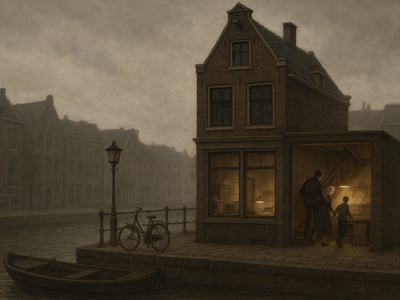
Anne Frank had begun writing in 1942. That same year, the Frank family went into hiding in Amsterdam during the German occupation of the Netherlands. Their refuge was the concealed space now widely known as the Secret Annex, at Prinsengracht 263. Anne wrote there from 1942 to 1944 while eight people lived in hiding under increasingly dangerous conditions. Her entries recorded daily tensions, fear of discovery, quarrels in close quarters, hopes for the future, and the thoughts of a teenager trying to understand herself while the world around her was being destroyed.
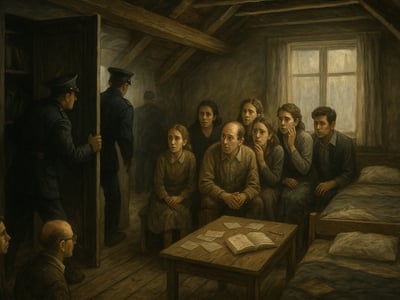
Those pages were private writings, but they were not casual notes. Anne revised parts of her work during the war, showing that she had already begun to think about shaping her account. Even so, nothing about the survival of the manuscripts was guaranteed. On August 4, 1944, the people hiding in the Secret Annex were arrested. Their removal could easily have marked the end of the diary as a historical source.
Instead, Anne’s papers remained. Miep Gies, who had helped support the group in hiding, preserved the notebooks and loose sheets after the arrest. That act was essential. Without it, there would have been no text for later readers, no book in 1947, and no direct written testimony from Anne herself. The existence of *Het Achterhuis* depended not only on Anne’s writing but also on the survival of the manuscripts through the final year of the war.
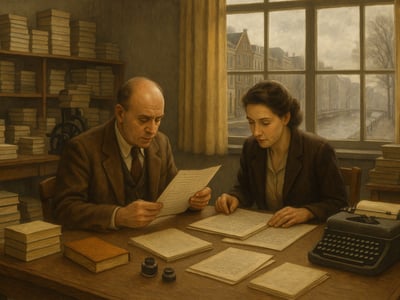
After 1945, Otto Frank returned from the war as the only known survivor among the eight people who had hidden in the annex. He then faced a deeply personal and historically consequential decision: whether Anne’s writings, created under extreme circumstances and never seen into print during her lifetime, should remain private or be shared publicly. He received her manuscripts and prepared them for publication. That process involved selecting and editing material into a publishable form, something that later became an important part of the diary’s textual history.
The book that appeared on June 25, 1947 was issued by Contact Publishing in Amsterdam under the Dutch title *Het Achterhuis*, often rendered in English as *The Annex* or associated with the later title *The Diary of a Young Girl*. In publishing histories, the first edition is often said to have had a print run of about 3,000 copies, though that figure is commonly repeated with the caution that it should be confirmed against archival or bibliographic sources. What is clear is that the edition was modest in scale at first. It was not yet the globally recognized work it would become.
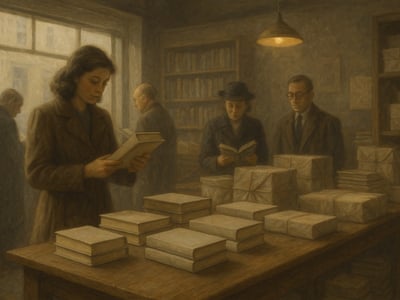
That first publication mattered because it converted a handwritten wartime record into a public document. Once a diary enters print, it changes status. It can be cataloged, reviewed, translated, circulated, taught, preserved by libraries, and debated by readers who never knew the writer. Anne Frank’s words moved from the hidden interior of the annex into the visible space of postwar cultural memory.
The timing also mattered. The Netherlands, like the rest of Europe, was still emerging from occupation, destruction, and loss. Publishing a diary by a Jewish teenager murdered in the Holocaust placed a personal voice into a postwar landscape often described through military, political, and diplomatic events. Anne’s writing did not replace those larger histories, but it gave them a human scale. The book made persecution legible through the routines and reflections of a single life interrupted.
Over time, later editions, translations, and editorial discussions would shape how readers understood the text. Scholars and institutions have paid close attention to the diary’s manuscript history, the differences among versions, and the editorial choices involved in producing publishable editions. Those questions are important because they show that even very intimate historical documents reach the public through material and editorial processes. But the central fact remains straightforward: on June 25, 1947, Anne Frank’s writings were first published as a book in Amsterdam.
Why it still matters
The 1947 publication of *Het Achterhuis* remains important not only because of what Anne Frank wrote, but because of how private testimony becomes part of the historical record. Her diary is now one of the best-known personal documents of the twentieth century, yet its survival depended on a sequence of concrete actions: writing, preservation, recovery after war, editing, and publication. That sequence is a reminder that archives and public memory are not automatic. They are built through choices made by individuals and institutions.
The book also helped shape Holocaust education. In classrooms, museums, and archives, Anne Frank’s diary has often served as an entry point into the history of Nazi persecution because it presents that history through the perspective of a young person in hiding rather than through official documents alone. It does not stand for the whole Holocaust, and it should not be treated as a complete account of it. But it remains one of the most widely read eyewitness-related texts connected to that history.
Its print history also shows how publishing networks can transform a local document into a global one. What began as writings produced in a concealed space in Amsterdam became, through translation and republication, a text read across languages and generations. The 1947 Dutch edition was the beginning of that process. It marked the point at which Anne Frank’s surviving manuscripts entered public circulation and began their long afterlife in historical memory.
The importance of that date lies not in a single publishing milestone alone, but in what it made possible: a preserved wartime voice could now be read, studied, and remembered far beyond the place where it was first written.
Timeline
- Anne Frank begins diary
- Frank family in hiding in Amsterdam
- Secret Annex occupants arrested
- Diary manuscripts preserved and recovered
- Postwar editing of manuscripts
- Het Achterhuis published in Amsterdam
- Later translations and international editions
What you uncovered
From Diary to Historical Record
You didn't just complete a puzzle; you traced the moment Anne Frank's writing began its transition from private pages into a published historical testimony.
The importance of the 1947 publication lies not only in what Anne Frank wrote, but in the chain that carried those pages into public view. Preservation, editorial preparation, and a publisher's decision all shaped how a personal document entered the historical record after the war. That process still matters because many of the sources used to understand the past reach readers only through similar acts of selection, editing, and circulation.
After the arrest of the people hiding in the Secret Annex on 4 August 1944, Miep Gies preserved Anne Frank's papers.
FAQ
When was Anne Frank’s diary first published?
It was first published on 25 June 1947. The Dutch book Het Achterhuis was issued in Amsterdam by Contact Publishing.
Where and by whom was Het Achterhuis published?
It was published in Amsterdam by Contact Publishing. The 1947 edition appeared in the Netherlands.
Who preserved Anne Frank’s papers after the arrest?
After the arrest on 4 August 1944, Miep Gies preserved Anne Frank’s papers. They were later passed to Otto Frank after the war.
Who prepared the diary for publication?
Otto Frank received Anne Frank’s manuscripts after 1945 and prepared them for publication. He was the only one of the eight people in hiding known to have survived the war.