
About this story
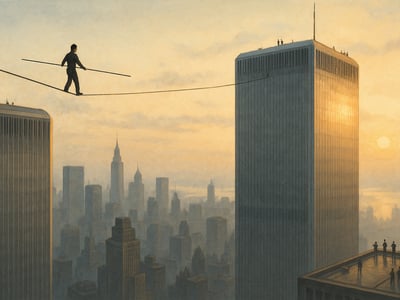
On 7 August 1974, French high-wire artist Philippe Petit walked between the Twin Towers of New York’s World Trade Center. The unauthorized performance became one of the most famous skyline spectacles of the twentieth century and a lasting image of the towers before 2001.
Philippe Petit on a cable between the World Trade Center towers, 7 August 1974
On August 7, 1974, French high-wire artist Philippe Petit stepped onto a steel cable suspended between the two towers of the World Trade Center in Lower Manhattan. The buildings rose 110 stories above New York City, and the wire was set roughly 1,350 feet above the ground. The act lasted only part of a morning, but it immediately became one of the most widely remembered public performances associated with the site.
An unauthorized plan above Manhattan
What made the event remarkable was not only the height or the setting, but the fact that it had not been authorized. Before Petit could take a single step, a cable had to be carried to the roofs, stretched between the towers, secured, and balanced well enough to bear a human body in open air. All of this had to happen without the knowledge of building authorities and before police could intervene. The walk itself was visible and dramatic. The preparation required patience, concealment, and technical precision.
By 1974, the World Trade Center had already become one of the defining features of the Manhattan skyline. Its twin towers represented a new scale of urban construction. For Petit, who had already built a reputation through earlier high-wire performances, the towers were not simply tall buildings. They offered a space that could be transformed, briefly, into a stage. The challenge lay in turning architecture designed for offices and commerce into the setting for an act of balance.
Rigging the cable between the towers
Petit did not work alone. Among the collaborators associated with the project were Jean-Louis Blondeau, Jean François Heckel, and Annie Allix. Their roles differed, but the performance depended on collective effort. Entering the World Trade Center before dawn, they had to move equipment, reach the rooftops, and complete the installation in limited time. The obstacle was concrete and immediate: if the wire could not be fixed correctly, the walk would never begin. If the group were discovered too early, the attempt would end before anyone below knew it had been planned.
Accounts of the preparation have helped explain why the event has remained so compelling. The public memory often centers on the image of one man standing in open air between the towers. Yet the crossing also rested on practical problems of access, weight, distance, and timing. A steel cable between rooftops could not simply be carried across by hand. It had to be established in stages and then adjusted so that it would hold under extreme conditions. The feat was artistic, but it was also logistical.
Walking the wire
Once the wire was in place, Petit stepped out above the city. Contemporary reports and later retellings describe him crossing between the towers as people on the streets below looked upward and officials reacted to the unfolding scene. The financial district, usually ordered by routines of work and movement, suddenly became the audience for something unscheduled and difficult to classify. It was not part of a festival, not an official dedication, and not a paid commercial stunt in any ordinary sense. It was a performance carried out in public view, yet outside formal permission.
The danger was not abstract. A loss of balance at that height could have been fatal. The weather, the movement of the cable, and the physical demands of standing and turning on a wire all mattered. At the same time, the performance created a striking contrast between control and exposure. The towers were symbols of engineering and permanence; the figure on the wire seemed almost weightless against them. That contrast became central to how the event was photographed, reported, and later remembered.
Arrest, memoir, and lasting image
Police were called as the unauthorized walk drew attention. Petit remained on the wire for a time before eventually leaving it, and after the performance he was taken into police custody in New York. The legal consequences were part of the story from the beginning. This had not been a sanctioned use of the World Trade Center, and authorities responded accordingly. Yet the event had already moved beyond a simple question of trespass. Through press coverage and photographs, it entered public memory as a singular encounter between performer and skyline.
Petit later gave his own account of the planning and execution in his 1983 book *To Reach the Clouds*. That primary-source telling helped preserve not just the image of the walk, but the sequence of decisions that made it possible: choosing the towers, gathering collaborators, studying the site, carrying equipment, and acting before dawn. It confirmed that the performance had depended as much on preparation as on nerve.
Why it still matters
The walk remains a reference point in discussions of performance art beyond conventional venues. Museums, theaters, and galleries usually define where art is expected to occur. Petit’s crossing did the opposite. It used a working urban structure as both setting and medium, challenging the boundary between the built environment and artistic action. That does not erase the fact that the event was unauthorized, but it helps explain why it has continued to attract attention from artists, architects, historians, and the public.
It also remains closely tied to the cultural memory of the World Trade Center. Long before later events changed how the site would be understood, the towers had already generated powerful images of scale and modernity. Petit's walk became one of those images. For many people, it offered a way of seeing the towers not only as office buildings, but as part of a wider visual history of New York.
More broadly, the event shows how cities can become stages for unsanctioned spectacle. Modern architecture is usually designed for utility, regulation, and controlled access. Petit’s act temporarily reversed that order. Without altering the buildings themselves, it changed what people imagined them to be. For a brief period on a summer morning in 1974, the space between two skyscrapers became a site of performance, risk, and public attention.
That combination of planning, danger, and image has helped the walk endure. It survives in archival reporting, photographs, memoir, documentary treatment, and later film retellings. But at its core, the historical event is straightforward: on August 7, 1974, Philippe Petit walked on a wire between the Twin Towers of the World Trade Center, and in doing so created one of the most memorable episodes in the visual history of modern New York.
Timeline
- World Trade Center towers completed
- Philippe Petit high-wire walk at World Trade Center
- Publication of To Reach the Clouds
What you uncovered
The Architecture of the Feat
You didn't just piece together a daredevil act; you reconstructed a moment when access, timing, and urban space were as important as the walk itself.
What made the performance remarkable was not only the balance on the wire but the system behind it. The walk depended on studying a new skyscraper complex, moving through restricted space, and turning the roofs into a temporary stage. That helps explain why the event still matters in conversations about performance art: it blurred the line between built infrastructure and public spectacle.
After the 1974 performance, Philippe Petit was taken into police custody in New York.
FAQ
What did Philippe Petit do on 7 August 1974?
On 7 August 1974, Philippe Petit performed a high-wire walk between the Twin Towers of the World Trade Center in New York City. It was an unauthorized performance.
How high was the wire walk above the ground?
The cable crossing was about 1,350 feet above the ground. The towers were 110 stories tall at the time.
Where did the Twin Towers walk take place?
It took place between the north and south towers of the World Trade Center in Lower Manhattan, New York City. Petit walked between the tower roofs.
Was Philippe Petit taken into police custody?
Yes. After the performance on 7 August 1974, Petit was taken into police custody in New York.