
About this story
The Frank family went into hiding at Prinsengracht 263, Amsterdam, on 6 July 1942.
On 6 July 1942, Anne Frank, her sister Margot, and their parents Otto and Edith Frank went into hiding in Amsterdam. They moved into concealed rooms behind Otto Frank's business premises at Prinsengracht 263, a building that later became known around the world through Anne's diary and through the name often given to the hiding place: the Secret Annex. Their decision came one day after Margot Frank received a call-up notice from the German occupation authorities ordering her to report for labor service.
By the time the family disappeared from view, Jewish life in the Netherlands had already been narrowed by a growing system of restrictions. Germany had occupied the country since May 1940. In 1941 and 1942, anti-Jewish measures increasingly shaped daily life: registration, exclusion, compulsory identification, and limits on movement and work. What could look on paper like administrative procedure was, for Jewish families, a tightening framework of control that carried the threat of deportation.
The Frank family had not made its preparations overnight. Otto Frank had begun considering a hiding place in advance, aware that the pressure on Jews in occupied Amsterdam was intensifying. His companies, Opekta and Pectacon, operated from the front building at Prinsengracht 263. Behind that workplace were rooms that could be used as a concealed refuge. The plan depended not only on the space itself but on trusted non-Jewish helpers who worked in the office and were willing to take serious risks.
The call-up notice received by Margot on 5 July 1942 turned preparation into immediate action. Such notices were presented bureaucratically, but families understood the danger they represented. Rather than comply, the Franks advanced their plans and left the next day. Their move had to be carried out carefully. A family trying to vanish in a city under occupation could not simply lock a door and disappear without notice. Every movement, every explanation to neighbors, and every item brought along carried risks.
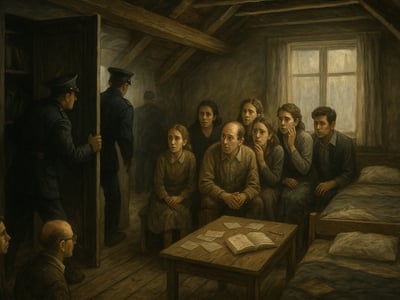
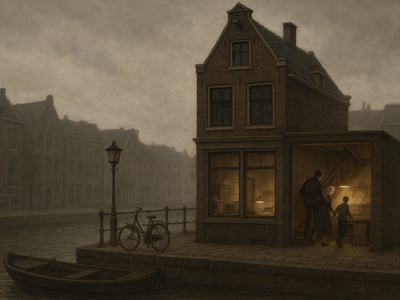
When the Franks entered the concealed rooms on 6 July, they crossed from a life under visible restriction into one of secrecy and dependence. Hiding offered a chance to avoid deportation, but it also meant isolation, silence, and constant caution. The annex was not a remote shelter. It was embedded in an ordinary canal-side building in the middle of Amsterdam, linked to a working business in the front. That setting made concealment possible, but it also meant the people in hiding lived close to office routines, warehouse activity, and the sounds of the city, always vulnerable to discovery.
The effort required a network of helpers. Among those who assisted were Miep Gies, Johannes Kleiman, Victor Kugler, and Bep Voskuijl, office workers connected to Otto Frank's business. Their support helped make daily survival possible. They obtained food and supplies, passed along news, and helped sustain the hidden household over time. Under occupation, such acts were not ordinary errands. They exposed helpers to danger in a system that punished those who aided Jews in hiding.
Anne Frank had received her red-checkered diary on 12 June 1942, less than a month before the family went into hiding. Once in concealment, writing became one way of recording life under extraordinary circumstances. The diary is now one of the best-known personal documents from the Holocaust, but on 6 July 1942 none of the later fame existed. There was only a family responding to immediate danger, using a prepared refuge and relying on a small circle of trusted people.
The move into hiding also marked the beginning of a longer, changing household. Later in July 1942, the Van Pels family joined the annex, and in November Fritz Pfeffer arrived as well. The hidden space became a shared environment shaped by fear, routine, tension, and the need for discipline. Those later developments are often part of the story people know, but the first step was the quiet movement of the Frank family into the back rooms on that July day.
Seen closely, this moment was both specific and representative. It was specific because it involved one address, one family, one workplace, and one immediate document delivered to Margot Frank. It was representative because similar pressures were forcing Jewish families across occupied Europe into impossible choices. Some tried to comply with orders they could not fully understand. Some fled. Some sought false papers or hiding places. Some found helpers; many did not. The Frank family's move into hiding belongs to that broader history of persecution under Nazi rule.
Why it still matters
The Frank family's decision to go into hiding remains important because it connects large historical processes to a human scale without simplifying what was happening. The German occupation of the Netherlands and the persecution of Jews were carried out through decrees, registrations, notices, workplaces, and transport systems. The events of 6 July 1942 show how those structures entered a household and forced an immediate choice.
The annex at Prinsengracht 263 and Anne Frank's diary have become major reference points in Holocaust education, museums, and archives. They help explain that persecution was not only a matter of camps and distant authorities, but also of offices, neighbors, schedules, rationing, and paperwork. The story also highlights the role of civilian networks: survival could depend on whether trusted people were willing and able to help.
Remembering this day therefore means more than recalling the beginning of a famous diary story. It means recognizing one family's attempt to escape a system of persecution that was already leading toward deportation and mass murder. The move into hiding did not stand outside that history; it unfolded within it, in ordinary rooms in the center of a European city.
Timeline
- German occupation of the Netherlands
- Anti-Jewish decrees in the Netherlands
- Van Pels family arrives in annex
- Margot Frank receives call-up notice
- Frank family enters hiding in Amsterdam
- Fritz Pfeffer joins annex
- Annex occupants are arrested
What you uncovered
When Bureaucracy Became Immediate
You didn't just… place the Frank family in Amsterdam; you traced the moment when persecution narrowed into a private decision to disappear from daily life.
What stands out here is how persecution operated through ordinary-looking systems as much as through visible force. A call-up notice was only a piece of paper, but within Nazi rule it carried the power to force a family into secrecy, dependence, and isolation. The hiding place, the office building, and the helpers around it show how survival could depend on prepared spaces and trusted civilian networks inside a city.
Anne Frank received her red-checkered diary on June 12, 1942, less than a month before the family went into hiding.
FAQ
Why did the Frank family go into hiding on 6 July 1942?
They went into hiding after Margot Frank received a call-up notice on 5 July 1942 ordering her to report for labor service. The family had already prepared a hiding place, and the notice made the move urgent.
Where did the Frank family hide in Amsterdam?
They hid in the concealed rooms at the rear of Otto Frank's business premises at Prinsengracht 263 in Amsterdam. This hiding place is known as the Secret Annex.
Who helped the Frank family while they were in hiding?
Miep Gies, Johannes Kleiman, Victor Kugler, and Bep Voskuijl were among the office workers who assisted the people hiding in the annex. They helped support the family from the office side of the building.
What was the importance of Margot Frank's call-up notice?
Margot Frank's call-up notice turned the family's hiding plans into an immediate decision. It came during a period of intensifying anti-Jewish measures in the German-occupied Netherlands.