

About this story
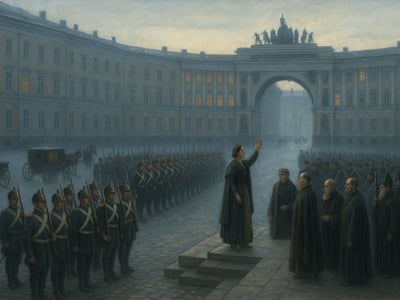
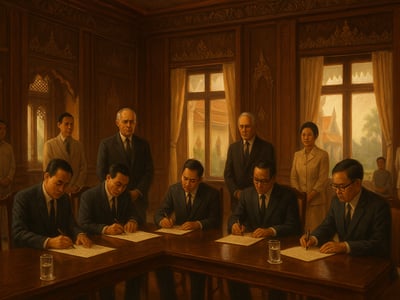
Khana Ratsadon personnel near Ananta Samakhom Throne Hall during the 1932 Siam coup.
On June 24, 1932, a small group of civilian and military conspirators in Siam moved before dawn in Bangkok and brought an end to the absolute monarchy of King Prajadhipok. Acting while the king was away at Klai Kangwon Palace in Hua Hin, the Khana Ratsadon, or People's Party, seized key points in the capital, detained senior princes and officials, and issued a declaration demanding constitutional government. The operation was brief, coordinated, and carried out with limited bloodshed in the capital, but its consequences were lasting: it changed the structure of the Siamese state.
The event is often described as a revolution, though in practical terms it began as a coup organized by a relatively compact network of officers and civilians. Its members had been shaped by years of discussion about the direction of the country, including the pressures facing late absolute-monarchy Siam. Some of them had studied abroad; others had risen through the bureaucracy and military. They shared a view that state authority should no longer rest solely in the hands of the monarch and royal court, and that a constitution was needed to define political power more clearly.
This was a risky plan. The Khana Ratsadon was not a mass movement filling the streets of Bangkok. Its success depended on speed, secrecy, and the ability to control the capital's administrative and military nodes before royalist officers could respond. If communications had slipped out of their hands, or if important units had refused to cooperate, the conspirators could have faced immediate arrest and likely execution for treason.
That is why timing mattered so much. King Prajadhipok, also known as Rama VII, was not in Bangkok on June 24. He was in Hua Hin, and the organizers judged that his absence reduced the chance of an immediate palace-centered response in the capital. In the early hours, coup participants gathered troops and detainees near the Ananta Samakhom Throne Hall in Bangkok's Dusit district, a ceremonial and administrative center that gave the action visibility as well as strategic value.
Among the leading figures associated with the movement were Pridi Banomyong, an important civilian intellectual and political organizer; Plaek Phibunsongkhram, a military officer who would later play a major role in Thai politics; and Phraya Phahon Phonphayuhasena, another key military figure. Their cooperation reflected the mixed character of the Khana Ratsadon itself. It was not simply an army mutiny, nor only a civilian constitutional campaign. It was an alliance that joined parts of the bureaucracy, the officer corps, and reform-minded elites.
Once the key arrests had been made and troops positioned, the group issued a public declaration explaining its actions. The declaration stated its reasons for ending absolute rule and called for a constitution. That step was essential. The operation could not rely on force alone; it also needed a political justification that would present the takeover as a reordering of government rather than a temporary military seizure. By making its aims public immediately, the Khana Ratsadon tried to set the terms of the crisis before opponents could define it differently.
The central gamble was that authority would shift if enough of the state apparatus accepted the new reality quickly. In that sense, the coup was not won only by the detention of princes and officials. It was won by the absence of an effective counteraction in the crucial first hours. A rapid loyalist response might have changed the day completely. Instead, the combination of surprise, control over strategic sites, and the political fact of the king's distance from Bangkok gave the conspirators room to consolidate.
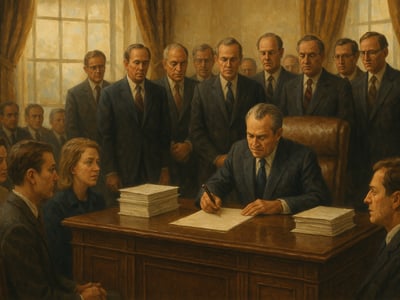
The immediate result was not the abolition of monarchy itself, but the end of absolute monarchy. Within days, the new order began to take constitutional form. A provisional constitution was accepted on June 27, 1932. Later that year, on December 10, 1932, a permanent constitution was promulgated. These documents did not settle every question of political power in Siam, and tensions soon emerged between civilian and military factions within the new regime. Still, they marked a decisive transfer of state authority into a constitutional framework.
It is also important to see what did not happen on June 24. The capital did not become the site of large-scale battle. The event was serious and coercive, but in Bangkok it unfolded with limited bloodshed. That fact helps explain why such a small group could succeed. They did not need to defeat the state in open warfare; they needed to demonstrate that they already controlled it.
The years that followed would show that constitutional change did not remove conflict from Siamese, later Thai, politics. The balance among monarchy, parliament, military leadership, and civilian reformers remained unsettled. Yet the basic break had occurred. After June 24, 1932, it was no longer possible to describe the kingdom's political order in the same way as before.
Why it still matters
The events of June 24, 1932 remain central to the history of modern Thailand because they marked the institutional shift from absolute monarchy to constitutional government. Even though later constitutions, coups, and political crises would reshape the system many times, this was the moment when the legal and political principle of unlimited royal rule ended.
The coup also remains a reference point for understanding the recurring role of military and civilian elites in restructuring the Thai state. The Khana Ratsadon was an alliance of both, and its success established a pattern in which political change could come not through mass electoral processes alone, but through coordinated action by actors inside the state itself.
Finally, the constitutional documents that followed in 1932 continue to matter because they anchor later debates about where authority should lie: with the monarchy, with parliament, or with the executive. For that reason, June 24 is not only an episode in the end of one form of rule. It is also the starting point for many of the central arguments in Thailand's modern political history.
Timeline
- 1932 Siam coup
- Provisional constitution in Siam
- Permanent constitution in Siam
What you uncovered
Power Through Coordination
You didn't just…complete a puzzle; you traced the moment a small group used speed, coordination, and control of the capital to force a constitutional break in Siam.
What stands out about 24 June 1932 is not only the change in formal rule, but the method: control of a few administrative and military centers proved enough to reshape the state before opponents could organize. That helps explain why the event remains central to Thai political history, where institutions, armed actors, and civilian elites have repeatedly intersected in moments of restructuring. The constitutional shift mattered, but so did the demonstration that authority could be redirected quickly if key nodes of power were secured first.
A provisional constitution was accepted three days later, on 27 June 1932, before a permanent constitution followed on 10 December 1932.
FAQ
What happened in Siam on 24 June 1932?
On 24 June 1932, the Khana Ratsadon carried out a coup in Bangkok that ended the absolute monarchy of King Prajadhipok in Siam. The group also issued a public declaration calling for constitutional government.
Who were the Khana Ratsadon in 1932?
The Khana Ratsadon, or People's Party, was the group that organized and carried out the coup on 24 June 1932. Its members included civilian and military conspirators.
Where did the 1932 coup take place?
The coup took place in Bangkok, Siam, with important activity near the Ananta Samakhom Throne Hall in the Dusit district. King Prajadhipok was away from the capital in Hua Hin at the time.
How did the 1932 coup change Siam's government?
The coup ended absolute monarchy and shifted state authority into a new constitutional framework. A public declaration demanding a constitution was issued on the same day.