

About this story
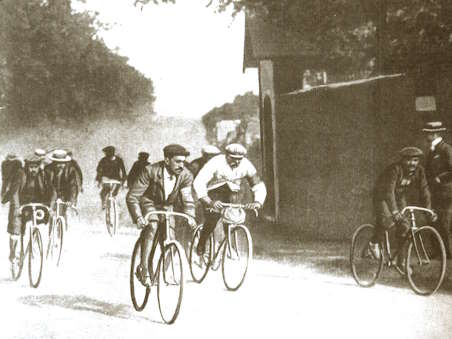
Montgeron start of the 1903 Tour de France near Paris
Video puzzle
On 1 July 1903, a new kind of sporting experiment began at the Café Au Réveil Matin in Montgeron, southeast of Paris. Sixty riders assembled for the start of the first Tour de France, an event organized by the newspaper *L'Auto*. What would later become one of the world's best-known races began not as an established tradition, but as a risky and highly practical idea: a long-distance competition designed to capture public attention and give the newspaper a stronger place in a crowded media landscape.
The race had been announced months earlier, on 19 January 1903, in the pages of *L'Auto*. Its editor, Henri Desgrange, directed the project, and Géo Lefèvre helped shape the format. The plan was ambitious. Rather than a short race near Paris or a single-day contest, the organizers proposed a route around France divided into six stages, with a total distance of 2,428 kilometers. Riders would leave from near Paris, pass through Lyon, Marseille, Toulouse, Bordeaux, and Nantes, and then return to Paris.
That outline helps explain why the first Tour mattered even before anyone had finished it. The challenge was not only athletic. The organizers had to prove that such an event could actually function. Could a newspaper create a race large enough to hold national attention? Could riders endure the distance? Could the route be managed from city to city at a time when travel, road conditions, and communications were far less streamlined than they would become later in the century?
In 1903, none of those answers was guaranteed. The event asked competitors to attempt something that was still unusual in scale. A six-stage route may sound modest compared with later editions of the Tour, but each stage was long, and the total journey placed heavy demands on riders. The race was an endurance test in a very literal sense. To remain in contention, a rider had to survive not just rivals, but fatigue, time, and the cumulative pressure of a format that had not yet proved itself.
The Tour's origins were closely tied to the competitive world of the French press. *L'Auto* was seeking circulation and public visibility, and the race offered a dramatic way to create both. This relationship between journalism and sport was central to the event from the start. The race was not simply reported by the newspaper; it was brought into existence by it. That gave the first Tour a dual character. It was at once a contest on the road and a carefully designed public spectacle, meant to unfold over days as readers followed each stage and the standings that emerged from it.
As the riders moved through Lyon, Marseille, Toulouse, Bordeaux, and Nantes, the race began to demonstrate that the concept could work. The route tied together distant parts of France in a sequence that gave the event rhythm and narrative shape. Each stage added suspense, because the competition did not end in a single afternoon. Instead, it accumulated meaning over time. Success depended on consistency across the whole route, not on one isolated effort.
That structure distinguished the Tour from many other sporting events of the era. It also made the race easier for the public to follow. A multi-stage event created intervals of expectation: one city to the next, one result after another, one new overall picture after each leg. The race became a continuing story. For *L'Auto*, that ongoing story was part of the point. For the riders, it meant that every stage mattered both on its own terms and within the larger contest.
By the time the race concluded in Paris on 19 July 1903, the experiment had produced a clear outcome. Maurice Garin finished as the overall winner. His victory did more than identify the strongest rider in that first edition. It also helped confirm that the event could succeed as an organized competition with recognizable stages, an overall classification, and a finish that gave the entire route a coherent result.
The first Tour was therefore important not because it already looked exactly like the modern race, but because it established a workable foundation. Its early format belonged to its own moment, and many details would change in later years. Yet the essential idea had been tested in public: riders could be sent over a long route in stages, newspapers could sustain attention from day to day, and the race could become larger than its starting line.
Why it still matters
The 1903 Tour de France remains significant because it helped define the model of the multi-stage road race. Later cycling competitions, and later editions of the Tour itself, would refine rules, classifications, and race calendars, but the basic template was already visible in that first edition. A route spread across several days, an overall winner determined by cumulative performance, and a sequence of cities linked by competition all became durable features of professional cycling.
It also offers a clear example of how modern sport grew alongside modern media. The Tour did not emerge separately from the newspaper world; it was shaped by it. *L'Auto* used sport to attract readers, while the race used reporting to extend its reach. That connection between publicity, audience-building, and athletic competition became a familiar pattern in the 20th century, not only in cycling but across many sports.
Finally, the first Tour still matters because it turned geography into part of the event's meaning. The route around France was not just a backdrop. It gave the race scale, identity, and continuity. That idea—that a sporting event can be defined by how it moves through places over time—remains one of the central features of the Tour de France today.
What began in Montgeron with 60 riders was therefore more than an isolated race. It was a test of endurance, organization, and public interest that succeeded well enough to endure. The first edition did not merely crown Maurice Garin in Paris; it established a format that would remain one of the defining structures of international cycling.
Timeline
- L'Auto announces the Tour de France
- Tour de France starts at Montgeron
- Tour de France concludes in Paris
What you uncovered
A Race Built for Attention
You didn't just complete a puzzle—you traced the opening of an experiment that tested whether a grueling race could hold a country's attention day after day.
The first Tour de France mattered not only because riders covered a long route, but because it turned endurance into a serial public event. Each stage created a new moment for audiences to follow, giving the organizers a way to connect geography, suspense, and newspaper coverage into one repeatable format. That combination helped define how modern sports could be scheduled, promoted, and consumed over time.
The race's 1903 start took place at the Café Au Réveil Matin in Montgeron, southeast of Paris.
FAQ
When did the first Tour de France begin?
The inaugural Tour de France began on 1 July 1903. It started from Montgeron, near Paris.
Where was the 1903 Tour de France start held?
The race started at the Café Au Réveil Matin in Montgeron, southeast of Paris. The opening day was 1 July 1903.
Who organized the first Tour de France?
The race was organized by the newspaper L'Auto. Henri Desgrange directed it, and Géo Lefèvre helped develop the event format in 1903.
How long was the first Tour de France?
The 1903 edition covered 2,428 kilometers. It was run over six stages.
Who won the first Tour de France?
Maurice Garin finished as the overall winner when the race concluded in Paris on 19 July 1903.